Derik Mills was stuck in traffic on his way to yoga when an inconvenient thought occurred to him: the class was happening somewhere else. He wanted it in his living room. In 2007, that wish became the beginning of the project that would turn into Glo. California had supplied the obstacle. Mills would have to supply the camera, the teachers, and a reason for people to feel they were actually there.
There is something agreeably unheroic about this beginning. No mountain summit, no sudden revelation in a boardroom. A person is late to a class he wants to attend. The interesting part comes afterward: deciding that the distance between an intention and an action is a problem worth spending years on.
Mills became a co-founder of a company built to shorten that distance. His story also contains a quieter question. Once you have delivered the lesson, how do you preserve the relationship that made someone want to take it?
The classroom before the camera
He grew up in Montclair, New Jersey, with two educators for parents. Summers could mean traveling around the United States or staying with grandparents in Germany. Before high school, he also lived for a year in Oregon and a year in Hawaii. His childhood gave him repeated encounters with other settings and ways of seeing things. He later credited that variety with widening his perspective.
Yoga entered his vocabulary in a college classroom in 1996. The reading included the Rig Veda, the Upanishads, and the Bhagavad Gita. His first encounter was with texts and interpretation; the studio came later. He traveled briefly to India after college, curious about the traditions he had studied. He also completed a master’s degree.
On the last day of that college course, the professor asked students what they wanted for their lives. Mills remembered giving an answer that sounds wonderfully ill-suited to a recruitment form:
“I want to sustain and expand my capacities for wonder.”
Derik Mills, recalling his college answer
Wonder is difficult to put on a calendar. Building a service, however, gives it appointments, invoices, and people waiting for decisions. Mills would eventually bring the two into the same working day.
Three classes and a place in the room
After moving from New York City to Los Angeles in 2005, Mills attended Jo Tastula’s classes in Manhattan Beach. In early 2008, he approached her after class and explained his idea as they walked toward the pier. By his later account, he had committed his savings and development was underway. He was nervous about asking. Tastula was receptive.
His brother Ryan was part of building the business. In November 2008, YogaGlo put its first three classes online. All were taught by Tastula. The first test shoot shows the undertaking at human scale: Jo, Derik, and Ryan in a room, with the Pacific visible beyond the windows.
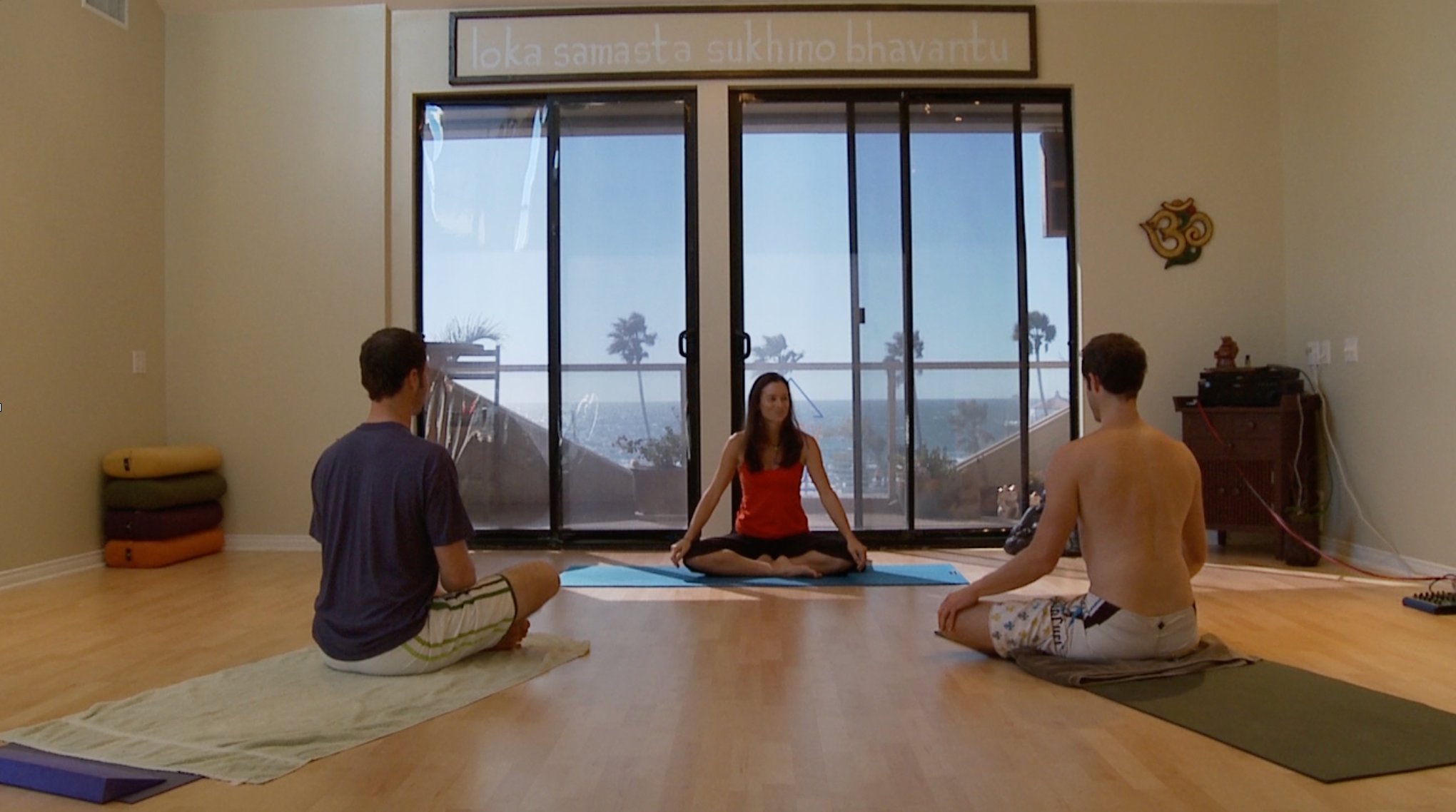
They converted a Santa Monica workspace into a recording studio. People could attend the filmed classes free. For the person watching remotely, other students helped establish a sense of sharing the room. The work involved translating the social arrangement of a class into something a camera could convey.
In a 2019 conversation with Elena Brower, Mills discussed the later move toward a more personal camera setup and the influence of customer feedback. The initial answer could change. Keeping a relationship with the person watching required paying attention to how that person experienced the screen.
Historical milestones; the country count describes 2018.
By March 2019, the business was still described as self-funded. Its team, including faculty, numbered more than 100, and it had produced more than 10,000 classes. Those are dated measures of the distance traveled from the first shoot. They also describe a growing obligation: every addition needed to be worth somebody’s time.
The financing choice mattered to that early account. Self-funding meant the brothers committed their own resources to an idea whose audience still had to form. Years later, Mills continued to describe that choice with some deliberation. The company had grown, but the story he told about it still began with personal commitment and the people who agreed to help.
The trouble with owning a viewpoint
The camera brought a less comfortable chapter. In 2013, YogaGlo faced objections to its effort to patent a filming arrangement. Yoga Alliance organized a petition against the application. The dispute concerned how an online class was recorded and presented, placing a question of ownership inside a business devoted to access.
Mills defended the company’s position publicly. He said it was seeking protection for a distinctive filming perspective and explained that the aim was to protect intellectual property. Critics worried about the breadth of that protection and what it might mean for other people making instructional videos.
In October 2014, the company announced it would forfeit its issued patent. Mills’s statement said it had not enforced the patent and had considered concerns about its scope. An update later that month addressed the forfeiture of both patents. The episode belongs in his story because it shows how a founder’s conviction can meet a community’s very different reading of the same decision.
A shorter name, a wider doorway
Names occupied Mills for months. An early candidate was Viviyana, a construction drawing on Latin and Sanskrit. It held meaning for him, but required explanation. A company teaching through a screen already had enough to explain. YogaGlo gave prospective members a clearer indication of what they would find.
Even so, he had reservations about putting “yoga” in the name. He understood the word broadly, through philosophy as well as practice, and knew other people brought different associations to it. The naming problem was partly a problem of invitation: how much could a single word welcome, and whom might it discourage?
Inside the company and its community, people began shortening the name to Glo. In early 2018, the business acquired glo.com. The shorter identity gave an existing habit of speech a permanent address.
Athletics worked on the new identity, language, and interface. Its team read a translation of the Bhagavad Gita to understand an influence on Mills. That is a fairly demanding addition to a design brief. Yet it makes sense for a founder whose questions about a digital product lead back to a college reading list.
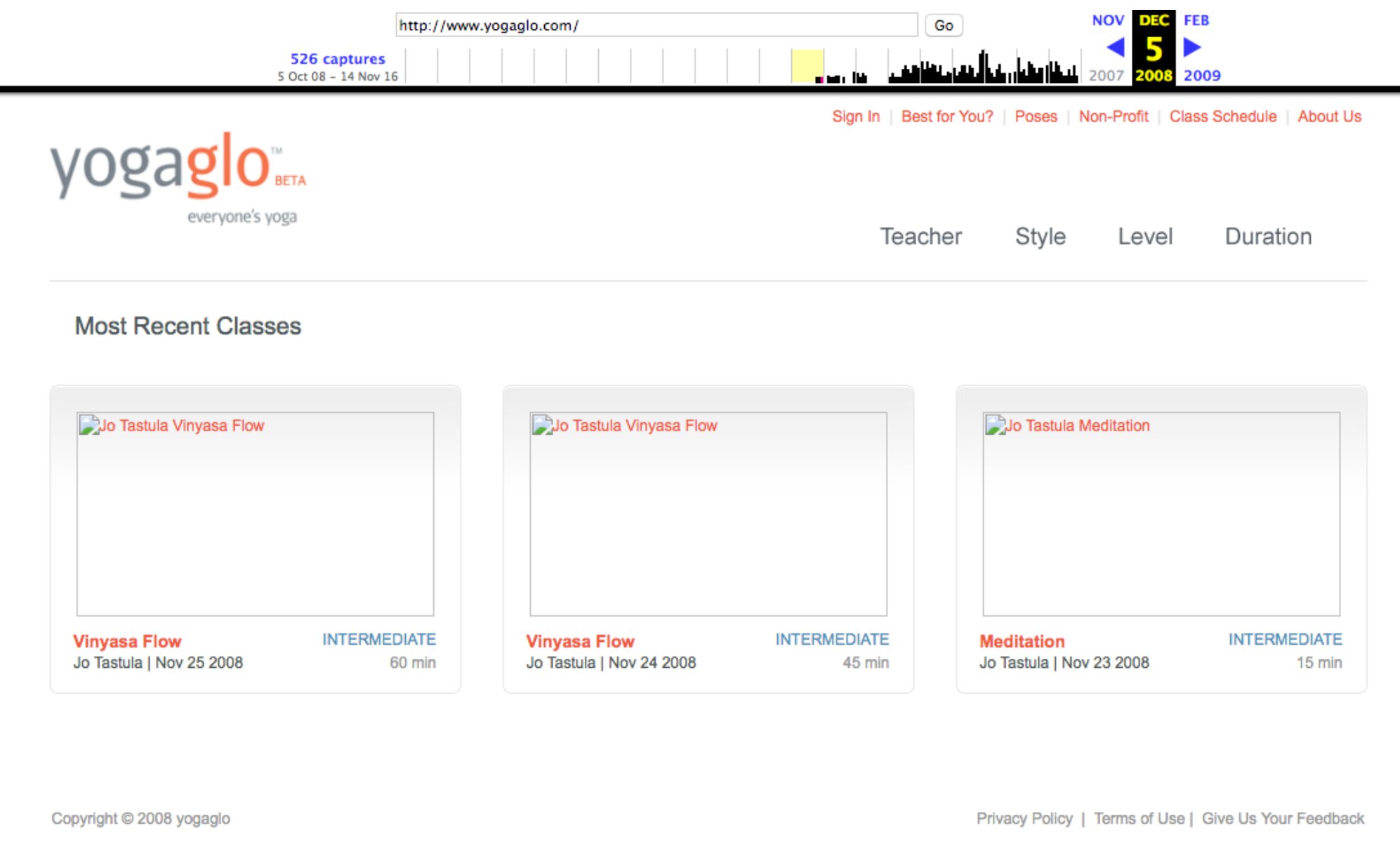
The visual choices brought that discussion down to the level of a page. Search, navigation, recommendations, and curation all affected how a member found a class. For someone opening a large catalog with a small amount of time, those details carry the promise of the service. A broad idea about access eventually has to become a usable button.
When the audience answers back
In his tenth-anniversary letter, Mills reported that Glo had reached people in 164 countries. He also said personal recommendations remained the largest source of new registrations. He described feedback arriving through surveys, class comments, messages, and meetings with members. The people using the service were helping determine what it should become.
Growth created an ordinary nuisance. Comments had been available since launch, but a larger library scattered conversations across more classes. Finding them became harder. In March 2020, Mills announced Glo Community as a renewed place for interaction. A service can accumulate material faster than it accumulates useful ways to talk about it.
He was also putting the company’s internal arrangements into public view. In June 2020, he published a statement acknowledging shortcomings around racial equity and setting out changes to recruiting, selection, and company processes. A subsequent update described leadership training and plans for a People Operations role. These were stated commitments and reported actions, with the work of following through still attached.
The founder takes the other chair
Interviewing became another way for Mills to pursue his questions. In 2020, he spoke with Andrew Skotzko about business and the years he had spent traveling before entrepreneurship. The conversation’s frame was the relationship between personal purpose and the culture a founder creates around other people.
When he announced The Glo Podcast trailer in 2021, he thanked the team, teachers, and members. He also credited Lee Schneider at Red Cup Agency for production support and Carrie Rodriguez and Luke Jacobs for the music. The credits reveal the practical company behind the voice: people preparing, recording, editing, and giving a conversation its setting.
His guests have included Drybar co-founder Alli Webb, with whom he discussed starting ventures and difficult conversations. With Elena Brower, a longtime colleague, the subjects include poetry, writing, teaching, and friendship. Their March 2024 conversation looks back on working together since 2009. A business relationship had become a shared history long enough to reminisce over.
The format gives Mills a different job from introducing the company. He has to make space for somebody else’s account, including experiences that do not fit neatly into a founder’s vocabulary. The titles and subjects of the conversations show the breadth of that curiosity. A discussion can begin with professional work and spend its time on how someone learned to do it.
Leave a few decisions unmade
For all the philosophical vocabulary, Mills has some plain preferences. In a 2018 account of his mornings, he described buying shirts and trousers he liked in multiples. Fewer wardrobe decisions left fewer things to negotiate before work. He also described tea, writing, and rides in the Santa Monica Mountains. There is a useful comic proportion here: expansive questions about existence, efficiently purchased pants.
In May 2026, he returned to the earliest collaboration. Tastula had reached her thousandth Glo class. Mills marked it by remembering the first test shoot and her willingness to join an uncertain experiment. Nearly eighteen years after launch, he was still writing about the teacher who had agreed to begin.
The story returns naturally to that small group in a room. A founder can buy equipment and commission software. The teaching still depends on someone showing up, and the experience depends on someone else deciding to listen. Mills’s original problem was how to get to a class. The work that followed has kept bringing him back to the people already there.