The latest twist in Big Think’s story requires no bandwidth. Open its membership page and there, beside the classes and digital interviews, is a print magazine. A company associated with watching clever people explain things now wants readers to turn pages. Its first physical issue, announced in August 2025, tackled consciousness. Even the question of what it means to be awake could, apparently, use some time away from a screen.
The magazine is a useful way into a business that is easily mistaken for a YouTube channel. Big Think publishes journalism, sells memberships, supplies workplace learning and makes content for brands. Across those activities, the basic material is consistent: people who know something interesting, given room to explain it. The commercial challenge is persuading different customers that an expert’s time on camera deserves their money as well as their attention.
A good guest was only the beginning
Founded in 2007 by Victoria Montgomery-Brown and Peter Hopkins, Big Think grew out of television production experience. Both founders had worked on The Charlie Rose Show. They took the expert conversation and adapted it for the web, with the speaker addressing the camera and the interviewer largely disappearing from the finished experience.
Early ambitions were more participatory. In March 2008, journalist Ari Melber reported that Big Think wanted viewers to contribute their own video responses. Few did. Most preferred written comments. The first visible friction was between an invitation to participate and the effort of appearing on camera. A viewer could enjoy an intellectual conversation without wanting to film one.
There was physical friction, too: Melber described a Manhattan office with insufficient desk space for five employees. Big ideas, limited furniture. Early backing included Peter Thiel and Lawrence Summers, but recognizable investors did not erase the everyday work of finding an audience.
Today’s company emphasizes professionally produced expertise. The early participation problem offers a practical lesson: make the requested action proportionate to the audience’s commitment. Watching, commenting and recording a thoughtful response are three different jobs.
The same curiosity, several customers
Big Think’s public face ranges across science, philosophy, business, history and human behavior. Its recurring editorial offerings include Mini Philosophy, Starts With a Bang and Strange Maps. That mix gives readers permission to wander. Someone arriving for an explanation of the universe may leave considering a workplace habit or a philosophical dilemma.
The stated mission is to broaden understanding while keeping intellectual growth accessible. In practice, the publication packages expertise in several ways: long conversations, shorter videos, columns and themed editions. It acts as an editor between specialists and a general audience, choosing both the question and the amount of explanation that fits the format.
That editorial identity also defines its commercial audience. An individual buys access to more material and fewer interruptions. A corporate learning team buys content it can organize around leadership needs. An advertiser or brand commissions storytelling and access to an audience interested in ideas. Those buyers may encounter the same name, but they are paying to solve different problems.

Big Think Creative extends the production capability into commissioned work. Its offering includes brand storytelling and documentary-style content; the main publication also promotes advertising integrations and live events. The business logic is straightforward: expertise in making an interview watchable can serve an editorial assignment, a learning product or a client brief. Each still needs a reason for the viewer to care.
What happens after the video?
Big Think+ is where the company makes its most explicit promise of practical usefulness. The corporate product gives learning teams expert content for developing leaders, including people who have yet to become managers. Its about page advertises more than 400,000 learners and 1,500 lessons. These are company-reported scale figures, useful for understanding the catalog’s reach rather than judging its effect on performance.
“We don’t explain, we explore.”Big Think+ · stated values
The product has several levels of commitment. An August 2026 help-center update describes short video lessons, classes organized around an expert, company curations and longer courses. A lesson typically occupies three to seven minutes; an expert class takes roughly 30 to 60. Courses can require five to eight hours, with practice and reflection built into the format.
Video lesson3-7 min
Expert class30-60 min
Course5-8 hr
Published format guidance, August 2026. Company curations vary in length.
Cal Newport’s Slow Productivity provides a concrete example. The class lists eight lessons totaling 49 minutes. It covers doing fewer things, working at a natural pace, caring about quality and designing more deliberate work routines. A viewer can sample an idea in a short segment, then continue through the connected lessons.
Here is one way a reader could use that material: select a recurring work problem before pressing play. If constant switching is the problem, use the lesson on time blocking to design one protected work session. Try it, then record what interrupted it. That is an editorial suggestion for applying the class, not a promise that watching it will make someone more productive.
The boundary matters. A video cannot rearrange a manager’s priorities or create uninterrupted time in an overloaded team. It can supply language, examples and an exercise. Whether the workplace allows someone to act on them is another question.
The scent company that supplied the homework
ScentAir, the scent-marketing business, shows what that follow-through can look like. Its ELEVATE Academy uses Big Think+ within a 12-month leadership program. The customer story describes a need for a more consistent way to connect leadership development, employee ideas and execution across the company.
ScentAir defined the competencies it wanted, mapped learning material to them and surrounded the videos with other work. Participants joined monthly 90-minute leadership circles, undertook cross-functional capstone projects and presented progress to senior leaders. Assessments involved both participants and their managers. The expert lesson was preparation for a conversation and a project, rather than the whole intervention.
Savings from one ScentAir ELEVATE capstone initiative, according to the customer’s August 2026 announcement.
In that announcement, ScentAir reported five Gold Brandon Hall Group awards for ELEVATE. Two recognized work in partnership with Big Think+: video learning and blended learning. The company also said one capstone initiative generated more than $250,000 in savings. That result belongs to the broader program; it does not isolate what the video library contributed.
The copyable part is the sequence. Pick a business problem, define the relevant capability, assign a focused lesson, discuss it with colleagues and apply it to real work. Then assess the result. A training budget that buys only access leaves the customer to supply most of that sequence.
The price depends on which door you enter
For individual readers, the prices are public. As checked on September 8, 2026, digital membership costs $96 a year or $10 when billed monthly. Print plus digital costs $144 a year or $15 monthly. Choosing annual billing therefore changes the effective monthly cost to $8 or $12 respectively.
The membership includes expert classes, ad-free reading and early interview access. Print members receive quarterly magazines, currently shipped within the United States. Digital members can download PDF editions. These subscriptions address personal use; the site directs organizations toward Big Think+ and a sales conversation.
For a prospective corporate buyer, the useful comparison is the whole program: content, administration, discussion time and the capacity to evaluate changes in behavior. The lowest subscription price cannot answer whether a team will use the material. Nor does an impressive speaker guarantee that the selected lesson matches a company’s particular problem.
Big Think operates in a market with credible alternatives. MasterClass sells expert-led leadership content to businesses, while LinkedIn Learning offers management and leadership courses. Famous instructors and online delivery are shared features. Big Think’s distinctive proposition is the connection between a broad ideas publication and a workplace library, giving learning teams material with an editorial identity their employees may already recognize.
A screen-born publisher learns to sit still
The move into print adds a different rhythm. The inaugural consciousness issue brought together thinkers including Anil Seth, Annaka Harris and Peter Godfrey-Smith. Its subject suited a physical edition: a collection of competing explanations to revisit, rather than a single answer to consume and forget.
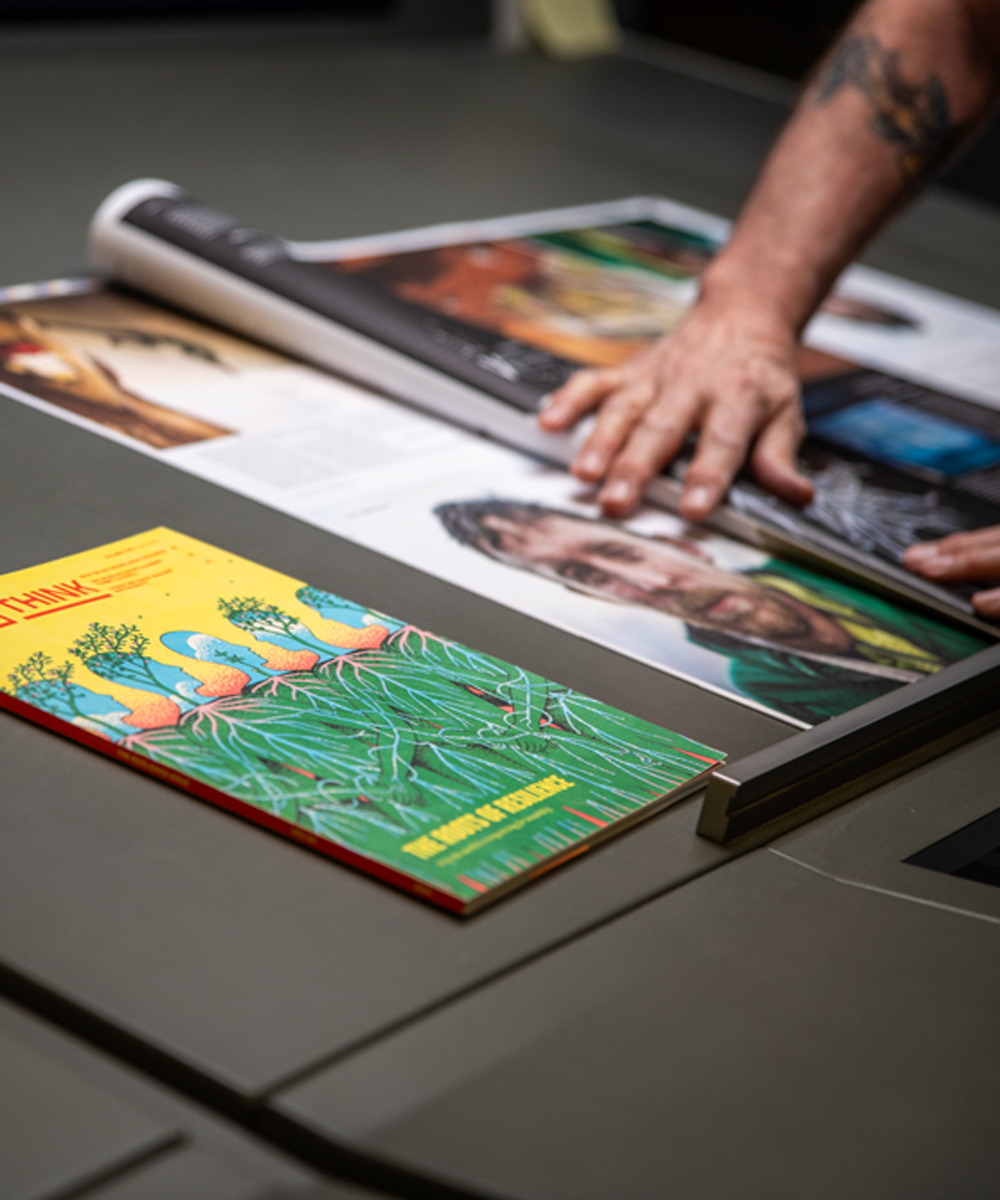
By March 2026, the editors described a monthly themed digital magazine and four print editions a year. The second print issue, The Roots of Resilience, included commissioned journalism, essays and custom artwork. The physical product gives membership something visible to keep, lend or leave beside a chair.
The editorial operation was changing too. In February 2026, Freethink announced that its publication had merged with Big Think. Managing editor Kristin Houser introduced the change with a biology-themed issue and described a direction involving deeper reporting and more original journalism. The announcement made the consolidation explicit after years as sister publications.
Together, those moves suggest a company broadening what its audience can expect from it. A viewer may still arrive through a short interview. The next encounter could be a reported feature, a class assigned at work or a magazine in the mail. That interpretation follows the products; it need not assume a hidden conversion formula.
The test for Big Think is specific to each setting. Readers need an idea worth staying with. Employers need a lesson that survives contact with an actual working day. Print needs to earn its place on the table. The company can put an expert in front of all three audiences. The next move belongs to whoever is listening.
Keep thinking
Explore the publication, membership options and Big Think+ overview and trailer. Watch Cal Newport on Slow Productivity, or browse Big Think’s YouTube interviews.
Follow along on LinkedIn, X, Instagram, Facebook and Substack. Read the editorial merger announcement and print debut announcement.