Ayush Jain still had the slides. The business was called Cool B School, and its proposition was practical enough: help college students learn skills they could use at work. The venture did not last. Years later, talking about it, Jain remembered the presentation files on his computer with affection. Most companies have an archive of things that succeeded. Here was a founder who had kept something that hadn’t.
The detail is a useful introduction to the co-founder and CEO of Mindbowser. His career contains a book marketplace, an attempt to sell workshops to colleges, a remote-work venture, and a software business built with Pravin Uttarwar. The ventures have different endings. Jain has continued to find things to learn from them.
Cool B School was meant to offer workshops in subjects such as Excel and Google Ads. He pitched colleges, including his own institution. Being only a little older than the students proved a handicap: the people buying instruction wanted experience attached to the instructor. The idea had encountered a qualification that enthusiasm could not supply.
An education with customers attached
Jain grew up in Agra in a family that made education a priority. At ABV-IIITM in Gwalior, his studies brought technology and management together. He finished in 2010. Books supplied another education, one he has described as continuing well beyond college. A book is a forgiving place to encounter a business problem. It usually allows you to turn the page.
He moved to Pune for a startup job, deliberately choosing a small company where he could work close to the CEO. His responsibilities included sales and marketing. There were brochures to make and customers to speak to, useful exercises for somebody who already wanted to build a company.
The earlier book-marketplace idea had come from being a reader himself. People could list used books for others to buy or exchange. It attracted few sales, and his collaborators had jobs they were reluctant to leave. A shared interest had brought them together. Keeping the venture going required a more demanding agreement about time.
There is something appealingly circular about this beginning. Jain would eventually write a guide for founders. First, he tried helping readers move books between themselves. The business changed; books remained in the picture.
A partnership that could keep working
Mindbowser began in 2012 with Uttarwar. Their division of responsibilities became straightforward: Uttarwar handled technology as CTO; Jain handled the business as CEO. Describing their relationship years later, Jain reached for the phrase “like a happily married couple.” It is a warmer piece of organizational theory than most business schools offer.
“Like a happily married couple.”
Ayush Jain on working with Pravin Uttarwar
The company initially found work through freelance marketplaces, including Elance and Upwork. Consulting brought in money that could support the operation. Customers needed software built, and the founders could offer that service. A continuing business emerged from work people were already willing to pay for.
That beginning gives the partnership a practical setting. There were projects to win, promises to keep, and different kinds of work to divide. The arrangement could be tested against a customer’s expectations rather than left as a declaration between two founders.
Learning which work to accept
Growth did not arrive as one clean revelation. Jain has described years of experimenting, with revenue spending an uncomfortable stretch near the million-dollar threshold. By that stage, the business employed roughly 60 to 70 people, largely in Pune. Being close to a round number can make the number feel oddly personal.
One change was greater selectivity. The team began looking harder at the startups it agreed to serve. Good engineering alone could not ensure that a customer would find funding or build a viable business. The prospects of the client mattered to the prospects of the agency working for it.
This was a delicate adjustment for a company accustomed to bidding for projects. Every refusal has an immediate cost you can imagine. The value of protecting the team’s time is harder to put on an invoice.
Later figures show a different scale. Jain put annual revenue at $2.5 million in 2020 and $3.5 million in 2021; by his 2024 account it exceeded $5 million. These are milestones in his retrospective, rather than a promise that growth becomes orderly once a company reaches a certain age.
The marketplace came with homework
RemotePanda, which he co-founded in 2018, offered another way to work with software teams. It helped founders find remote talent, adding screening and support. The venture completed more than 50 engagements. When it joined Mindbowser, Jain said the team moved across without job losses.
He nevertheless wrote publicly about falling short of the scale he had wanted. His account examined the difficulty of taking responsibility for results when other people controlled the execution. A marketplace could make an introduction; making the finished work dependable created further obligations.
The admission matters because it leaves the ambition visible alongside the outcome. Fifty engagements meant people had bought something. It did not settle whether the model could become the business its founders imagined. Jain chose to keep asking that question after the venture’s independent life had ended.
The meeting starts with the founder
Some of his more revealing lessons are smaller. He once described trying to improve punctuality through systems and intervention, then recognizing that he himself habitually arrived five or ten minutes late. He started getting to meetings on time and noticed the behavior spreading.
The anecdote has the virtue of an identifiable culprit. Management advice often asks a team to improve in the abstract. Jain’s example required the person giving the advice to look at his own calendar.
He has also acknowledged launching too many internal initiatives too quickly, learning to do fewer things consistently. Together, the two admissions suggest a founder becoming more attentive to repetition: what the team sees him do, what it can expect him to keep doing, and which promises survive the excitement of announcing them.
A workplace has an excellent memory for abandoned initiatives. Consistency gives it something more useful to remember.
A book for the person asking the questions
Writing gave Jain a place to collect what he had learned. The Zero Hiccup Way to Building a Technology Company addresses founders navigating product development and working with development teams. The ambition in its description is brisk: “Fill you with enough knowledge to make you dangerous.”
Here, dangerous means able to ask informed questions and make decisions about work that can otherwise feel mysterious. The founder does not need to become every specialist on the team. The founder does need enough understanding to discuss choices whose consequences will arrive later.
His interest in explanation also took a more investigative form. For What Matters for Startups, Jain described interviewing more than 25 founders who had raised between $1 million and $10 million in the preceding two years. He wanted to find patterns in experiences that can feel intensely individual.
That approach suits somebody who learned in part by hosting Startup Grind conversations. He has described those events as a way to meet entrepreneurs and draw lessons from them. A public conversation can serve two audiences at once: the people in the room and the person asking the questions.
The book launch supplied its own lesson in nerves. Jain recalled feeling anxious despite having organized events before. More than 100 people attended, with three keynotes and two panels. He also admitted enjoying the requests for his signature. After so much advice about building products, a small queue for an autograph must have been a pleasingly simple transaction.
Curiosity gets a microphone
 WATCH THE TALK ↗
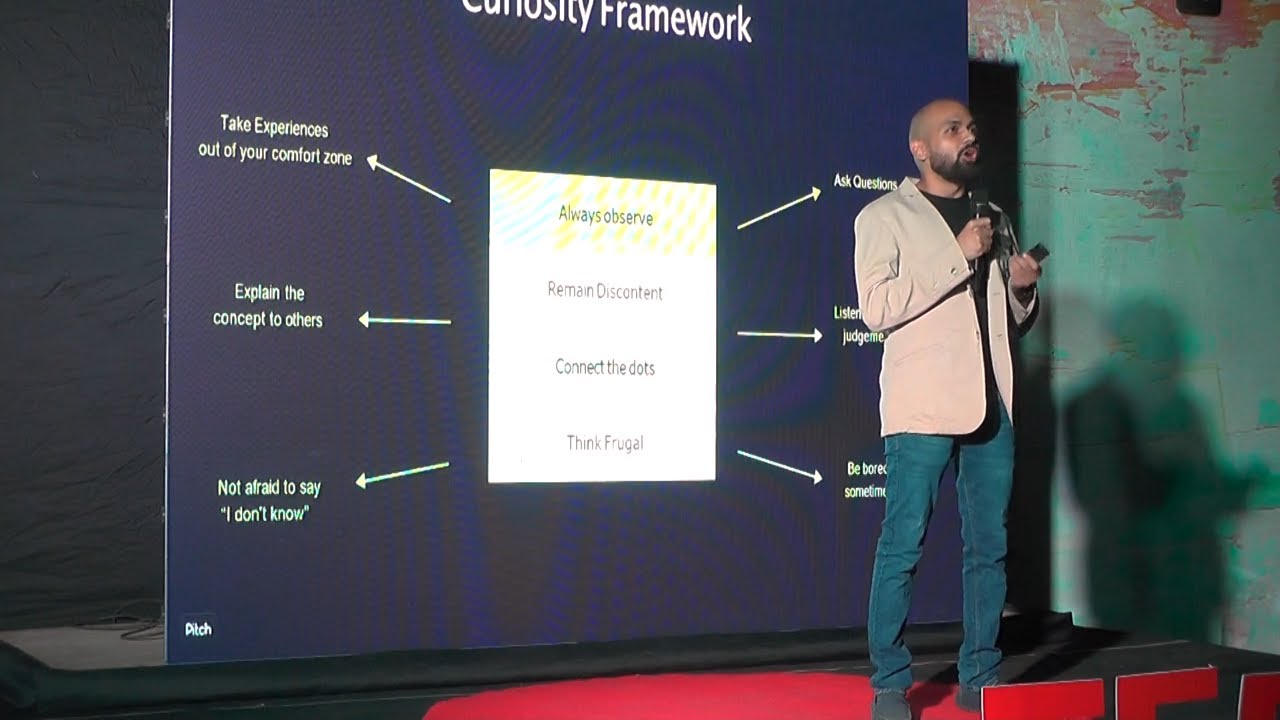
At TEDxVIIT, Jain spoke about the evolution and execution of ideas. The talk’s theme fits the uneven route of his own ventures. Ideas acquire new uses as they pass through people, circumstances, and attempts to make them work.
In the stage photograph, he stands beside a slide titled Curiosity Framework. Among its visible prompts are observation, questions, and a willingness to say that you do not know. For a person whose work includes selling expertise, the last of those makes a useful companion to confidence.
His stated ambition for helping founders is numerical. In his eChai biography, he described a vision of helping create 100 companies with $10 million in revenue apiece. The arithmetic produces $1 billion. It remains an ambition, distributed across businesses other people would build.
The aspiration also changes the unit of attention. A service business works inside other people’s plans, often before those plans have earned much certainty. Jain’s writing and conversations make room for that stage: the founder with a question, the team choosing a method, the idea still being revised. It is familiar territory for somebody whose early pitches did not persuade every buyer.
There is no need to turn every abandoned venture into a secret triumph. A venture can disappoint its founders and still leave them with a better question. Jain’s willingness to describe the disappointments allows that distinction to remain. The reader gets a career with revisions visible, including places where effort and outcome did not agree.
That is a fitting place to leave him: interested in what might happen through the work of others, with a collection of his own attempts behind him. The Cool B School slides had survived their business. Their owner had found another audience, and plenty more questions.