A handshake is an awfully small place to put a career. Yet Denise M. Dudley has given it the sort of attention most people reserve for a contract. The hand, the face, the voice: each contributes something to an introduction. Before the conversation has properly begun, several conversations are already happening. One of them may be saying something you never intended.
Dudley breaks the encounter into parts you can actually practice. There is the physical contact, the eye contact, and the greeting. Thinking about all three turns a supposedly natural social gesture into a manageable task. This is a characteristic Dudley move. Take an instruction such as “make a good impression,” which is almost useless to someone who needs it, and find the smaller actions inside it.
It is also a revealing way into her working life. As co-founder and former chief executive of SkillPath Seminars, she helped build a business around learning things that employment often expects people to know already. Later, as an author, speaker, and coach, she kept returning to the individual at the doorway. You may understand the work perfectly. Getting someone else to understand you requires another set of skills.
A job interview, in this view, contains opportunities before the first question arrives. Dudley encourages candidates to recognize that an invitation already represents progress: someone has chosen their application from the pile. Preparation then becomes quite concrete. Research the organization. Arrive early. Present yourself appropriately for the role. Give the interviewer reasons to imagine you working there. The advice has the useful modesty of something a person can do tomorrow.
Three parts of one ordinary moment, drawn from Dudley’s approach to teaching a handshake.
A business built around the next thing to learn
SkillPath dates its founding to 1989. Dudley co-founded it with Jerry Brown, and the name neatly describes its subject: the distance between where a working person stands and what that person needs to learn next. Management, communication, and supervision became recurring territory in her career. These are subjects with immediate consequences for the colleague on the other side of the desk.
The organization grew into an international training business. Its later history includes a transition to educational nonprofit status in 1995 and an association with Graceland University. Today, SkillPath says its excess earnings support Graceland students. The classroom and the workplace remain connected, even when the person taking a course has long since stopped thinking of herself as a student.
For Dudley, the company is part of a continuing career in teaching. She now offers speaking, coaching, and consulting under her own name. That sequence matters because a former CEO can have plenty to say about leadership from a comfortable distance. Dudley keeps working at the point where an abstract principle must become a sentence somebody can say, a request somebody can make, or a habit somebody can rehearse.
There is an appealing lack of ceremony about that approach. A newly promoted supervisor may have a title before having the language to give useful feedback. A graduate may have finished years of study without practicing an introduction. A company can buy training; the learning still has to happen person by person. The practical question is what someone will do differently when the session ends.
The graduate who wanted something to read
The book Work It! Get In, Get Noticed, Get Promoted, published in 2017, emerged from a recurring request. After Dudley spoke to high school and college audiences about entering working life, students wanted a reading resource. She could not find one that matched the guidance she wanted to give them, so she wrote it.
Its scope extends beyond securing an offer. Finding a place in a team, seeking responsibility, pursuing promotion, and deciding when to leave all belong to the same working life. The subtitle moves briskly through those stages. In between are the less photogenic questions: how to behave, how to ask, how to be useful, and how to make your contribution legible to somebody else.
Dudley told interviewer Pete Mockaitis that she was donating the book’s royalties to youth organizations. The students’ question had become a project with a second educational purpose. It also found readers further along in their careers, including people changing direction. A first job and a fresh start have something in common: both can make an accomplished person feel like a beginner again.
Her willingness to address that beginner is part of the book’s appeal. “Get noticed” can sound like an invitation to become the office peacock. In Dudley’s wider work, attention is tied to preparation and participation. There is room for ambition without making every meeting an audition. The object is to become someone others can recognize as capable, and then give them enough evidence to recognize it.
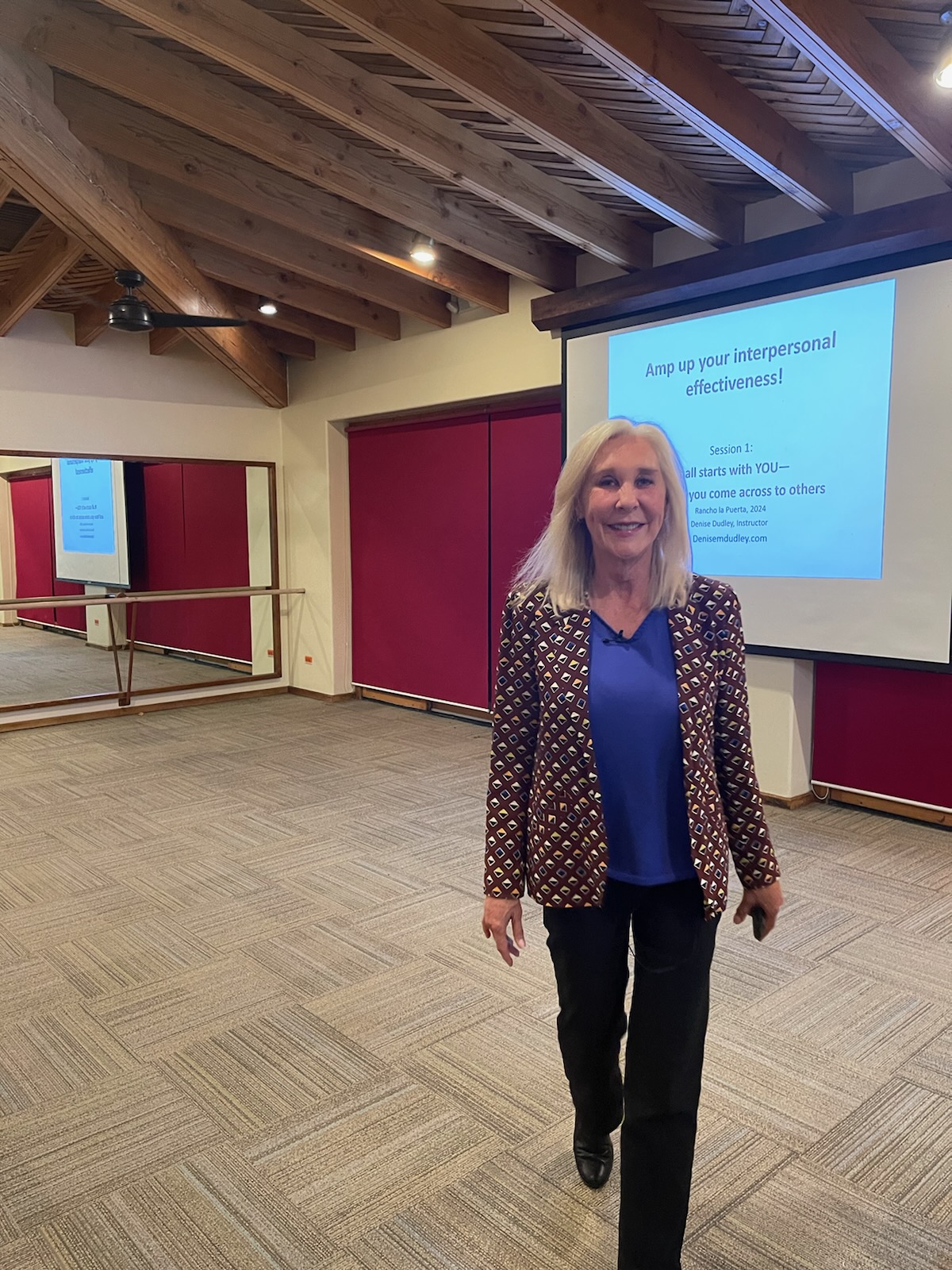
The executive with the cupboard key
Dudley’s management writing contains a small, splendid detail: an executive who guarded the only keys to the janitorial closet. It is hard to improve on that as a picture of control. Somewhere in the building, a person needed cleaning supplies. Somewhere else, authority was enjoying the weight of a key.
In her 2019 discussion of employee empowerment, she asks managers to examine the places where their presence is unnecessary. Routine approvals, recurring meetings, access to information: each can become a checkpoint that survives because nobody has asked whether it still helps. Handing over responsibility begins with looking carefully at what the boss is holding.
She also describes coaching a young manager who wanted to set his team’s break and meal schedules. They rehearsed the request and prepared for objections. When he finally asked, his boss agreed immediately. The anticipated battle never happened. It is a compact account of the value of preparation, and of the trouble with assuming you already know someone else’s answer.
Dudley places obligations on both sides of the conversation. Managers need to explain expectations and remain available. Employees can ask for autonomy and make a credible case for it. Her executive experience gives these exchanges an interesting tension: she understands the attraction of keeping control, while asking the person in charge to consider what that attachment costs everyone else.
In defense of the younger colleague
In 2018, Dudley took on another familiar office habit: complaining about millennials. Her vantage point included training rooms and home. She wrote about her two adult sons and their friends arriving for a meal, a place to stay, or career advice. The supposedly mysterious generation was also sitting in her living room.
Her argument was pointed. Traits described as faults could look quite different when a manager considered what they offered. Comfort with technology could improve communication. Moving between jobs could reflect a search for meaningful work. Expecting leaders to earn respect through their actions could be a reasonable standard for leadership. She asked older colleagues to reconsider the running joke.
She also advocated reverse mentoring, with younger employees and experienced managers learning from each other. That is consistent with the rest of her teaching: the person with the longer résumé still has something to learn. An organization loses useful information when status determines who is allowed to supply it. The junior colleague may know something the executive needs, even if the executive has the nicer chair.
Confidence, with the volume turned down
Dudley’s 2021 writing on workplace confidence gives a quieter person room to breathe. She describes confidence through listening, making decisions, acknowledging limitations, and continuing to learn. A strong presence need not come with a loud voice. For an employee who dreads being told to “just be confident,” that is a more workable assignment.
One recommendation is almost stubbornly ordinary: keep a written record of achievements. Memory is a fickle colleague, particularly before a difficult conversation. A record gives someone specific evidence to revisit. Another recommendation is to ask for honest input about weaknesses and make a plan to improve them. Confidence acquires a connection to work already done and work still possible.
The same concern appeared in her September 2026 conversation with Jo Espejo on The Branded Impact Podcast. They discussed authenticity, visibility, and the danger of borrowing somebody else’s entire manner. Admiring an effective communicator can be useful. Adopting every gesture and phrase can obscure what made you worth listening to in the first place.
That conversation also made room for smaller speaking opportunities and repeated practice. A public presence can be built a little at a time. There is kindness in that scale. It allows someone to attempt a new behavior without believing the next appearance must settle the question of who they are. The experienced speaker and the hesitant beginner can occupy different points on the same path.
“Everything counts.”
Denise M. Dudley
A room has more than one conversation
In October 2026, Dudley published an essay about emotional contagion, looking at how expressions, voices, and behavior affect a group. Meetings, in her account, carry more than the information on the agenda. Participants also read one another. A leader’s manner becomes part of what the room has to interpret.
It is a continuation of the interest visible in her handshake teaching. Communication happens through several channels at once, and the formal words cannot carry the whole load. The person who thinks the spreadsheet explains everything may be missing what everyone else is watching. Dudley’s subject keeps returning to the human detail that sits beside the official business.
The classroom ends; the muddy boots remain
Away from work, Dudley describes a California ranch shared with rescued animals, including horses, donkeys, goats, and alpacas. She is also a keen hiker who has crossed England from the Irish Sea to the North Sea. Her public account of herself leaves room for outdoor life and the occasional donkey with independent opinions about where to go.
The juxtaposition is pleasing: a person who teaches assertiveness living among creatures unlikely to be impressed by a keynote résumé. It also gives the professional picture some air. Dudley’s working interests are serious, but her account of everyday life makes room for mess, movement, and humor. A career spent helping people present themselves need not result in a life kept permanently ready for presentation.
“Everything counts,” she told Mockaitis, describing the lesson she often leaves with audiences. The phrase can sound demanding until you consider its smaller invitation. A useful introduction counts. A clearly expressed request counts. So does a manager’s decision to hand over a little responsibility. Dudley has spent her career attending to those moments, where an ordinary exchange gives somebody a chance to move forward.