The most revealing sentence on Dubai Business Women Council’s website is tucked inside the membership terms. After the workshops, events and directory comes a small corrective to the romance of networking: buying membership does not guarantee customers. For AED 1,500 a year, the council offers opportunities to learn and participate. The member still has to turn up, ask useful questions and do something with the answers.
That is a sensible place to start with an organisation whose name can sound more ceremonial than its timetable. DBWC’s recent work includes artificial intelligence education with Oracle, business software workshops with Odoo and structured mentoring. Its audience ranges from women building companies to professionals developing careers. The common thread is access to knowledge that can be used at work.
The price changed in January 2026. The underlying proposition has a longer history: bring businesswomen together, bring expertise into the room, and give the gathering a practical purpose. Twenty-four years after its founding, the council is testing that proposition against a different set of questions. What should a small business automate? How does a founder assess an AI idea? Where does an experienced woman begin after a career break?
A council with a working timetable
Raja Easa Al Gurg founded DBWC in 2002 under the umbrella of the Dubai Chamber of Commerce and Industry. Her experience came from operating businesses: she is chairperson and managing director of the Easa Saleh Al Gurg Group. The council’s leadership also includes vice president Faiza Al Sayed, whose official biography describes her involvement from its establishment and her own ventures in furnishings and beauty.

DBWC’s stated purpose combines professional development with women’s contribution to the economy. It welcomes Emirati and expatriate businesswomen, with a remit extending beyond Dubai into the UAE and region. That breadth matters. A council serving only startup founders would organise a different curriculum from one also serving executives and employed professionals. Here, leadership, business operations and entrepreneurship share the same calendar.
The organisation’s expertise is partly in assembling other people’s expertise. Its public team page names responsibilities for membership, communications, events and partnerships, alongside director Nadine Halabi de Francesca. This helps explain the delivery model: a continuing member community supported by specialists recruited for particular subjects. The institution supplies continuity; its partners bring technical depth.
The fee has changed. So has the homework.
The current annual membership costs AED 1,500, paid in full. In her message announcing the revision, Al Gurg linked the increase to investment in development programmes, wider networks and support for members. The council describes it as its first fee revision in more than two decades. Existing memberships renewed at the previous rate were allowed to run to the end of their terms.
AED 125 per month when divided across a year.
Illustrative arithmetic. Payment is annual, not monthly.
For a prospective member, the useful calculation is personal: how many relevant sessions can she realistically attend, and which skills does she need? An inexpensive membership left unused is still an expense. A recurring programme can be worthwhile if it helps someone solve a problem she repeatedly encounters. The fee provides a clear starting point for that assessment, without pretending to put a price on every conversation.
The council’s membership terms draw unusually explicit boundaries. Applications require approval. Participation does not bring automatic rights to run events, and the network cannot be treated as an unrestricted prospecting list. Those conditions make engagement a two-way responsibility: members receive a professional setting and are expected to respect it.
“Business success depends solely on the individual member’s initiative and engagement.”
DBWC membership code
AI gets an assignment
DBWC and Oracle launched sAIdaty in January 2024 with the aim of teaching AI skills to women professionals and entrepreneurs. By January 2025, Oracle reported 500 women trained in the inaugural edition and announced a second. That is a measure of training participation. It should be read on its own terms, without turning it into a claim about businesses transformed or revenue generated.
The initial curriculum covered cloud computing, AI and generative AI, alongside leadership development. The second edition was designed to move into more advanced applications and deployment strategies. For a business owner, that progression has a practical logic. Understanding the vocabulary helps her question a supplier, discuss an idea with colleagues and judge where an experiment might be useful.

The programme’s ideathon made that progression visible. Its published format asked members to propose an AI use case, attend practical sessions, refine a short video pitch and compete for expert mentoring. Teams could include up to three members. Five leading participants were to receive individual guidance from Oracle specialists before the final showcase.
- 01Choose a
business problem - 02Learn, test
and refine - 03Pitch for
expert guidance - 04Present
the idea
On February 10, 2026, DBWC documented the ideathon at Oracle headquarters. Members applied learning from three stages of the Oracle AI Core Programme to proposed solutions. The event offers a more interesting editorial detail than the usual partnership announcement: participants had something to prepare and present. A course with an assignment gives learning a destination.
There is also a quieter route into technical study. The sAIdaty page offers active members sponsored Oracle MyLearn access, with self-paced training and certification in areas including AI, cloud infrastructure and cybersecurity. For members balancing a company or a job with professional study, that format extends the programme beyond a fixed event calendar.
The spreadsheet deserves a workshop, too
In May and June 2025, DBWC’s Odoo collaboration put six everyday business functions on the agenda: automation, finance, human resources, marketing, e-commerce and internal communication. These are the subjects behind the scenes of a growing firm. A founder can be persuasive about her product and still need help organising the information, people and processes that keep it moving.
The series was presented as practical, step-by-step instruction by regional Odoo experts. Its appeal is easy to understand: members encounter the tools in the context of running a business. The limitation is equally worth remembering. A supplier-led workshop reflects that supplier’s products and perspective. An attentive participant can learn from it while still deciding independently what belongs in her own company.
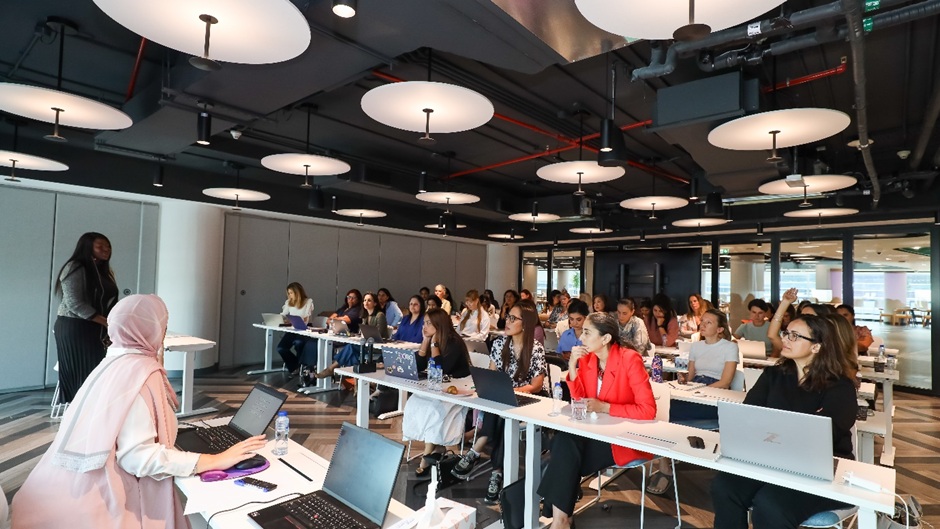
The council’s year-end account said it delivered more than 20 workshops during 2025, covering subjects including corporate tax, financial literacy, sustainability and personal branding as well as technology. The range shows where DBWC sits in the market. It offers continuing business education across disciplines, with the social benefit of learning alongside other working women.
She Leads: read the prize label
The entrepreneurship work has its own history. In September 2020, DBWC and Creative Zone began delivering She Leads online. The first session addressed moving from a business idea into implementation, including testing assumptions against customers. Creative Zone’s event listing advertised a free Zoom session and a 12-week sequence covering subjects such as finance, sales, marketing and leadership.
A later session tackled strategy and confidence as markets and consumer behaviour changed during the pandemic. That tells readers something concrete about the programme’s purpose: help founders reconsider a plan when conditions move underneath it. The lesson anyone can borrow is modest and useful. Put customer response into the business review early, while changing the plan is still manageable.
The 2021 edition produced a prize announcement that needs careful reading. She Leads 2.0 and Creative Zone’s separate Startup X programme together attracted more than 500 applications; 20 businesses were shortlisted across the two. Two winners received a combined AED 200,000 worth of business support services, including licensing and technology-related benefits. Those are shared programme figures and service values, rather than a cash investment in DBWC.
Give the relationship a calendar
Mentoring provides a different kind of help. DBWC’s programme archive begins in 2018. Its sixth cycle, in 2024, specified a three-month period and used an induction to set expectations about trust, confidentiality, regular communication and professional boundaries. Experienced businesswomen were paired with people seeking guidance, with active participation expected on both sides.
Other professional communities could copy that discipline. Establish the purpose, agree how people will communicate and give the relationship a timeframe. These are small design choices, but they make the word “mentorship” less vague. A useful mentor can help a member think through a decision; progress still depends on the member bringing a decision worth discussing.
DBWC’s 2026 agenda announced a seventh mentoring cycle, more work with Oracle and Odoo, a third Canon creative-skills cohort and a new programme for women returning after career breaks. The plans suggest a community responding to different stages of working life, including the difficult point where experience exists but recent workplace confidence needs rebuilding.
Choose the room you will use
DBWC is one option in a wider market for women’s business support. Sharjah Business Women Council also offers mentoring, entrepreneurship resources and visibility, with membership tiers aimed at different business stages. Geography, curriculum and the relevance of the other participants are sensible points of comparison. A standalone course may suit a narrow learning need; a continuing council offers repeated contact across subjects.
The member company profile feature adds another practical layer: registered DBWC members can submit information about their businesses for a public showcase. Combined with learning resources and events, it gives the organisation a presence between meetings. But the strongest reason to join remains specific. Pick the skill, question or professional relationship you intend to work on. Then make room in the diary.