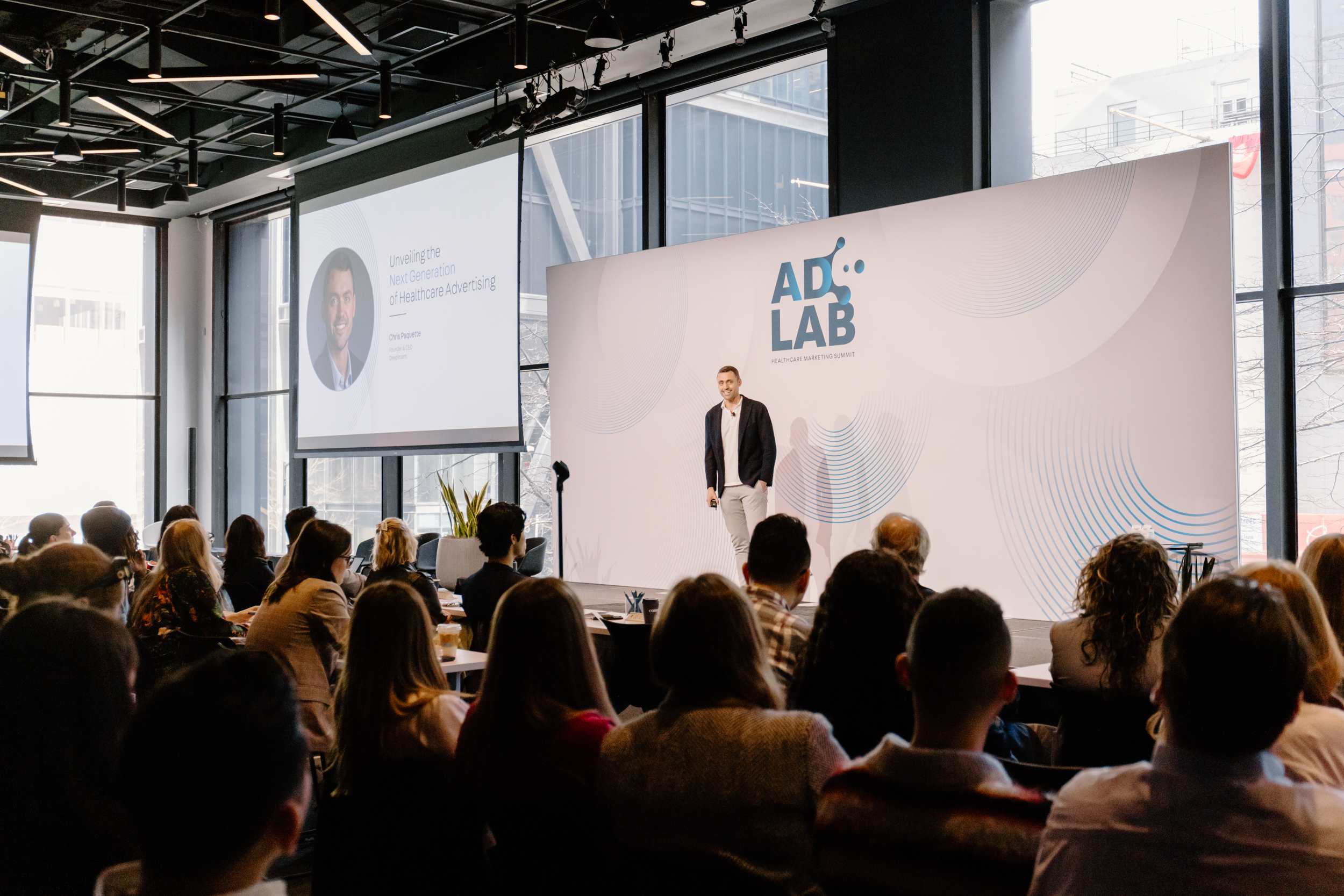
The first thing DeepIntent failed to sell was its own inevitability. In 2016, Chris Paquette and a business partner self-funded a new demand-side platform, or DSP, just as investors were losing interest in funding yet another piece of advertising machinery. The founders expected early wins to unlock venture capital. Instead, by 2017, cash flow was tightening and the category's money spigot had largely closed.
The company did not respond by bolting on a trendier pitch. It changed who it asked for money, turning to corporate investors, and kept sharpening the product around healthcare. That sounds tidy from a decade's distance. At the time it was a blunt correction: growth without financeable cash flow is a countdown, not a strategy.
“Cash flow is king.”Chris Paquette, on DeepIntent's early funding scare
Paquette had an unusual reason to persist. He studied bioengineering and machine learning, worked in ad tech, and later helped build a data-science team at Memorial Sloan Kettering Cancer Center. There, patients told him how difficult it could be to find useful information about diagnoses and treatments. His father had once been misdiagnosed with the wrong type of cancer and found the right answer only after seeking a second opinion. Paquette's conclusion was not to build another health-content site. It was to improve the distribution machinery that decides which information reaches patients and clinicians.
A buying desk with a medical chart attached
A DSP automates the purchase of ad inventory across websites, streaming television, audio, apps, digital screens, and other channels. A generalist platform is designed to sell almost anything to almost anyone. DeepIntent's version is built for pharmaceutical and life-sciences marketing, where the audience can be a neurologist, a person likely to have a rare condition, or a caregiver looking for treatment information - and where identity, privacy, safety, and evidence all carry extra weight.
Its customers are brand teams and the agencies that serve them. Their job begins with planning an audience, continues through media buying and optimization, and ends with an awkward question from a finance or commercial leader: what changed in the real world? DeepIntent tries to keep those stages in one system. Its software joins media, identity, and privacy-safe clinical data so a trader can measure verified audience quality, doctor visitation, new-patient starts, or prescription lift instead of stopping at impressions and clicks.
This is an enterprise B2B ad-tech business. Brands and agencies contract for self-service or managed campaign activity, plus the data and platform capabilities around it. DeepIntent has also promoted zero-fee trading in some arrangements, which is a useful reminder that the economics of a DSP are negotiated across media, service, and data rather than reduced to a neat app-store subscription.
That feedback loop is the company's most important product. DeepIntent Outcomes links exposure data with clinical signals and adjusts bidding toward impressions associated with better audience quality or script performance. Patient Modeled Audiences creates privacy-conscious segments around health characteristics. The newer Cortex interface brings those functions into a rebuilt workflow with AI recommendations, daily-refreshed health data, and a choice of data providers including IQVIA Digital and Symphony Health.
Six hundred brands and one stubborn question
DeepIntent said its platform supported advertising for more than 20 major pharmaceutical companies and more than 200 healthcare brands in 2020. It now says more than 600 brands, at least 10 top global drugmakers, and more than 50 agencies trust the company, with 98 percent client retention. Those are company figures, not an audited market census, but they show why specialization can compound. Each additional campaign produces operational knowledge about the same narrow set of buyers, rules, datasets, and outcomes.
The narrow focus also changes product design. Cortex was built over nearly two years with healthcare programmatic traders. DeepIntent says its automation can reduce campaign-management and optimization time by as much as half. In initial tests, an enhancement to its audience-quality optimization lifted the average improvement by 80 percent. The precise numbers will vary by campaign, but the design lesson travels: automate a workflow whose delays you have observed, using outcome data the customer already values.
| Question | DeepIntent's answer | Generalist route |
|---|---|---|
| Who? | Verified patient and HCP audiences | Broad demographic or behavioral segments |
| Where? | Web, CTV, audio, DOOH, point of care, EHR | Broad media inventory, with health partners added |
| What worked? | Audience quality, visitation, new starts, script lift | Impressions, reach, clicks, conversions |
| What is hard? | One healthcare-specific identity, data, and compliance stack | Assembling specialist vendors around a core DSP |
The exit that did not exit
DeepIntent's second public setback arrived after it had become strategically important. IQVIA, one of the world's largest healthcare-data companies, proposed acquiring Propel Media, DeepIntent's owner. The Federal Trade Commission sued in 2023, arguing that the combination would reduce competition in programmatic advertising aimed at healthcare professionals. A federal judge granted a preliminary injunction. In January 2024 the parties abandoned the deal.
A blocked sale can leave a company suspended between strategies. DeepIntent kept shipping. It introduced a third-party data due-diligence label called Data HealthChecks, launched Cortex in March 2025, and six months later accepted a $637 million investment from Vitruvian Partners. Vitruvian took a majority interest; DeepIntent continued to operate independently under Paquette.
The amount is striking, but the sequence is more useful. The company's value was not solely the buyer that wanted it. It was the infrastructure, client relationships, patents, supply connections, and measurement loop that another owner could finance. Founders cannot copy the check. They can copy the preparation that makes more than one strategic future plausible.
The DSP grows a cloud - and learns to chat
In 2026, DeepIntent moved up the stack. Helix opened parts of its healthcare-data infrastructure to agencies and brands that want to combine first-party, third-party, and media data; analyze markets; build proprietary tools; and activate audiences without constructing the regulated plumbing themselves. The company says the system covers nearly 4 million providers and more than 250 million patient lives.
Helix AI adds a conversational layer. A strategist can ask about prescriber overlap, geography, patient and provider journeys, competitive dynamics, reach forecasts, or campaign performance; build an audience; then activate it in DeepIntent or another channel such as social media. Beta agencies reported a 50 percent reduction in planning-cycle time. The interesting asset is not the chat box. It is the permissioned, organized, frequently refreshed healthcare and media data behind the chat box.
The interface is new. The expensive part - trustworthy data that can survive a compliance meeting - took a decade.
The company is also following healthcare audiences into places that scarcely resemble the banner-ad web. Partnerships with epocrates and OptimizeRx bring programmatic buying toward clinician workflows and authenticated electronic health records. Live sports tools use verified streaming inventory and event-specific pacing, supported by a multi-million-dollar data-center environment called AEGIS 1. A Vistar Media integration adds digital out-of-home screens. Audio, FAST channels, connected TV, and point-of-care inventory sit beside familiar display and video.
This breadth makes DeepIntent more useful, but it raises the difficulty level. Every channel brings its own supply quality, frequency, identity, and attribution problems. A prescription filled after a CTV spot is not proof that the spot caused it. DeepIntent's differentiation depends on managing those caveats better than a client assembling a generalist DSP, separate data vendors, and an attribution partner.
What a builder can actually copy
DeepIntent's playbook begins with a useful refusal: do not serve everyone. The company accepted a smaller addressable market in exchange for denser expertise. Then it built around a metric that matters to the buyer's buyer. A media trader likes efficiency; a pharmaceutical commercial leader cares whether the right audiences were reached and treatment adoption changed. Software becomes harder to replace when it translates between both.
There is another copyable move in Data HealthChecks. Third-party audiences are only as credible as their provenance, consent, and construction. Instead of treating vendor diligence as backstage paperwork, DeepIntent turned part of it into a visible product signal. In markets thick with questionable data, showing your quality-control work can be a feature.
Where the playbook breaks
- The advertiser is too small to generate stable outcome signals or justify specialist infrastructure.
- The market lacks lawful, permissioned data and reliable identity matching.
- The outcome happens too slowly, too rarely, or with too many confounders for credible optimization.
- A general-purpose platform plus one data partner can deliver comparable results at lower cost.
- Expansion into more channels outruns the team's ability to police supply, privacy, and attribution.
DeepIntent is not a universal model. Its specialization is both moat and boundary. Outside healthcare, much of the clinical-data advantage disappears. Inside healthcare, a marketer still needs enough budget, signal, and patience to test incrementally rather than confuse correlation with causation.
But the company has made a coherent bet: when advertising involves sensitive audiences and expensive treatments, the buyer will pay for fewer loose ends. DeepIntent's first crisis taught it that market enthusiasm cannot substitute for cash. Its later growth suggests the complementary lesson - a narrow product can become a large company when it owns the unglamorous connections everyone else would rather rent.