Deepak Chopra was considering a future in tacos when his wife asked a question that deserved a place in the business plan: what did he know about them? He had worked in electronics. He understood sensors, semiconductors and the awkward business of making things. A franchise would have required a different education. Nandini’s question sent him back toward the one he already had.
He borrowed a friend’s computer, wrote a business plan and sold the family house to help finance a company. He promised his wife another house. The venture became OSI Systems, which he would lead as president and chief executive from its founding in May 1987 through the end of 2024. The tacos remained a possibility mercifully spared an earnings call.
Chopra’s account of becoming a founder contains hesitation, domestic advice and an engineer’s return to familiar work. It is an appealingly untidy beginning for a business whose products depend on getting the details right. Looking back in 2011, he resisted the suggestion that he had always intended to build a company. “I was always an engineer,” he said.
A November trip with permanent consequences
His technical education began at Punjab Engineering College in Chandigarh. He came to the United States for graduate study in 1971 and earned his master’s degree at the University of Massachusetts Amherst in 1973. His subject was semiconductor electronics, a field concerned with devices small enough to disappear inside someone else’s invention.
During summer holidays, he worked as a cook at Hardee’s in Boston. The future consideration of a food franchise therefore had a modest practical precedent. His subsequent career, however, kept returning to electronics. His first job after graduate school was with RCA in New Jersey; later employers included TRW and Intel.
A work trip helped determine where that career would unfold. Sent to Southern California for a conference in November, he found beaches, volleyball and weather that compared rather favorably with the East Coast. He decided to stay. In his telling, RCA had inadvertently arranged a very persuasive recruitment exercise for California.
By 1976 he was working at United Detector Technology. After a stint at Intel beginning in 1979, he returned to run United Detector under ILC Technology. These were years spent learning the business around the engineering: manufacturing, customers and responsibility for an operation. OSI’s later purchase of United Detector assets in 1990 brought part of that working history into his own company.
The customer with the unpaid bill
One of the revealing turns in Chopra’s career began with money that might never arrive. Rapiscan, a British customer buying components, was in financial trouble. OSI faced losing a receivable worth about £2 million, he later recalled. He went to look at the situation and began considering whether buying the customer offered a way forward.
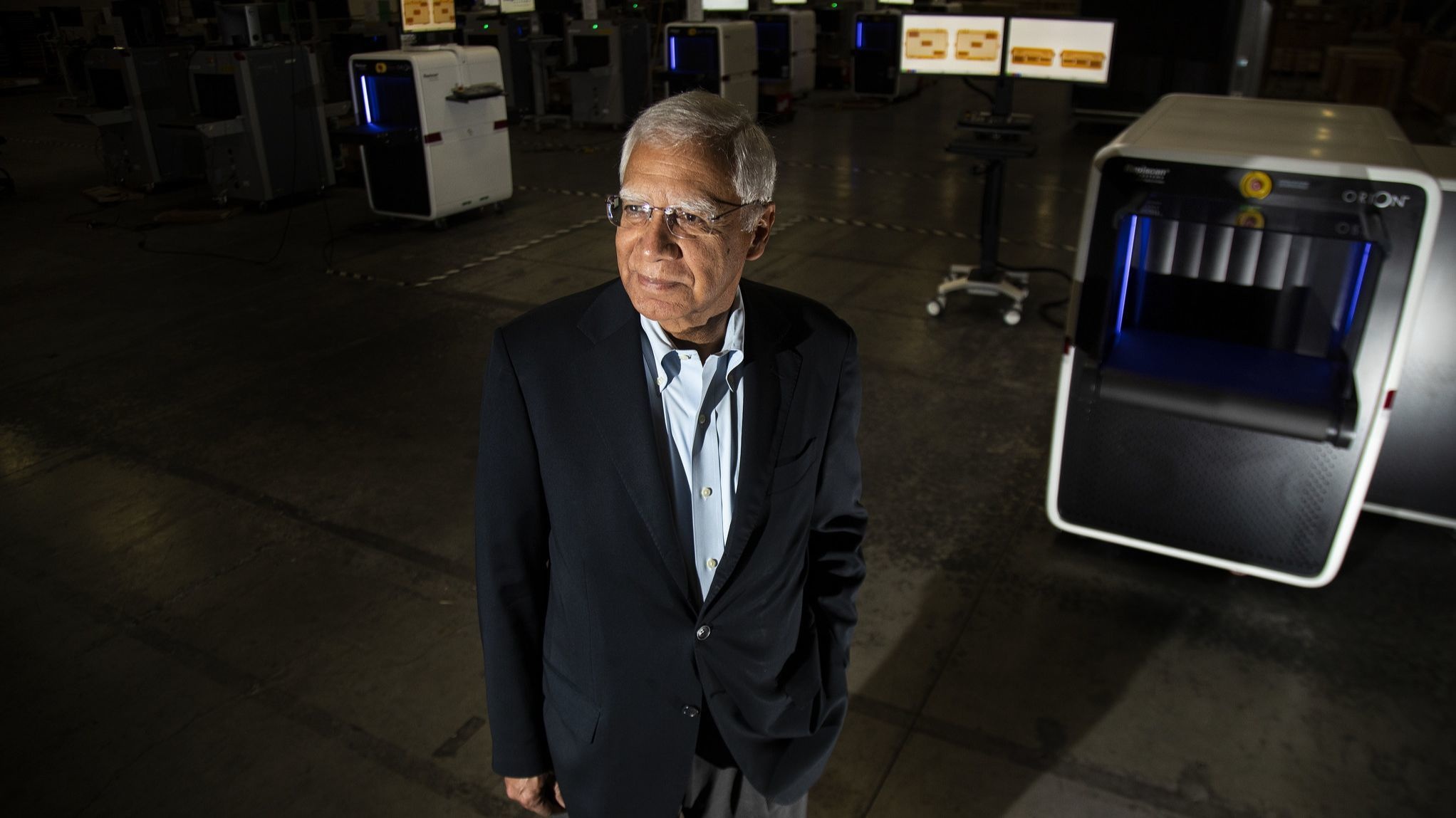
OSI acquired Rapiscan in 1993. A supplier of parts now owned a business making complete security inspection machines. The transaction changed the company’s relationship with the market: it could supply components to manufacturers and sell finished inspection systems to the organizations using them.
That is a substantial change to hide inside an unpaid-bill story. A component manufacturer has to satisfy a product specification. A systems supplier also has to understand the place where the equipment will work, the people operating it and the customer’s reason for buying it. Airports, ports and borders became part of OSI’s working geography.
An illustration of the business’s scope, not a manufacturing flowchart.
A prospectus replaces the business plan
By the time Chopra took OSI public in 1997, the company had both sides of that business in place. Its optoelectronic devices sensed light and converted it into electrical signals. Its Rapiscan products inspected baggage, cargo and other objects. The underlying technology could travel through several layers of a product before reaching the customer.
The numbers from that year make the combination unusually clear. Devices and subsystems generated $42.9 million in revenue. Security and inspection products generated $34.7 million. Total annual revenue was $77.6 million. The security business was already a substantial part of the company, four years after its entry into that market.
The offering was priced at $13.50 a share. For a founder who had helped fund the beginning by selling a house, a public company brought a different set of obligations. The business plan now had a much larger audience, with shareholders entitled to ask how the next decision would affect them.
Fiscal 1997 revenue. Bars share a zero baseline; figures rounded to $0.1 million.
Acquisitions continued to add capabilities. On September 12, 2016, OSI completed the purchase of American Science and Engineering for approximately $269 million. The deal added inspection systems using X-ray backscatter technology, including a van-based system and a portable instrument. Those were specific additions to what OSI could offer customers concerned with cargo, parcels and personnel inspection.
The transaction also shows how far Chopra’s responsibilities had moved beyond designing a component. He was buying businesses whose technologies had to fit into a larger offering. The question had expanded from how a device worked to what an acquired company would enable OSI to do.
Decisions without a procession
Chopra described his preferred organization as informal, with few layers between management and the production floor. He valued knowing the people doing the work and making decisions while there was still time to act on them. Speed, in his account, came with the possibility of mistakes. Waiting carried a cost of its own.
There is a familiar tension here for an engineer running a business. Engineering rewards careful analysis. A transaction or customer decision arrives with a clock attached. His stated preference was to act in time, accepting that certainty might remain incomplete. The Rapiscan story gives that preference a concrete setting: the problem had already arrived, and it required an answer.
“Our values should guide our conduct and our conduct must represent our values.”
Deepak Chopra · 2016 message to colleagues
He also put expectations in writing. His introduction to OSI’s 2016 code of ethics named integrity, accountability, innovation and teamwork as company values. He asked employees to read the code, ask questions and hold one another accountable. The message tied the company’s reputation to the trust of customers, shareholders and communities. Informality still needed rules people could understand.
There was room away from work for machines with rather different purposes. Chopra’s interests include antique cars and toy trains, alongside Indian art, tennis and travel. An engineer’s curiosity can survive a promotion. So can the pleasure of looking at something built to move, especially when it has no quarterly targets.
The engineer at the trade table
His operating career eventually brought him into discussions about how countries do business with one another. He served on the U.S.-Brazil CEO Forum in 2011–2013 and again in 2015–2017. The forum brought business leaders together with government officials to discuss commercial relationships. Manufacturing experience had become a reason to ask for his views beyond the factory.
In December 2018, he was appointed to the U.S.-India CEO Forum. He expressed an interest in bilateral trade, investment and job creation. Another appointment followed in 2022. The forum’s job included developing joint recommendations for the two governments on strengthening economic and commercial ties.
For someone educated in both India and the United States, the assignment connected two places already present in his biography. It also connected two kinds of work. A manufacturer deals with customers, facilities and distribution across borders. A trade forum considers the conditions under which those relationships operate. The conversation grows more formal; many of the practical concerns remain recognizable.
In his final year as chief executive, those cross-border concerns remained practical. His 2024 letter to shareholders discussed expanding operations in Mexico and the company’s manufacturing infrastructure in Asia Pacific as ways to diversify its supply chain. He also described security projects that included ongoing operations and services. Selling equipment had grown into supporting the work customers did with it.
Handing over the controls
Chopra’s tenure as CEO ended on December 31, 2024. His successor, Ajay Mehra, had joined OSI in 1989, worked in finance, served as chief financial officer and led the Security division. By the succession announcement, that division had passed $1 billion in annual revenue. The board selected someone with a long record inside the company.
Mehra became president and CEO on January 1, 2025. Chopra became executive chairman. He praised Mehra’s knowledge of the business and experience through acquisitions, expansion and multiple business cycles, and said he looked forward to working with him. The appointment put a colleague of more than three decades in charge of running the company.
Mehra becomes CEO.
Chopra becomes executive chairman.
Chopra becomes chairman
of the board.
The second step came on January 1, 2026, when Chopra moved from executive chairman to chairman of the board. He signed the company’s fiscal 2026 annual filing in that capacity. The distinction matters: the founder remained chairman, while the chief executive’s job belonged to Mehra.
Recognition arrived during that transition. UMass Amherst had given Chopra its Alumni Honors Lifetime Achievement Award in 2022. In May 2025, ACG Los Angeles honored him with its own lifetime achievement award, recognizing a career that included dealmaking, mentorship and engagement in Southern California’s business community. Chopra’s response credited mentors, colleagues and the OSI team.
It is a fitting place to leave a story that began with advice at home. Nandini’s question, the customer’s unpaid bill, the colleague who eventually became CEO: other people keep appearing at the consequential turns. Chopra brought the engineering. Building OSI required listening, buying, deciding and, eventually, handing over a job he had held for more than three decades.
Continue the conversation
Follow the company, revisit the interviews or watch Chopra address his colleagues.