Robert Keane missed his graduation ceremony. He had a business to prepare. At INSEAD in France, he had been working on a problem that would occupy considerably more time than his MBA: why was it so difficult for a tiny business to buy a small amount of good-looking print? A brochure was a modest object with an immodest entrance fee. The machinery expected a crowd. The customer might be one person.
This was 1994. Keane had grown up outside Buffalo, near the Canadian border, studied economics at Harvard, and worked in Boston before going to business school. He chose INSEAD partly because its one-year programme would get him back to work quickly. During the summer and autumn, a new-ventures assignment became a business plan. Preparing the launch took precedence over collecting the ceremonial evidence that he had finished studying.
He brought practical experience to the question. Between 1988 and 1994, he had been an executive at Flex-Key, which made keyboards, displays and retail kiosks used for desktop publishing. Here was someone who knew that a design on a screen and an object in a customer's hand belonged to the same problem. Much of his career would be spent connecting them. The company he founded in January 1995 eventually became Cimpress, parent of VistaPrint.
Paris, paper and a badly timed strike
The first version had the pleasing French name Bonne Impression. Keane worked alone from his Paris apartment. Rather than sending every order to a distant factory, the early proposition helped customers make materials on their own desktop printers. A catalogue sold software and specialist papers. The small-business owner supplied the computer, the printer and, presumably, a reasonable tolerance for paper jams.
Microsoft became an early connection of consequence. Keane consulted for the Publisher team, researching European small businesses' design and printing needs. Microsoft France also agreed to distribute his catalogues inside Publisher boxes. It was a promising way to find people who already wanted to make their own marketing materials. In November 1995, the catalogue launched into a French general strike. Keane later recalled that the business nearly failed.
It restarted in spring 1996. The distribution relationship helped it grow, but dependence had a price: reaching customers outside Microsoft's channel was much more expensive. A partner could open the door and still leave you with a room that was getting too small. By the end of the decade, Keane was looking for another way to reach the same people.
A factory hidden inside a browser
The move online took shape in 1998 and 1999. Customers could design in a browser, place an order and have it printed centrally. The VistaPrint name followed in 1999; the company entered the US market in 2000. What sounds ordinary now required two kinds of software to work together: one that let a novice arrange a design, and another that made the resulting orders economical to manufacture.
The important trick was aggregation. A customer's small order could travel through a production system alongside many other small orders. The individual still received something personal, while the factory gained the benefits of volume. In that arrangement, the unglamorous work of scheduling, preparing files and moving information mattered enormously. A helpful website could win the order. A well-organised production system had to make the promise affordable.
Keane resisted the tidy origin story. He described the development as “a dimmer switch that was faulty”. There were years of experiments, losses and occasional progress before the combination worked. The phrase suits a founder whose achievement involved repeated adjustment. Anyone looking for a single moment of revelation would have had a long wait, perhaps long enough to order some stationery.
The money that never arrived
The internet provided a route to customers and a fresh opportunity to run out of money. Keane arrived in the US as the dot-com market collapsed. Raising capital became difficult. In February 2001, the company sold its declining European catalogue operation to its management team and committed to the internet business. A reassuring second option had disappeared.
Looking back, Keane gave the financing drought some credit. Companies with large venture rounds could postpone difficult decisions. His company had to reduce costs and support itself from its own cash flows. That is a useful recollection because it leaves the discomfort intact. A forced decision can turn out well without having felt remotely fortunate when it was made.
His account also makes room for other people and chance. He attributed success to work, the abilities of many colleagues and luck. The retrospective version of entrepreneurship often gives its central character suspiciously good foresight. Keane's version has a smaller costume budget. He remembers an organisation compelled to face its economics, with survival setting the agenda.
“A dimmer switch that was faulty.”Robert Keane, recalling the search for a working model, 2015
Free cards, very deliberate arithmetic
Then there were the free business cards. Someone at the company proposed the offer, and it became a way to persuade unfamiliar customers to try VistaPrint. In its early form, customers paid shipping and handling. The cards came with limited designs and a longer delivery time; customers could pay for other options. Giving away the first product made sense only if the machinery behind it kept costs under control.
Keane had chosen a market many others disliked. Microbusinesses were dispersed, hard to reach and short of money. Large corporate print buyers looked more attractive. But the tiny customer had a different unmet need, and the company had built its tools around that need. The free-card offer gave people a comparatively easy first purchase. Further orders could include products for which they were willing to pay.
By fiscal 2001, the business had $6.1 million in revenue and 25 employees. Revenue reached $35.4 million in fiscal 2003 and $401 million in fiscal 2008. These figures describe a particular period of VistaPrint's history, before the later group of acquired businesses. They also reveal how far a company could travel by taking apparently unpromising orders seriously.
Small orders, growing revenue
A customer with a second job
Keane's descriptions of customers were unusually specific. In 2008, he talked about house painters, tennis coaches, eBay sellers and a teacher who tutored on the side. Some customers had only a part-time business. The average order, including design services and shipping, was then $33. There was little room in that sum for a lengthy consultation, a complicated hand-off or an avoidable mistake.
He looked beyond printing for operational examples, naming businesses such as Southwest Airlines, Toyota and Dell. His interest was in the steady reduction of costs alongside improvements customers actually valued. That emphasis helps explain the breadth of the work: advertising, technology, manufacturing and customer service all had to cooperate. A cheap press run alone would never settle the whole bill.
The product range widened too. Research into why customers came to VistaPrint pointed toward marketing their businesses, which could require apparel, promotional items and websites as well as cards. By 2009, the company also offered subscription email marketing. Keane's explanation of its name was wonderfully economical: “we just call our services what they are.” It was called Email Marketing. A committee might have needed longer.
When a rival hands you the award
In 2014, the parent company adopted the Cimpress name while VistaPrint continued as a customer-facing brand. The distinction matters today. Keane is Cimpress's founder, chairman and chief executive. Florian Baumgartner became CEO of the Vista business in February 2023. A familiar name on a business card now sits inside a broader collection of printing and custom-product businesses.
Keane has argued publicly for working with competitors as well as competing with them. In a 2016 essay, he used the technology industry's overlapping relationships as a model for specialisation and partnership in print. The customer, in that view, should benefit from companies choosing where to excel and where another company can help. Corporate pride makes a poor substitute for a better product.
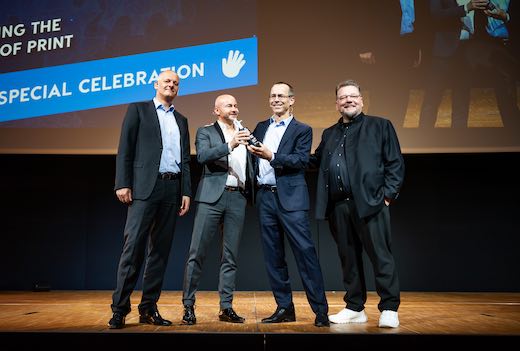
There was an agreeable illustration in Munich in March 2023. At the Online Print Symposium, Flyeralarm founder Thorsten Fischer presented Keane with the First Pioneer of Global Online Print award. A rival founder doing the honours is a more interesting photograph than the usual executive standing beside a logo. Keane used his keynote to stress the contributions of family, friends and colleagues, alongside automation and persistent attention to customers.
Still adjusting the machinery
The honours had begun earlier: INSEAD named him its 2017 Global Entrepreneurship Award recipient. Yet the more revealing measure of his ambition may be an answer from 2009. Asked where he wanted to be in five years, he requested a different timescale: “I would like to modify that to 15 years or 20 years.” He was interested in an institution built over decades. It is a demanding answer for anyone hoping to wrap up an interview before lunch.
His July 2024 investor letter described a structure that combined decentralised responsibility with a few shared capabilities. By September 2026, he was discussing a more balanced relationship between decentralisation and centralisation, including shared technology and closer operational cooperation. The organisational design, like the early business model, remained open to adjustment. Keeping a founder's original customer problem does not require preserving every subsequent decision.
At that September investor day, Keane reported fiscal 2026 revenue of $3.7 billion for Cimpress. His discussion centred on higher-value customers, packaging and other expanded products, shared production capabilities and artificial intelligence. He also described the Canva partnership announced in July, connecting designs made on another platform to Cimpress fulfilment. These are management's chosen directions, with their eventual results still to be earned.
The scale has changed beyond anything suggested by an apartment full of catalogues. The underlying question remains recognisable: how can someone order exactly what their business needs without paying the penalties traditionally attached to being small? Keane has spent more than three decades changing his answer. The next version still has to reach the customer as a useful physical object. Preferably on time, in the right colour, with the name spelled correctly.