After Gatwick Airport shut down in December 2018 amid reports of drones, Newcastle International Airport had a problem that was easier to describe than to solve. A runway could be guarded. A terminal could be searched. The air above them remained inconveniently open. Newcastle’s subsequent choice of Dedrone began with a modest ambition: find out what was happening up there.
- The job: detect, identify and track drones, then give security teams information they can act on.
- The method: combine radio signals, radar and cameras in one software platform.
- The twist: technology built to find unwanted drones now helps emergency-response drones fly.
Newcastle’s case study describes learning when drones appeared, how long they flew and where they were. Those observations became the raw material for response protocols. The first improvement was knowledge. A frightening possibility had acquired a timetable, a location and something resembling a plan.
The fence has a ceiling
Dedrone was founded in 2014 by Jörg Lamprecht, René Seeber and Ingo Seebach. Its premise was wonderfully awkward for the security industry: a perimeter is only as useful as the directions it covers. An airport worries about flight disruption; a prison about contraband; a research facility about cameras looking where visitors cannot. Each has a different reason to look up.
The company sells to those institutions, rather than to hobbyists seeking an argument with the neighbor. Public customer accounts include Newcastle, NASCAR, Con Edison and police departments. Government and military buyers form another substantial constituency. In August 2024, Dedrone reported deployments at 851 sites in 32 countries, including 49 airports and 61 stadiums. These are company-reported counts from that period.
A committee of sensors
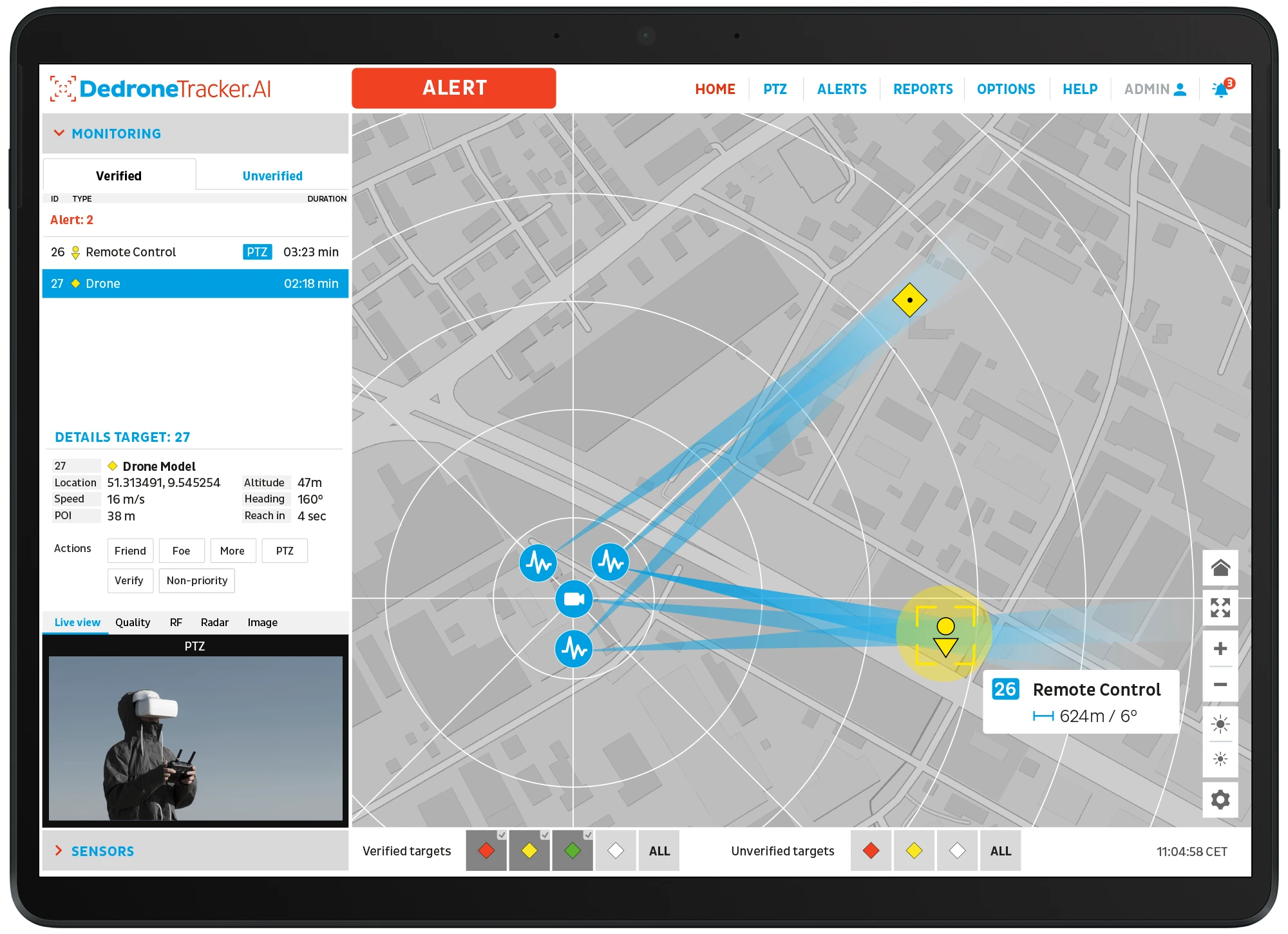
The technical center of the business is DedroneTracker.AI, command-and-control software that brings together different kinds of evidence. Radio-frequency sensors contribute information about electronic signals. Radar supplies tracks of moving objects. Cameras add imagery. The platform also supports acoustic inputs. Sensor fusion means combining these observations into a more useful account of what is flying.
The software uses behavior, imagery and flight data to classify targets and prioritize risk. It can track authorized drones alongside suspicious ones and, with suitable inputs, help locate a pilot. The distinction matters: security staff need a usable queue of things to investigate. A screen full of uncertain dots merely relocates the confusion indoors.
Signals02 / RADAR
Movement03 / CAMERA
Imagery
ONE AIRSPACE PICTURE
Dedrone’s advantage is this integration work. Its certified partner list includes radar and camera suppliers such as Echodyne and Axis Communications; an Axis partnership dates to 2017. Customers can assemble a system around their site instead of accepting one sensing method as the answer to every question. Software can run in the cloud or on premises, including air-gapped environments.
Security that arrives on a trailer
Permanent facilities can install DedroneFixedSite. Temporary events need something less architectural. DedroneRapidResponse, introduced in April 2022, put detection equipment on a towable trailer with a raised mast. Dedrone said the original unit could be deployed in under 30 minutes. Expeditionary kits serve government and military requirements; citywide offerings use existing detection infrastructure.
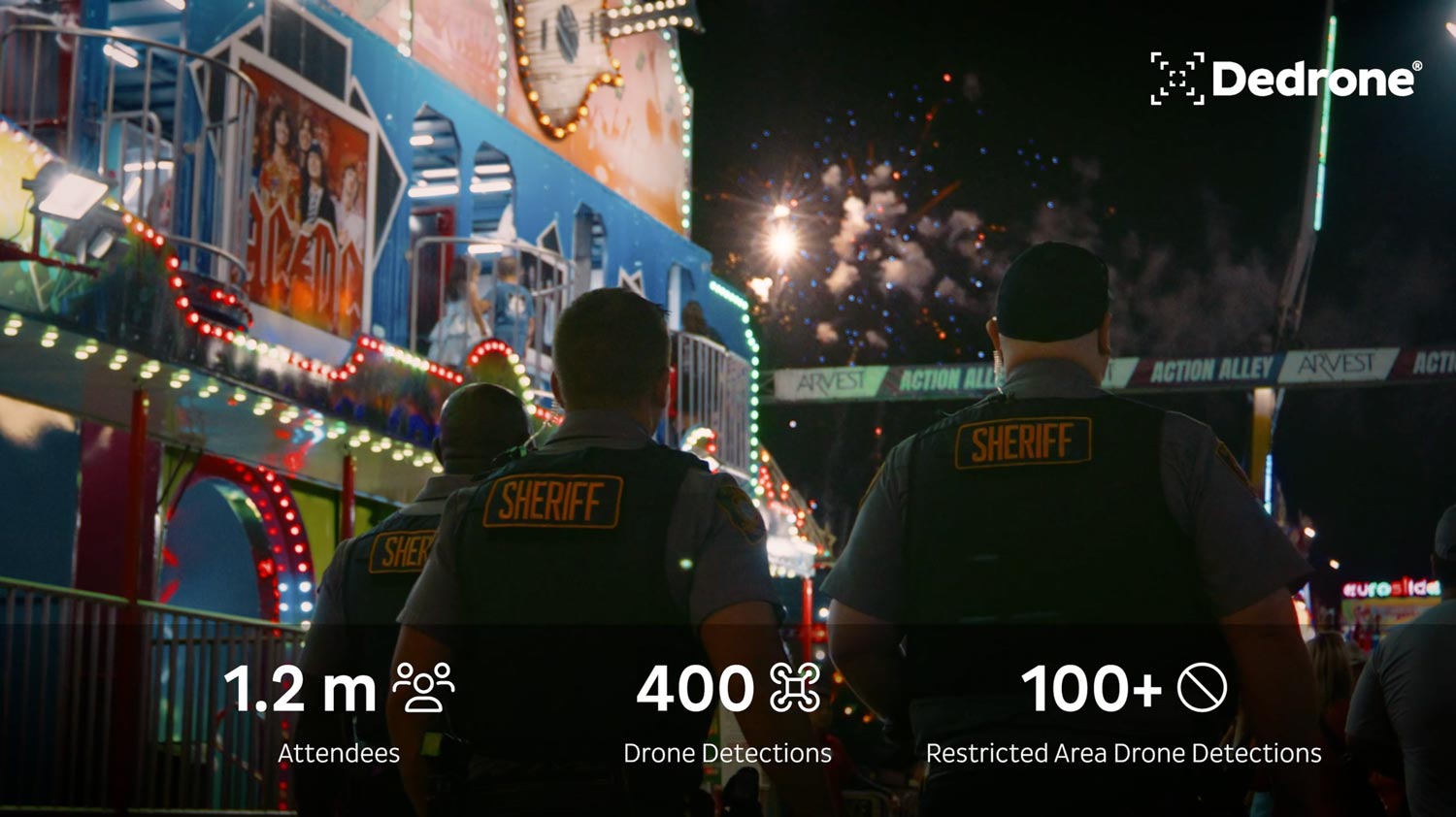
At NASCAR, the interesting detail is how early an intervention can begin. Dedrone’s customer account says supported drones can be detected when powered on, before takeoff, and their pilots located. Alerts go to both venue security and local law enforcement. The practical benefit is a conversation on the ground before an aircraft becomes a problem overhead.
The buyer who kept coming back
Axon, the public safety technology company, led Dedrone’s $30.5 million Series C in December 2021 and its $30 million Series C-1 in July 2022. Investment became ownership. Axon’s filings record the acquisition of the remaining 79.8% on October 1, 2024, for $391.1 million in incremental consideration. That figure paid for shares, rather than a fleet of customer installations.
“Our biggest competition is not having an airspace line item in security budgets.”Aaditya Devarakonda, then Dedrone CEO, speaking to Axios in 2021
There is a business model inside that complaint. Dedrone sells an institutional capability: software, sensing equipment and an integrated deployment matched to a threat. Purchases depend on configuration and requirements. Its market is crowded; Axon’s annual report names alternatives including Anduril, DroneShield, D-Fend and Fortem. Dedrone’s pitch rests on coordinating technologies, with Axon providing a broader public safety environment.
The useful drone needs a lookout
Then comes the reversal. If you can observe airspace to identify unwelcome drones, you can also help useful drones operate within it. DedroneBeyond, announced in October 2023, applies detection and sensor fusion to drone-as-first-responder programs. The operational problem is avoiding other aircraft when the remote pilot cannot keep the drone in sight.
Campbell Police Department’s earlier arrangement relied on human visual observers on rooftops and daytime-only permissions. Its DedroneBeyond deployment combines MatrixSpace radar, a 360-degree camera array, ADS-B and a pan-tilt-zoom camera. The customer account describes an FAA waiver supporting round-the-clock operations without those observers. Technology changed the arrangement; aviation authorization made the operating model possible.
Average response time reported in Dedrone’s Oakland County DFR case study, which describes a 20-square-mile operating area.
Oakland County’s account reports drones responding to more than 65% of emergency calls within its DFR zones. That does not prove every agency will get the same result. It does show what the company is selling beyond detection: information arriving early enough to influence a decision.
Measure the sky before buying the cure
The lesson readers can copy is Newcastle’s sequence: establish what flies nearby, understand the pattern, then assign a response. Ask which sensors cover the site and who receives the alert. Detection cannot itself confer authority to disable an aircraft. Nor does buying a detect-and-avoid system automatically authorize flights beyond visual line of sight.
For the 2026 World Cup, Axon described Dedrone C2, live-view sharing and an Advanced Trailer linking sensors and response workflows across all 11 U.S. tournament stadiums and more than 50 additional sites. The ambition has become coordination across an entire event. A fence still has its uses. Dedrone supplies the missing instructions for looking above it.