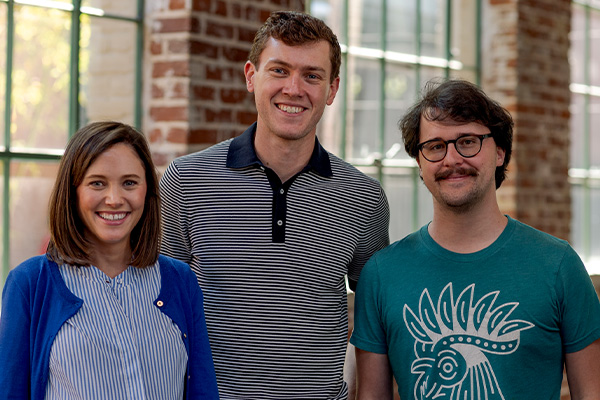
The first Flock Safety camera was an Android phone in a waterproof box. It was 2017, and Garrett Langley’s Atlanta neighborhood had endured a run of car break-ins. Police lacked useful evidence. Langley called two Georgia Tech friends, Matt Feury and Paige Todd, and the trio aimed their prototype at the ordinary clue most thieves could not hide: the car carrying them away. Two neighborhoods bought it immediately. The device was inelegant. The problem was painfully clear.
That scrappy box explains nearly everything Flock did right. The founders did not begin with a grand theory of artificial intelligence or a pitch to replace police work. They started with one missing fact after a property crime, built the smallest machine that could capture it, and took responsibility for the tedious parts. Today’s Flock license-plate readers can run on solar power, transmit over LTE and send images to cloud software. No trench for cable. No server closet. No local IT project that spends six months dying in committee.
The wedge
They sold the absence of infrastructure
Legacy license-plate recognition was often a custom infrastructure job. Flock turned it into something closer to a software subscription with a pole attached. The annual fee bundles the device, connectivity, storage, installation, maintenance and updates. That is the important difference from a cheaper camera on a procurement spreadsheet: Flock sells the removal of chores.
Public price schedules show why “what did it cost?” has no one-number answer. A standard license-plate reader has appeared around $3,000 to $5,000 a year, while long-range hardware can list near $10,000. Advanced search and platform features add software fees. A complete drone-as-first-responder package has appeared around $392,000 before cooperative-purchasing discounts. Big-city agreements can climb into eight figures because they mix hundreds of sensors, software seats, deployment and multiyear service.
From roadside sensor to flying response
Illustrative public schedules, not universal quotes. Contract size, add-ons, installation and negotiated discounts change the bill.Customers began as neighborhoods and homeowners associations. The circle widened to police departments, cities, schools, apartment operators, retailers and corporate-security teams. By 2026, Flock said almost 7,000 police agencies and tens of thousands of neighborhoods used its products. Reporting also placed the company with thousands of private-sector clients. Investors rewarded that reach: after rounds led or backed by firms including Matrix, Andreessen Horowitz, Tiger Global, Bedrock and Greenoaks, Flock raised $275 million in March 2025 at a $7.5 billion valuation.
Hardware was the wedge. The shared search network became the product. Governance became the debt.The Flock arc, in three lines
The stack
A plate reader grew wings and ears
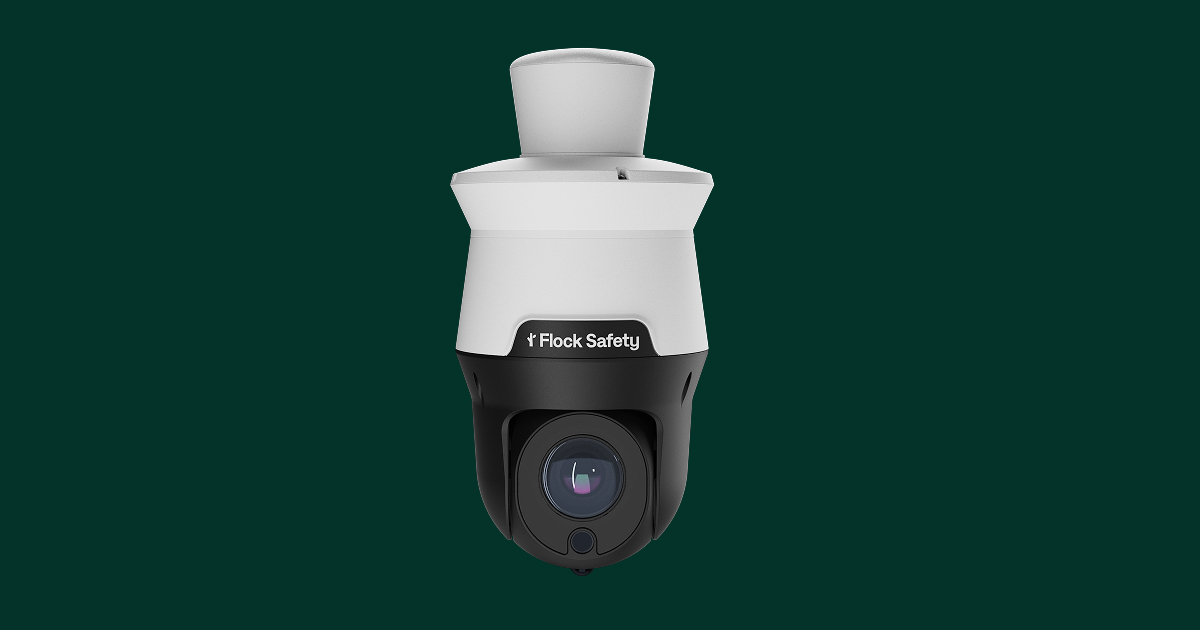
The catalog now resembles a public-safety operating system. Flock LPR identifies plates and vehicle characteristics. Fixed and pan-tilt-zoom cameras add live video. Audio sensors classify gunshots and selected events. FlockOS joins those signals with first- and third-party information for investigators and real-time crime centers. In 2024, Flock acquired Aerodome, adding docked drones and remote piloting. A 911 call, plate hit or audio alert can trigger a launch; responders can see a scene before the first patrol car arrives.
This integration differentiates Flock from point products. SoundThinking is known for gunshot detection. Rekor offers vehicle intelligence. Verkada and Avigilon sell enterprise video. Axon and Motorola Solutions are the broad platform competitors, spanning cameras, evidence and command workflows. Flock’s pitch is that its own sensors, software and network already speak the same language. The network helps a detective follow a vehicle across jurisdictions and lets a private camera contribute a lead without exporting an entire video archive.
The company says its technology supported roughly one million investigations in 2025 and contributed to an estimated 20 percent of cleared cases in customer jurisdictions. Those are company estimates derived from surveys, FBI data and internal assumptions, not a controlled national evaluation. The careful reading is still notable: agencies plainly use the system at scale, but a tool that appears in an investigation is not necessarily the tool that solved it.
The failure mode
The first thing to break was the permission model
At national scale, a fast search can be both the feature and the hazard. Police have used Flock data to locate missing people, stolen cars and suspects in violent crimes. Officers have also been accused of searching vehicles connected to spouses, ex-partners or family members. Investigations found agencies sharing data far beyond what some local officials understood. Camera misreads have contributed to wrongful stops when officers treated an alert as a conclusion instead of a lead. The camera can be correct often and still create serious harm when the human verification step disappears.
The moment that publicly changed Flock’s posture came in 2025. An Illinois audit found that Customs and Border Protection had accessed in-state plate data, where state law restricts sharing for immigration and out-of-state abortion investigations. Flock paused pilot programs with CBP and Homeland Security Investigations. Langley’s explanation was unusually direct: the company had communicated poorly and had not created distinct permissions and protocols for federal users.
Pressure continued. Communities canceled or reconsidered contracts. Douglas County, Colorado chose a nearly $23 million Axon agreement after raising trust, exposure and data-ownership concerns; Flock disputed the county’s account. In 2026, reporting documented dozens of alleged cases of officer misuse, while critics argued that audit tools had not been independently evaluated. This was not a sensor-accuracy problem that another model-training run could tidy up. It was a governance failure moving at software speed.
Flock responded by recommending a seven-day default retention period instead of 30 days, with an Evidence Mode for preserving data tied to active investigations. It announced mandatory case codes, required multi-factor authentication, stronger offense filters, proactive lockouts and compulsory Audit Assistance designed to flag abnormal use. Customers received more control over which outside offenses could justify a search. The company also engaged cybersecurity firm Bishop Fox and opened a coordinated vulnerability disclosure program.
These changes matter, but settings are not legitimacy. A dropdown reason can document a search without proving the reason is true. An alert about odd behavior helps only if an empowered person reviews it. Seven days is less data than 30, unless an exception quietly becomes routine. The company’s hardest product is no longer the pole, the drone or even FlockOS. It is a credible chain of permission from resident to council to agency to individual user.
The copyable part
Own the messy work - and the externality
Builders can copy Flock’s original playbook without copying its market. Start with a high-frequency pain that produces one valuable missing fact. Prototype with ordinary components. Sell before the object looks finished. Bundle installation, connectivity and upkeep so the customer buys an outcome rather than an integration project. Once the device works, connect nodes so each installation increases the usefulness of the rest. Finally, expand into adjacent moments in the workflow - detection, response, resolution - where the same data can reduce delay.
The amendment is just as important: design abuse cases when designing the happy path. Decide who can search, what justification is required, how long information lasts, who can share it and how an outsider can audit those decisions. If the product’s value compounds through pooled data, its potential harm compounds the same way. Governance cannot remain a terms-of-service chore until a newspaper discovers the edge cases.
Where the model can work
- A defined investigative need and lawful authority
- Reliable connectivity and useful placement
- Hit verification before enforcement
- Narrow sharing rules and short retention
- Independent oversight with real consequences
Where it comes apart
- Vague “public safety” goals
- Alerts treated as proof
- National sharing by default
- No staff assigned to audit access
- No public consent, exit terms or durable budget
That last list answers when Flock would not work. A town without clear rules, trained reviewers, community consent or the staff to investigate misuse is not ready for a networked surveillance system, however simple the installation. Nor is an organization that needs a one-time camera purchase rather than a recurring service, or a remote site without adequate solar exposure and cellular coverage. Flock’s convenience removes technical friction; it does not remove legal, financial or civic friction.
Flock’s market position is now larger than “license-plate camera company” and more politically fragile than “security SaaS.” It sits where smart-city infrastructure, enterprise security, police evidence, AI search and autonomous aviation converge. Drones have become one of its fastest-growing businesses. Its Georgia factory, a $10 million investment spanning 97,000 square feet, assembles solar components, supports drone production and refurbishes devices - tangible evidence that this cloud platform has learned to manufacture its own future.
The waterproof Android box solved a clean question: which vehicle left? The $7.5 billion company faces a harder one: who gets to ask? Flock’s next chapter will be judged less by how many cameras it can connect than by whether communities believe the connections are constrained. The company built its fortune by making public-safety intelligence easy. Now it has to make restraint just as operational.