The little aircraft can get into the building. The harder question is what happens once it is inside. Can it see in the dark? Can somebody talk through it? If it lands upside down, does the mission end? These are the questions that make BRINC Drones interesting. Its machines are designed for emergencies in which a beautiful aerial photograph would be beside the point.
- Go first: indoor drones put cameras and microphones into dangerous rooms.
- Arrive early: rooftop systems send aircraft toward 911 calls.
- Keep working: software, training and replacements make the aircraft part of a service.
01 / A room before a skyline
BRINC traces its public safety mission to the 2017 Las Vegas mass shooting. Founder Blake Resnick subsequently joined dozens of callouts with the city’s SWAT team while developing an indoor drone. That detail matters. An early prototype was knocked down during a SWAT demonstration, exposing the need to recover after an impact. A police call supplies a different design brief from a consumer electronics showroom: walls, darkness, confusion, people who may not want a robot nearby.
The resulting product family reflects that education. Lemur 2, introduced in 2023, uses LiDAR to hold position without GPS and generate floor plans as it moves. It has visual and thermal cameras, two-way audio and a glass-breaking attachment. Turtle mode flips an overturned aircraft upright. Even recovery from an undignified landing has become a feature someone can buy.
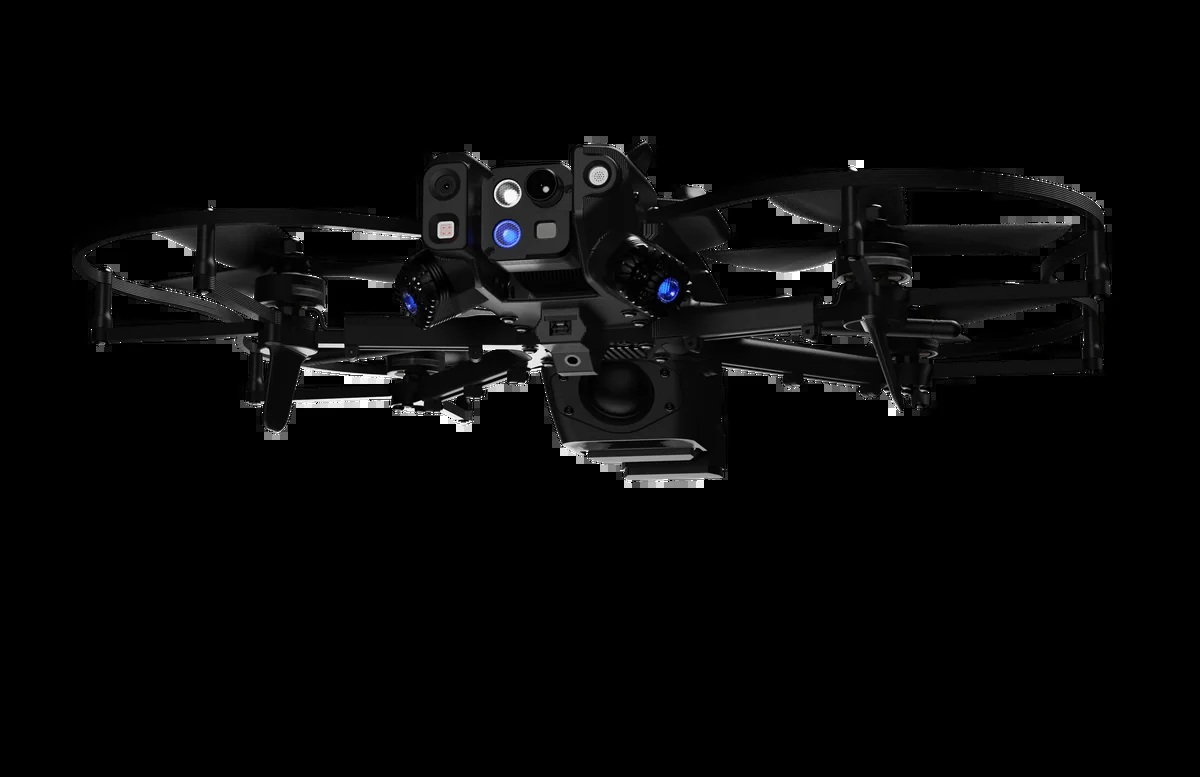
Communication is central to the proposition. An operator can call the drone and speak through it. BRINC also sells the Ball, a throwable cellular communication device. Sometimes the useful robot is the one without propellers. The job is establishing contact while keeping distance between people in a dangerous encounter.
02 / The speaker nobody expected to love
The company’s May 2026 account of Schenectady’s program contains a revealing admission. Sergeant Peter Montalto initially gave the onboard speaker little attention. Using it changed his assessment: officers could communicate before a close encounter. An apparently secondary component had become a practical part of the operation.
“It’s a lot more useful than you’d expect”Sergeant Peter Montalto, on the onboard speaker, in BRINC’s Schenectady account
That account reported 1,437 flights and 835 arrivals before ground responders, roughly 58%. These are figures published by the vendor about one department, rather than proof of what every city will achieve. Still, they point toward an appealing use of aerial information: letting dispatchers and officers understand a call earlier, sometimes without sending a cruiser.
835 of 1,437 flights arrived before ground responders.
BRINC’s account of Schenectady’s program. Results depend on deployment.
03 / The roof becomes part of dispatch
With Responder, introduced in 2024, BRINC moved its idea outdoors. Aircraft stationed around a city could launch toward emergency calls, stream video and carry useful supplies. LiveOps, its browser-based operations platform, connects remote piloting and live views with the information used to manage an incident.
Guardian, unveiled in March 2026, extends that approach. BRINC advertises up to 62 minutes of flight time, a 60 mph top speed and satellite connectivity. Those are published specifications, with real endurance dependent on conditions. The accompanying station automatically exchanges batteries and loads mission-specific payloads, including defibrillators and flotation equipment.
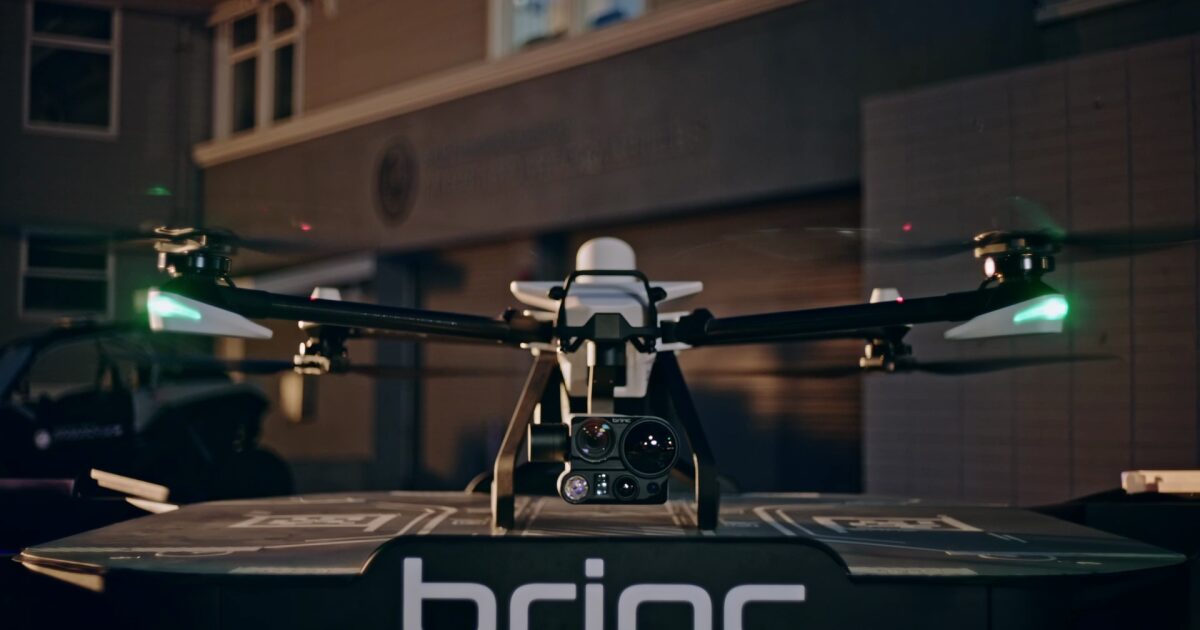
The station deserves attention because charging time is time without an aircraft available. BRINC is trying to sell readiness across repeated calls. A long flight helps; a machine that can prepare for the next assignment without a rooftop visit changes the operating routine.
- 01DispatchCall location reaches operations
- 02Observe + talkVideo and audio inform response
- 03Return + resetStation prepares the next flight
04 / The invoice is for a program
This is equipment sold to institutions with budgets, procurement rules and shifts to staff. Police, fire and rescue agencies are its customers. An August 2026 company announcement put adoption above 1,000 public safety agencies. Its July financing announcement named the Los Angeles Fire Department and St. Louis Police Department among customers.
The costs require the same institutional perspective. In February 2025, Newport Beach’s council agenda considered a $2.1 million, five-year agreement with BRINC. That figure describes a proposed program agreement. Dividing it by a drone count would produce a misleading aircraft price; an agency also needs to understand the services and obligations it is purchasing.
BRINC’s Safeguard program makes that distinction tangible: hardware and software upgrades, repairs, replacements, loaners, cellular data and training are bundled into continuing support. A broken aircraft creates an operational gap. Having a replacement process already funded may matter as much to a buyer as another line on the specification sheet.
05 / Selling into the radio network
BRINC competes with Skydio and Flock Safety for public safety drone spending, alongside DJI where purchasing rules permit it. Its position combines indoor tactical hardware, outdoor response systems and a dedicated service offering. U.S. manufacturing is another part of the pitch. Research, development and production are co-located, keeping product design close to the factory.
Motorola Solutions adds distribution and connections to the systems agencies already use. It participated in BRINC’s April 2025 $75 million financing, then led the $125 million round announced in July 2026. The relationship puts radios, dispatch workflows and drone operations in the same commercial conversation. A June partnership connected BRINC imagery with Nova’s mapping software. In August, BRINC added NOAA-based wildfire and smoke layers to LiveOps at no additional cost, bringing more incident information onto the operator’s existing screen.

06 / The battery gets the last word
There are limits to the rooftop promise. In Schenectady, Montalto identified battery endurance as a frustrating constraint during pursuits. More launch locations could reduce transit time. The inference is straightforward: advertised flight duration alone cannot describe useful time at an incident.
Coverage also depends on trained operators, communications, suitable weather and flight permissions. A payload still needs somebody able to use it. BRINC’s stated commitment against building technology designed to hurt or kill does not settle an agency’s decisions about surveillance, access or retention. Communities need understandable operating rules alongside the hardware.
The lesson other builders can copy is concrete: join the customer’s work, notice the overlooked component, and include the repair. For agencies, measure arrival times and actual decisions changed. BRINC’s most persuasive promise is a modest one with large consequences: a little more information before somebody has to walk through the door.