The strange thing about an ambulance handoff is what can disappear with it: the answer. A crew treats someone, delivers them to a hospital and returns to service. The diagnosis, the lab result, the eventual outcome may stay behind another organization’s login. How do you improve a decision when you never get to see its ending?
- ESO connects dispatch, EMS, fire and hospital data.
- Its Health Data Exchange sends patient outcomes back to crews.
- The payoff depends on integration, training and people using the feedback.
The answer used to take months
In Utah, that delay had a recognizable shape. Unified Fire Authority’s Ben Porter said crews could wait weeks or months to learn a patient’s final diagnosis. CommonSpirit Health’s exchange with ESO launched in July 2025, linking five hospitals with regional responders. The change, as Porter described it, was wonderfully concrete:
“Now we receive that feedback in a matter of hours.”
Ben Porter · Unified Fire Authority
ESO sells the software behind that return trip. Founded in 2004, with Chris Dillie as a co-founder, the company makes records, reporting and operational tools for organizations that meet the same emergency at different points. Its mission is improving community health and safety through data. The useful test is whether that data gets back to someone who can act on it.
A chart that can make the return trip
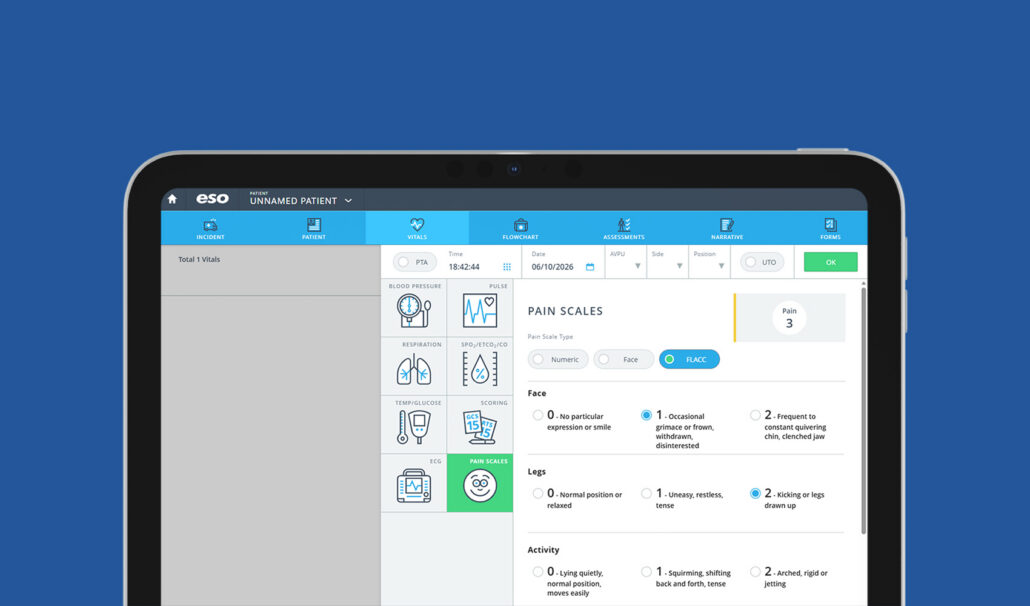
Start with ESO Electronic Health Record. Here, EHR means the patient care record used by emergency medical services. Crews document assessments and treatment; managers use the resulting records for quality review and reporting. Health Data Exchange, or HDE, connects those prehospital details with hospital systems and returns clinical information to EMS. The product is built around a conversation that crosses organizational boundaries.
Consider University Hospitals in northern Ohio. By October 2026, its HDE deployment linked 21 hospitals with more than 300 agencies across 16 counties. Prehospital records connect with Epic, while EMS teams can receive relevant laboratory results, imaging, vital signs and procedure notes. UH’s expanded arrangement adds ESO Prehospital Intelligence, including outcome summaries and prearrival planning indicators.
The distinction matters for buyers. ESO occupies the junction between public safety operations and hospital information systems. Hospital customers can connect their existing records. Fire departments get incident reporting and operational tools; states get repositories; hospitals get trauma and other patient registries. Inventory, scheduling and billing address the less cinematic work that keeps an emergency service running.
Buying the journey, one missing piece at a time
The acquisition trail explains the ambition. ESO bought Emergency Reporting in 2021, expanding its fire records business. In July 2024 it acquired Denmark-based Logis Solutions, adding dispatch, logistics and billing. In April 2026 came d2i, a hospital performance analytics company whose platform served more than 450 hospitals. Those purchases extend ESO’s view before the ambulance arrives and after it leaves.

There is clinical experience behind the strategy. Eric Beck, who succeeded Dillie as CEO in 2023, began as a firefighter and paramedic before becoming an emergency physician. He also led hospital operations at University Hospitals. ESO’s Virginia work brings together clinical staff, technical specialists and data scientists. Understanding the chart and understanding the shift are both part of the job.
ESO also has serious alternatives. ImageTrend offers EMS records and hospital outcomes exchange through its Health Information Hub. ZOLL sells emsCharts and RescueNet products across documentation, dispatch and billing. Buyers should compare the modules and connections they need. ESO’s case rests on the breadth of its emergency workflows and linked data, with implementation doing much of the practical work.
The bill includes the boring parts
A public October 2022 quote for Davidson County EMS makes the business tangible. The package covered 29,000 incidents and included EHR, cardiac monitor and dispatch integrations, a billing interface, reporting extracts and HDE. Recurring fees totaled $43,565 annually, with $2,380 for setup and online training. The quote also warned that third-party interface charges could apply.
First-year quoted total
This is subscription software with implementation attached. ESO’s EMS FAQ describes annual renewable agreements. Its published Emergency Reporting migration guide estimated 120 days from signing to access in the new system. Discovery, configuration, testing and training occupy that interval. Private equity has helped fund expansion: Accel-KKR announced growth investment in 2017, and Vista announced a strategic investment in 2021.
Existing customers face change too. ESO says Emergency Reporting will not be upgraded for NERIS, the newer fire reporting system; agencies need a transition plan. It offers historical record migration, and says NERIS compliance adds no extra charge for ESO Fire Incidents reporting. Preserving records and teaching a new workflow still require attention from the department.
Give the result back to the person who acted
Some improvements begin with less typing. ESO’s optional Auto-Generated Narrative feature drafts clinical narratives from patient-record data. In June 2025, the company reported 35,700 hours saved during its first month of availability. That is a vendor-reported estimate. Clinicians must review and approve drafts, keeping responsibility with the person documenting the care.
The broader lesson is portable: choose a recurring decision, find where its outcome becomes visible, and return that information to the decision-maker. Then make time to review it. ESO’s Data Collaborative supported 12 research abstracts announced in October 2026, showing another use for records that would otherwise sit inside individual encounters.
The limits follow the same logic. A disconnected receiving hospital, poor patient matching or incomplete documentation weakens the feedback. A prediction still needs local scrutiny. Software cannot make a department hold a useful case review. But when the connections work, the next ambulance crew can set out with something its predecessors lacked: evidence about what happened last time.