The ambulance has delivered its patient. Somewhere, a chart still needs finishing. At New Jersey’s JFK EMS, paper notes and improvised capture methods had become an obstacle to the work they were supposed to record. Details arrived unevenly. Quality reviewers inherited gaps. Clinicians carried unfinished documentation into their own time. ZOLL Data’s account of the agency’s switch to mobile charting offers a striking result: an 85% reduction in charting time.
- The job: connect ambulance dispatch, patient charts, hospital data and billing.
- The distinction: EMS software backed by a medical-device company, with links into clinical case review.
- The lesson: capture information where the work happens, then let it travel.
It is a company-reported customer result, not a forecast for every ambulance service. But it poses a useful question. How much of a professional’s working day is spent doing the job, and how much is spent reconstructing evidence that the job was done?
ZOLL Data Systems makes software for that second category. Its customers include ground and air ambulance operators, fire-based EMS, hospitals and healthcare finance teams. A dispatcher needs a usable map. A medic needs a complete record. A hospital needs the history before arrival. A biller needs enough accurate information to submit a claim. ZOLL’s commercial proposition is to connect those needs before someone has to start copying.
01 The chart that follows the stretcher
The company’s electronic patient care reporting product, ZOLL emsCharts, gives agencies configurable documentation, reporting and integrations. Its mobile companion, emsCharts NOW, supports iOS and Android and allows field capture without an active internet connection. The record can upload when connectivity returns. In an industry whose workplace moves, that is a practical accommodation.
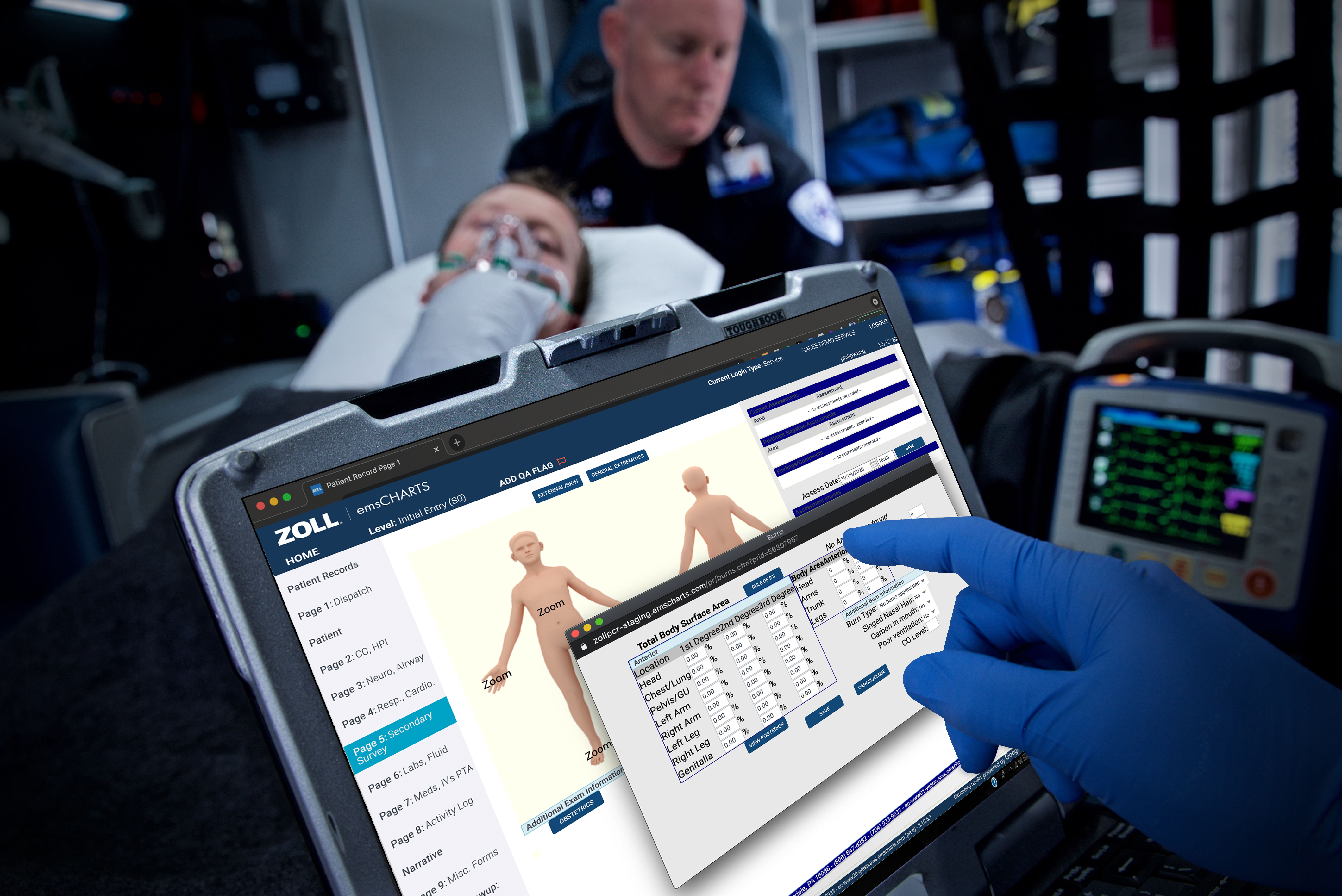
At JFK, the change put documentation closer to the encounter. According to ZOLL’s March 2026 account, adoption varied across clinicians; peer influence, training and successful internal examples helped it spread. That qualification makes the result more instructive. Installing an application and persuading tired people to change a familiar habit are separate jobs.
Relative index, not minutes. After = 100 minus the reported 85% reduction. One agency’s reported experience.
The mechanism is worth copying even without copying the software: identify where people first acquire information, make secure capture convenient there, and watch what happens to downstream rework. A beautiful form that nobody uses until the end of a shift can preserve the very delay it was purchased to remove.
02 The office that disappeared
A different ZOLL customer discovered the value of changing location by accident. In a February 2023 account, Thorne Ambulance founder Ryan Thorne described five dispatchers testing positive for COVID on the same day. The communications center suddenly had nobody to staff it. The agency used the cloud capabilities of ZOLL Dispatch to move the work into home offices.
Phones were forwarded. Management monitored the system. Crews kept receiving assignments. Thorne recalled that “One crew even offered to bring us coffee” because they had not realized the dispatchers had left the building. Few software testimonials have such an agreeable smell.
“One crew even offered to bring us coffee”Ryan D. Thorne / Thorne Ambulance Service
The agency then ran a 30-day trial and, Thorne reported, moved to entirely remote dispatch within 60 days. It also eliminated an office suite, saving $20,000 annually in leasing costs. Those are reported rent savings, not the price of ZOLL’s software or a complete accounting of the transition.
The less glamorous details deserve equal attention. Thorne described IT oversight of home workspaces, call-forwarding redundancy and a backup plan for coastal dispatchers facing hurricanes. A reader can copy the trial, the supervision and the fallback staffing. A remote arrangement without secure workspaces or reliable coverage would miss the conditions that made this account useful.
03 Four jobs, one travelling record
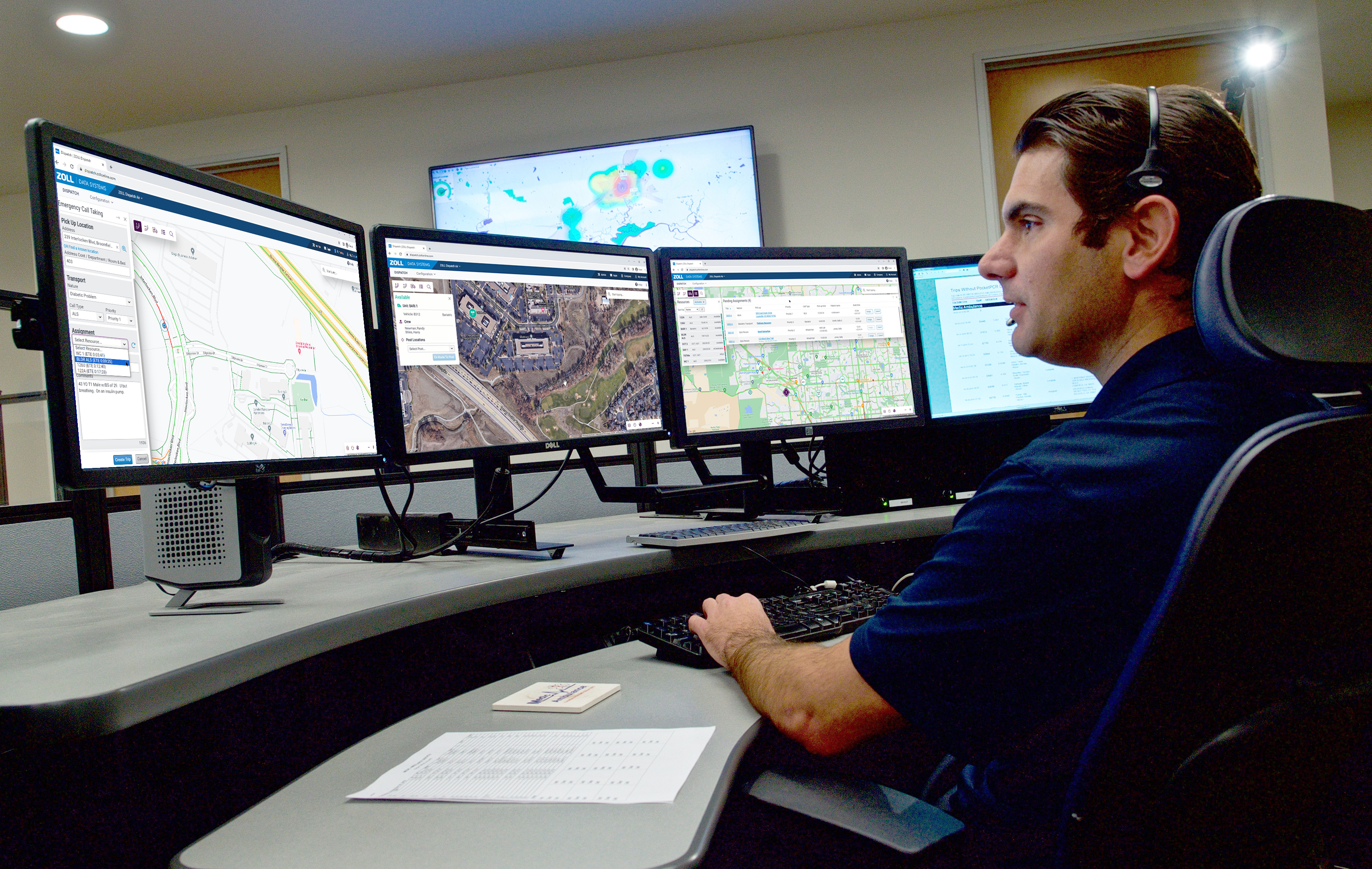
ZOLL Dispatch handles call taking and computer-aided dispatch, with map-based fleet visibility and resource ranking that considers proximity, traffic and road closures. Respond is its mobile companion for field crews. Mobile Care Connect is an optional module for requesting and managing non-emergency, inter-facility transport. Emergency response and scheduled transport share an operational problem: matching the right available resource to the request.
- DispatchAssign the resource
- ChartRecord the encounter
- ExchangeShare with the hospital
- BillPrepare the claim
Connected products support this journey. Exact connections depend on the systems and configuration an agency uses.
Care Exchange extends the record into the hospital. It standardizes and interfaces EMS reports into electronic medical records, and can return patient outcomes and demographic information to EMS. ZOLL lists HL7, CCD and FHIR among supported standards. The point is access: a receiving team should be able to see what happened before the patient crossed its threshold.
ZOLL Billing handles the financial workflow: pre-billing, claims processing, Medicare coding and embedded revenue-cycle tools. The company also sells consulting, reporting and data-access services. These are related purchases because a record that helps a clinician can also help a quality reviewer and a billing specialist - provided its information is complete and reaches them.
04 A bill is also a data problem
AR Boost takes ZOLL beyond agencies buying an entire EMS suite. Its customers can use revenue-cycle tools through APIs or batch requests inside existing healthcare platforms. The functions include demographic verification, insurance discovery, eligibility checks, third-party liability discovery, deductible monitoring and claim status.
The distinction between discovery and verification matters. Verification checks coverage information already in hand. Discovery looks for coverage that may have been missed. A presumed self-pay account may therefore represent incomplete information about who should pay. Correcting that information can change the route of the claim.
ZOLL describes AR Boost as a way to find, correct and verify patient and payer information before billing. Its API distribution lets other software providers incorporate those functions. The business model combines enterprise cloud software with data services and integration relationships; a customer can buy a connected workflow or add a particular capability to an existing one.
For procurement, the useful arithmetic includes migration, interfaces, training, support and staff time alongside the contracted price. Thorne’s rent saving belongs on that ledger, but does not settle it. A buyer should measure the local bottleneck first: chart completion, claim rework, unanswered calls or time spent looking for missing information.
05 The advantage is in the connections
ZOLL Data is a division of ZOLL Medical Corporation, part of the Asahi Kasei Group. Its software lineage includes RescueNet’s 1997 launch, the 1999 acquisition of Pinpoint Technologies and the 2019 acquisition of Golden Hour Data Systems. The portfolio has accumulated around EMS work rather than arriving as a single new application.
The medical-device relationship gives that history a practical expression. emsCharts can import device data, while RescueNet CaseReview Link gives quality reviewers access to associated clinical case files from the patient record. Reviewing the chart alongside device evidence is a more concrete proposition than merely promising another dashboard.
There is competition. ImageTrend Elite offers ePCR and reporting capabilities; Traumasoft markets connected CAD, ePCR, billing and crew management. Integration is a contested selling point. ZOLL’s case rests on its particular combination of EMS workflow, device links and healthcare financial data, and on whether those connections fit a buyer’s installed systems.
It also connects outside its own products. In March 2025, ZOLL and Pulsara described new integration functionality for importing patient data and images into emsCharts. Reducing duplicate documentation is the stated purpose. The company says many employees have worked as medics, dispatchers, firefighters or billing professionals. Its training programs and customer community recognize the other half of implementation: people have to learn how the connections work.
06 Following the money a little further
In June 2026, ZOLL announced Claims Clarity, a service using de-identified claims data to examine charges, payments, denials and payer behavior by region and specialty. The customer question expands from how to process a claim to how a reimbursement compares with the market.
That move makes sense beside the rest of the business. Dispatch decides where the ambulance goes. Documentation records what happened. Billing translates the encounter into a request for payment. Market intelligence adds context to what comes back. Across these jobs, ZOLL Data sells a way to make information available to the next person who needs it.
For an agency evaluating the company, the most revealing demonstration would follow one encounter all the way through. Ask a dispatcher, a medic, a quality reviewer and a biller to participate. Watch where someone retypes, searches or waits. The ambulance has already completed its journey. Its record deserves a route of its own.