A detective deleted the email. That is the small, rather unglamorous incident behind BLTN, the law-enforcement software built by Multitude Insights. In Matt White’s account, published in sponsored Police1 coverage, a BOLO - “be on the lookout” - arrived while he was sitting with a detective in a Boston suburb. The detective sent it to the trash. He received roughly 500 a month. White asked for another look. The detective recognized the person pictured.
The ensuing conversations connected the suspect to burglaries across agencies. The arresting detail in this story is the wastebasket. Useful information had reached its destination and still nearly vanished. Email had done its job. Human attention had run out.
- BLTN makes police bulletins editable, searchable and shareable across agencies.
- SmartLink suggests connections; investigators verify them.
- A published pilot FAQ quoted agency plans from $5,000 a year.
A bulletin that remembers
BLTN, pronounced “bulletin,” starts with a document officers already understand. A missing-person notice, suspect description or request for identification becomes a post in a shared workspace. Users can attach photos, video and audio, update the information and decide who receives it. Search and maps give the material a life beyond the moment it lands in a feed.
The familiar bulletin matters. Asking an officer to invent a new habit is expensive in time and patience. Making an existing habit less laborious offers a more plausible entrance. A PDF can travel widely, but each copy carries yesterday’s state of knowledge. A live bulletin can change as the investigation changes.
“Before Multitude, our most advanced collaboration tool was email.”
Det. Sgt. Swift · Boston-area detective · company testimonial
The product also takes distribution seriously. Its feed is designed around an officer’s role and region, rather than the magnificently indiscriminate logic of a large mailing list. A robbery detective and a patrol officer need different things. The company’s insight is that intelligence has an audience, and sending everything to everyone can make everyone stop reading.
The analyst still has work to do
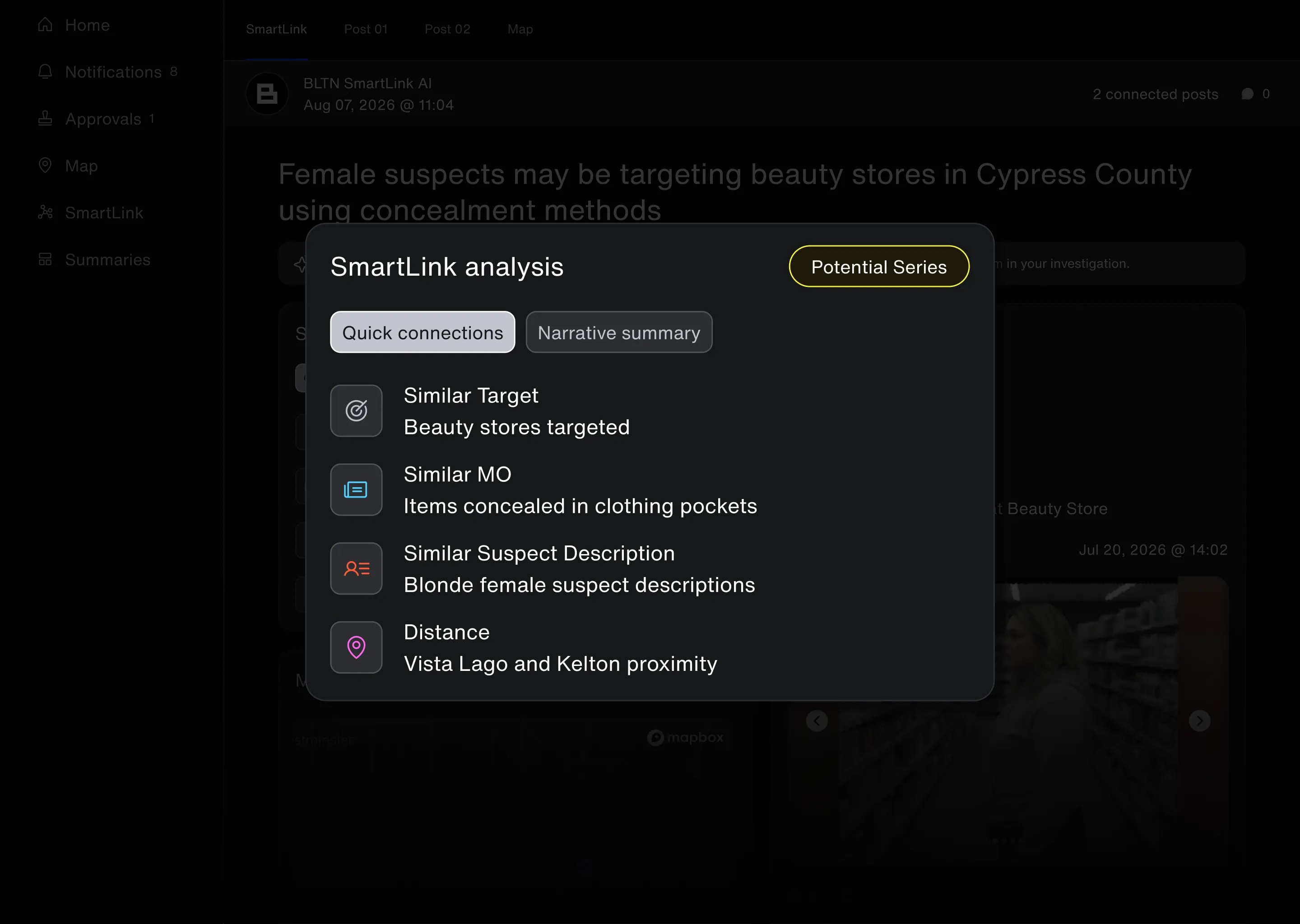
SmartLink is the analysis layer. It examines material already in BLTN and suggests related cases, recurring methods and other overlaps. That sounds abstract until a case study supplies the sequence. In the company’s Anne Arundel County account, officers in separate Maryland districts posted notices concerning retail theft and counterfeit bills. Clothing and physical descriptions helped link the posts. The company explicitly says this connection did not use facial recognition.
An analyst then checked nearby license-plate-reader data, obtained a vehicle tag, found a name and searched BLTN. Three Florida bulletins appeared. The machine-assisted connection was one step; an analyst’s work produced the next. Calling the whole sequence an AI discovery would give the software somebody else’s credit.
- 01Two Maryland
bulletins - 02SmartLink
suggests a link - 03Analyst checks
vehicle data - 04Name search finds
Florida bulletins
Sequence from the company’s Anne Arundel case study. A suggested link requires verification.
One contributing Florida agency was not itself onboarded. Its bulletin had reached Tampa Bay Regional Information Center, whose analyst uploaded it. This is a revealing wrinkle: a network’s reach depends on people putting information into it. The diagram may show lines between agencies. Someone still has to make the material available.
Seattle’s privacy assessment describes the boundary plainly. Detectives must independently validate proposed connections through standard investigative measures. It also says the documented deployment excludes facial recognition and other biometric analysis. BLTN can direct attention toward a lead. The evidentiary work remains with the investigator.
Boston asked for fewer handoffs
The company’s origins combine intelligence experience with legal experience. White, a Navy veteran, and co-founder Akihiko Izu, a former M&A attorney, both studied at MIT Sloan. MIT’s 2022 Demo Day book already showed BLTN in a live beta. The present team reports more than 115 combined years of military and law-enforcement service.
Experience is useful when it identifies where the work gets stuck. Boston Police Department was using Mark43 for casework and BLTN for distributing intelligence. It asked whether the two could work together. That request became the basis for an integration that reduces repeated entry when case information becomes a regional bulletin.
Mark43 remains the records platform; BLTN carries selected intelligence between agencies. The distinction gives Multitude a specific place in a crowded public-safety market. It can work alongside an incumbent rather than require a department to replace the system holding its records. The customer keeps control over what is shared.

A network with an annual bill
The business sells subscriptions to agencies. A CCAA pilot FAQ published in 2025 put enterprise plans at $5,000 a year and up, scaled by sworn-officer count. That historical entry price is a useful reference, not a current quote for every department. Implementation, permissions and integration needs belong in the purchasing conversation.
The company reports more than 60 agencies across 14 states, including Boston Police, New Jersey Transit Police and San Diego County Sheriff. In February 2026 it announced a $10 million Series A led by Primary Venture Partners. The announcement also identified offices in Boston and Portland, Oregon. Capital buys room to expand; it does not by itself establish better investigative outcomes.
Start with the sergeant
June 2026 brought Summaries: selected bulletins gathered into a briefing for a shift, case team or command staff. The software drafts a headline and summary; a user edits, chooses recipients and sends. Recurring briefings and permission checks address the practical chores that sit between having intelligence and getting anyone to read it.
There is a copyable lesson here for organizations far beyond policing. Keep a familiar unit of work. Make it searchable. Reduce repeated entry. Ask the person handling the information where the friction lives. A shared network helps only when relevant material enters it, permissions allow the useful handoff and people maintain its accuracy.
White’s purchasing advice in the Mark43 interview includes checking data ownership, export formats and what happens when an agency leaves a vendor. Sensible questions, particularly from someone selling a network. The bulletin that almost went unread explains the ambition. Getting information delivered is easy; getting it noticed, checked and used is the business.