The first thing Track Group sells is a black box strapped to an ankle. The second thing it sells is confidence in everything that happens after the box wakes up. A GPS fix travels over a cellular network. Software compares it with a curfew, inclusion zone, exclusion zone, or another person's location. A monitoring operator reviews the alarm. An agency decides whether to call, investigate, or arrest. The hardware is merely the beginning of a very consequential relay race.
That distinction explains the Naperville, Illinois company's economics. In fiscal 2025, Track Group produced $35.2 million in revenue. Monitoring and related services supplied $32.9 million, roughly 93 percent of the total. Product sales were the side dish. The recurring service around the product was dinner.
Its customers are corrections departments, probation and parole offices, courts, sheriffs, and other public agencies. They use the system for pretrial release, community sentences, curfews, probation, parole, domestic-violence cases, and alcohol compliance. The people who experience it are a wider group: officers managing caseloads, operators watching alarm queues, people wearing devices, and survivors carrying Track Group's Empower app.
The product is a chain of custody for location
ReliAlert XC5 is the newest face of the portfolio. Its predecessor, XC4, combines LTE connectivity, anti-tamper systems, a loud siren, secondary location technology, and direct voice communication. That last feature matters. An officer or monitoring-center operator can speak through the unit instead of treating every exception as a silent dot on a map. SecureCuff, an optional hardened-steel strap, is aimed at higher-risk assignments. An RF beacon helps verify a fixed place such as a home when satellite reception is poor.
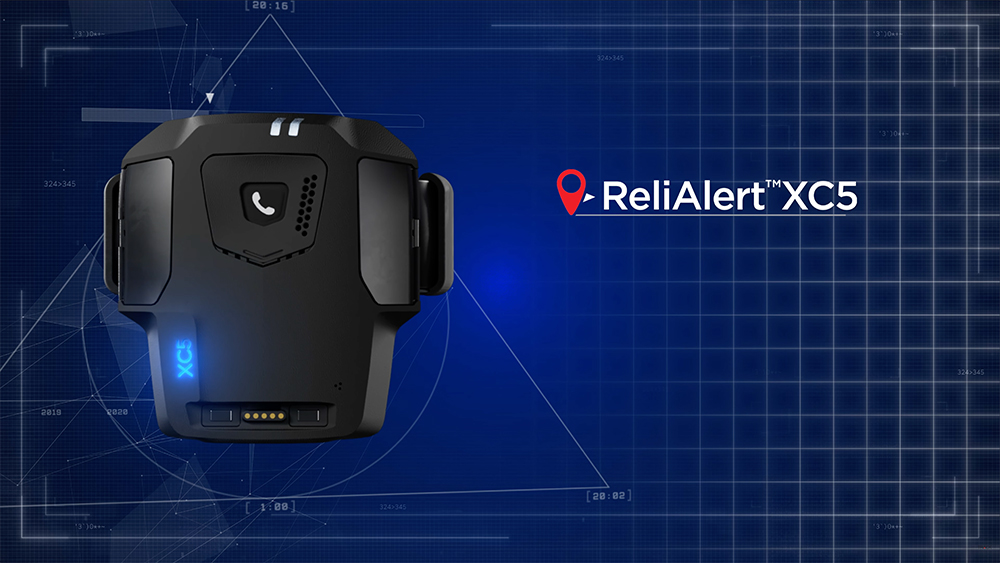
The company calls its platform device-agnostic, a useful position in a market where agencies can inherit mixed fleets and old integrations. Track Group layers case management, mapping, historical tracks, reporting, predictive analytics, and alarm workflows above the physical unit. Its bilingual monitoring staff work around the clock under protocols chosen by each customer. In practice, the sale is part hardware lease, part software subscription, part outsourced operations desk.
“An alarm is not an outcome. It is a request for judgment.”The operating reality behind electronic monitoring
Empower moves the fence with the person at risk
The most distinctive product is not worn by the monitored person. Empower creates a mobile geofence around a domestic-violence survivor's smartphone. The app synchronizes with an assigned person's GPS device; if that person enters the configured zone, the system can warn the survivor and connect to the monitoring center or law enforcement. Track Group says the phone reports approximately once per minute and includes panic and dispatch functions.
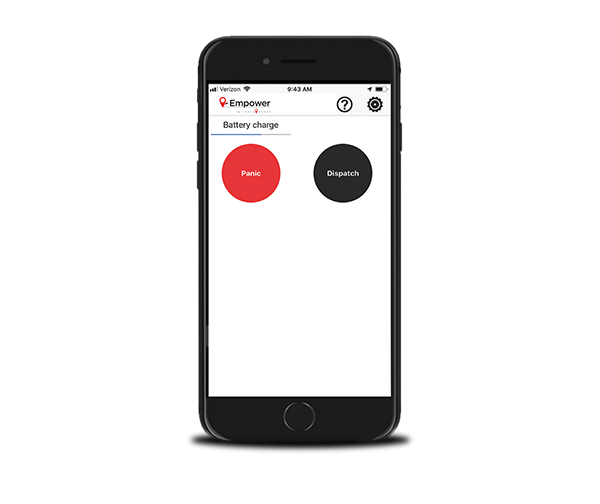
The concept fixes a weakness in traditional exclusion zones. A protected address is stationary; a person is not. Quebec's anti-approach-bracelet program offers a current field example. In a 2026 LinkedIn update, Track Group cited more than 1,600 survivors protected since 2022, full use of Empower among participating survivors, and 96 percent of warnings resolved without police intervention. Those are program claims shared by the company, not a controlled comparison. Still, they show the outcome customers want: useful distance restored before an encounter, not a better reconstruction afterward.
What fails first?
Usually, the ordinary thing: a battery is not charged, a strap is damaged, a basement blocks GPS, cellular service drops, a server slows, or an alert threshold floods the queue. Track Group's redundant location methods, voice channel, maintenance operations, and human review are responses to those mundane failures.
The harder failure is institutional. If nobody owns the alarm, if the escalation rule is vague, or if a low-quality location point is treated as certainty, technically correct data can still produce a bad decision.
Government procurement is the distribution engine
Track Group does not need millions of consumers. It needs a comparatively small number of agencies to trust it for years. Cook County captures the model in public: commissioners approved a $22,997,610 GPS-monitoring contract running from October 2024 through October 2027, with two one-year renewal options. An earlier county agreement was repeatedly expanded. In 2015, Virginia selected Track Group for a contract estimated at $11.3 million to support a program spanning more than 16,000 people.
The cost is therefore visible at the contract level but rarely reducible to a retail sticker. Agencies typically buy daily monitoring capacity, devices, connectivity, support, implementation, and reporting in a bundle. Price depends on population, service level, hardware, and who pays. This matters politically. Electronic monitoring can offer an alternative to a jail bed, but critics argue that it can also extend confinement into homes and workplaces, burden families, and turn technical errors into liberty problems. The tool does not decide whether a program is proportionate. Courts, legislatures, agencies, and their response rules do.
Track Group's competitors include BI Incorporated, Attenti, Securus Monitoring, Sentinel, SCRAM Systems, Shadowtrack, and SuperCom. They compete on price, battery life, reliability, tamper resistance, software, integrations, service, and reputation. Track Group's answer is a tightly bundled stack and a management team steeped in electronic monitoring. CEO Derek Cassell came through the 2014 acquisition of Emerge Monitoring and previously worked in correctional services at ADT, G4S, and ElmoTech. The company has 91 full-time employees, small enough that its 24-hour promise is an operating discipline rather than a slogan delegated to a giant workforce.
A pivot that kept the same primitive
Track Group's origin is stranger than its current pitch. Incorporated in 1995, its predecessor first made medical diagnostic products. It expanded into personal emergency-response systems and mobile GPS for older people in 2001, then introduced offender monitoring in 2006. It later operated as RemoteMDx and SecureAlert. Acquisitions in 2014 added Emerge Monitoring and G2 Research, a behavioral-analytics business. SecureAlert began using the Track Group trade name that year and made the legal name official in 2015.
What changed management's mind was less a eureka moment than an accumulating signal: location hardware had more value when paired with intervention, recurring service, and analytics. The company shifted from selling a thing to operating a system. Its later products widened that system. BACtrack Mobile adds photo, time, and location-verified breath tests. InTouch enables smartphone supervision. Voice biometrics checks identity over a call. Socrates 360 stretches beyond compliance into education, appointments, wellbeing, secure video, and local services for people returning to the community.

The balance sheet finally matched the reset
Fiscal 2025 was a useful contradiction. Revenue fell 5 percent, partly after Track Group sold its Chilean subsidiary and monitored fewer people for customers in Virginia and Washington, D.C. Yet operating results improved from a $1.9 million loss to $1.2 million of income. Lower monitoring-center and communications costs, reduced overhead, and a narrower organization did the work. The company still posted a $1.9 million net loss as interest and currency movements bit below the operating line.
Debt was the larger constraint. In May 2026, Track Group settled old borrowings at a substantial discount, raised about $10.3 million in a private placement, and took a new five-year $21 million term loan. The company said net debt fell by about $27 million, or 63 percent, and net leverage dropped from 7.2 to 2.6 times. Existing shareholders absorbed heavy dilution: shares outstanding rose from 11.9 million at September 2025 to 41.3 million in August 2026. A $23.5 million accounting gain on the troubled-debt restructuring then made nine-month net income look unusually large. Operating income for the same period was a more sober $1.45 million.
The first nine months of fiscal 2026 brought $27.1 million of revenue, up 4 percent, and $4.5 million of operating cash flow. Cash reached $8.4 million. Growth in Florida and Illinois helped. So did the simple fact that the capital structure was no longer demanding the same contortions from a modestly sized operating business.
What another company can copy, and what it cannot
The reusable playbook is clear. Sell the whole workflow, not a clever component. Price around ongoing use when the customer receives ongoing value. Build for boring edge cases before glossy features. Give each participant the right interface: an officer needs a caseload, an operator needs an alarm queue, a survivor needs a warning, and a supervised person needs clear instructions and a working device. Finally, use the data exhaust to improve decisions rather than merely drawing prettier tracks.
The model will not travel everywhere. It struggles where cellular and GPS coverage are weak, where agencies lack staff or crisp escalation policies, or where procurement cycles starve a small vendor. It should not be used when legal authority is shaky, due process is thin, a person cannot safely keep a device charged, or a less intrusive check would work. And it cannot turn surveillance into rehabilitation by adding an app. Socrates can offer tools; housing, employment, treatment, family support, and fair supervision still happen in the physical world.
Track Group's advantage, if it holds, is not that it knows where a person is. Satellites solved that. Its advantage is organizing the seconds after location becomes information: who sees it, who trusts it, who gets warned, and what anyone is allowed to do next. That is a smaller claim than perfect safety. It is also a much more honest description of the business.
Continue exploring