A gunshot has an odd relationship with a city. It can be loud enough to frighten a street and still leave the emergency system uninformed. Somebody must recognize it, decide to call, explain the location and wait for the machinery of response to start. SoundThinking built its original business in that interval: the space between something happening and an institution knowing.
- ShotSpotter combines acoustic sensors, software and human review to send gunfire alerts.
- SafetySmart adds investigative search, vehicle recognition, case management and weapons detection.
- Most revenue comes from subscriptions; results depend on what customers do after an alert.
- A September 2026 agreement would take SoundThinking private. The transaction remains pending.
The company now wants a larger role. A location becomes an investigative lead; a lead connects to a vehicle; a vehicle connects to records. Its SafetySmart portfolio follows those handoffs. The interesting question is how much useful work survives the journey. A map pin is wonderfully decisive. A criminal investigation is less obliging.
The customer was buying a job
The origin belongs to physicist Robert Showen. Working with sound-wave principles used to locate earthquakes, he saw a way to locate gunfire. The company dates its founding to 1996, with engineers Robert Calhoun and Jason Dunham helping turn the idea into a system. Its history lists Showen and Dunham as founders.
The commercial breakthrough came later. When Ralph Clark became CEO in 2010, customers were purchasing hardware and doing the reviewing themselves. Clark shifted the offer toward subscriptions, brought acoustic review into a centralized operation and added customer-success support. The purchase became easier to budget; the service took more work off a department’s desk.
That change contains a lesson for any specialist technology business. A customer may admire the invention while declining the chores attached to it. Equipment needs installation, sounds need interpretation and an unfamiliar alert needs a response procedure. Making those chores part of the service changes the thing being sold. The buyer can ask how the operation fits into a shift rather than how to become an acoustics department.

The minute with a person inside it
ShotSpotter’s basic sequence is straightforward. Distributed sensors capture impulsive sounds. Differences in arrival times help locate the event. Software classifies the sound, and acoustic reviewers assess potential gunfire before a notification reaches the customer. SoundThinking advertises an end-to-end alert time of less than 60 seconds within covered outdoor areas.
- 01ListenAcoustic sensors capture an impulse
- 02LocateTiming differences indicate a location
- 03ReviewSoftware and trained people assess it
- 04AlertThe agency receives incident details
The person in that sequence matters. An algorithm does not simply summon a patrol car without an intervening judgment. Human review is a feature of the service and a consequential interpretive step. SoundThinking says it adds consistency and accuracy. An Associated Press examination of review procedures in 2023 highlighted employees’ discretion to reverse machine classifications.
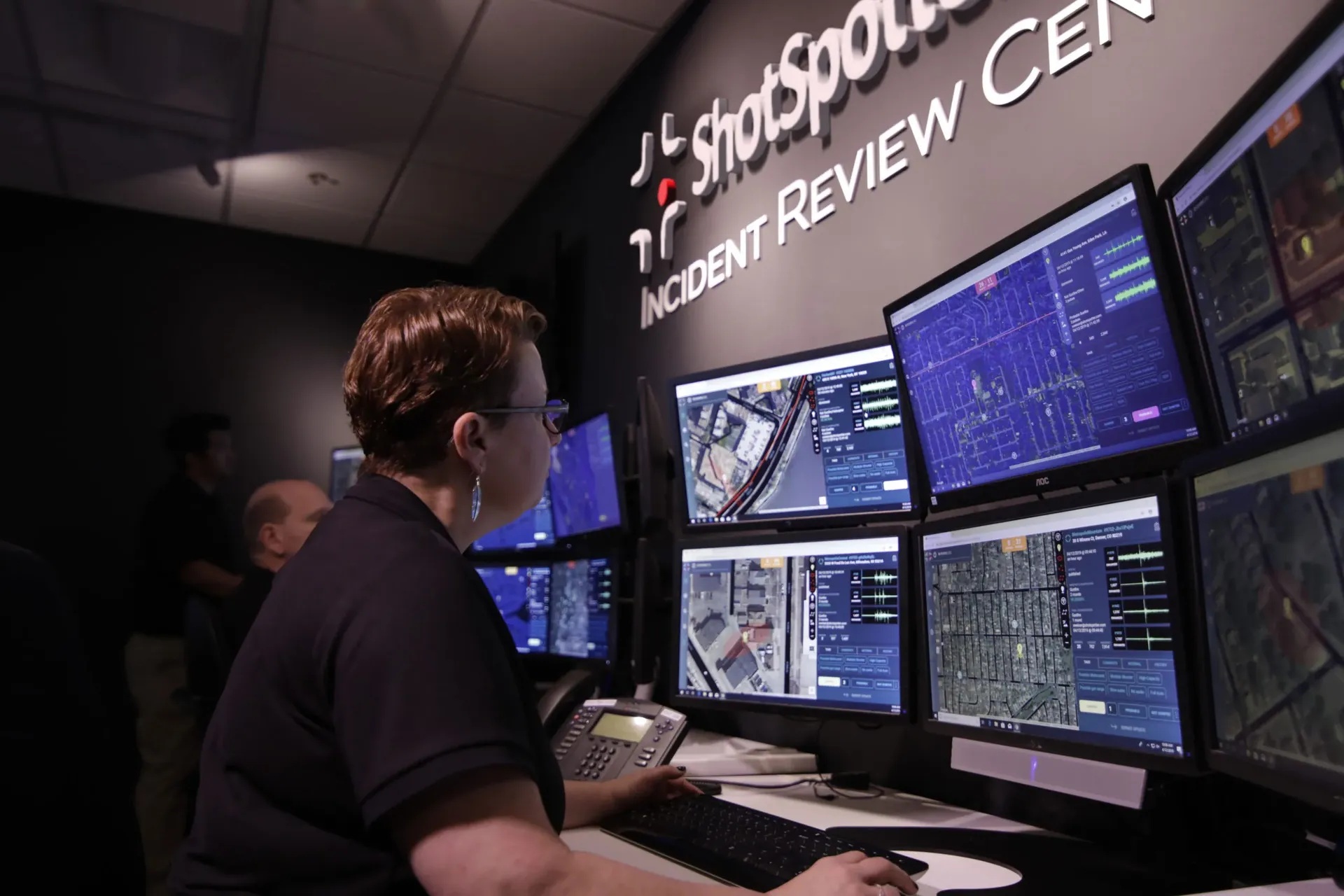
For an agency, the promise is earlier notice of gunfire that might otherwise go unreported, with a more specific place to search. It is a way to start a response. Finding a victim, collecting a casing or identifying a suspect requires additional work, often by different people. Those distinctions become important when the invoice and the performance report reach the same meeting.
Giving the alert somewhere to go
CrimeTracer tackles a familiar bureaucratic difficulty: the relevant information may already exist, but in another system or jurisdiction. Its Gen3 release connects law-enforcement and public records, adds dashboards and offers voice-enabled searches and AI summaries. The company describes access to more than a billion records associated with over 2,100 agencies. That is a data-network measure, not a count of paying customers.
A record appearing in a search is a lead to examine. CrimeTracer’s own product guidance describes its AI as assistive, with user-initiated, reviewable outputs. Selected Thomson Reuters CLEAR records require a separate subscription and appropriate permissions. The practical benefit is less switching among systems; the practical obligation is still to check the underlying record.
PlateRanger, powered by Rekor, adds vehicle and license plate recognition. Its integration with ShotSpotter and CrimeTracer is designed to help investigators connect a gunfire location with nearby vehicle information and existing records. CaseBuilder handles another stretch of the journey: organizing information, tracking assignments and assembling investigative material. ResourceRouter addresses deployment, creating directed patrol plans and recording activity when officers are between calls.
SafePointe gives the portfolio a different starting point. It seeks to detect concealed metallic firearms as people pass between unobtrusive bollards, using magnetic analysis, a 3D camera and AI processing. Hospitals, corporate buildings and hospitality venues are among the markets. SoundThinking acquired the business in 2023; it is selling security teams a chance to identify a threat before gunfire occurs.
These markets already have alternatives. Flock Safety offers overlapping camera and public safety tools. Evolv offers weapons screening. SoundThinking’s argument is the connection among its products and its managed operations. Buyers should examine that connection in their own workflow. A handsome collection of applications can still leave someone copying a crucial detail by hand.
The bill arrives in square miles
SoundThinking’s subscriptions have physical dimensions. Outdoor gunshot detection is priced by coverage area; SafePointe deployments by detection lane. Several software products are customized around agency size. Initial subscription terms commonly run one to three years, with setup, training and integration charges where applicable. The cloud still needs equipment on a street or at a door.
A historical contract makes the scale tangible. Chicago’s inspector general described a three-year, $33 million ShotSpotter agreement beginning in August 2018. That is one city’s contract, not a current rate card. A smaller deployment, a different product and a different term produce a different bill. Staff time spent responding also belongs in a buyer’s calculation.
The business reported record revenue in 2025, but remained loss-making on a GAAP basis. Chicago’s departure removed roughly $9 million of revenue compared with 2024. New and expanding subscriptions offset that loss at the revenue line. The picture is more revealing than either a celebratory growth figure or a lone cancellation.
Renewals supply the other half. In July 2026, SoundThinking announced a group of multi-year agreements representing over $23 million in total contract value. Albuquerque renewed for five years over 42 square miles; Worcester and Peoria were among the other renewing agencies. Total contract value spans contract terms. It should not be read as a single year’s revenue, nor as an independent demonstration of crime reduction.
Chicago asked a different question
Chicago’s 2021 inspector-general analysis examined what police responses produced. Of 50,176 confirmed and dispatched alerts in its study period, 4,556 had dispositions indicating evidence of a gun-related criminal offense: 9.1% of all responses. Some responses lacked a recorded disposition. The report also raised concerns about how the technology influenced officers’ perceptions and interactions.
An alert can be accurate and still leave the responding agency with little to show for the trip.
Editorial analysis
The 9.1% figure measures documented evidence yield. It does not establish that the remaining alerts were false. Conversely, a claim about detecting gunfire does not establish that detection reduces violence. SoundThinking disputes conclusions drawn from the Chicago analysis and argues that locating victims and initiating assistance matter alongside arrests and recovered evidence. Chicago ended use in September 2024.
The useful lesson for a buyer is to agree on the questions before deployment. Count alerts, response times, victims assisted, evidence recovered and staff hours separately. Examine false positives and missed incidents through a credible evaluation process. The system’s value will be constrained where coverage, available responders, investigative capacity or community acceptance cannot support the proposed service. A faster notification cannot supply any of those by itself.
A private future, with conditions
The newer AI layer, SafetySmart Field Agent, extends the same handoff ambition. Announced in June 2026, it was in beta with more than 20 ShotSpotter agencies, with wider availability targeted for later in the year. It is designed to answer questions about operational data and generate materials such as briefings, maps and reports. Authorized staff are meant to review and validate its outputs before acting.
The financial outlook became more difficult that summer. In August, SoundThinking reported second-quarter revenue of $23.9 million, down 8%, and lowered its 2026 revenue forecast to $99 million-$100 million. Management cited renewal delays or non-renewals, procurement conditions and the timing of opportunities. A recurring subscription is only recurring when someone signs again.
On September 29, Transom Capital Group agreed to acquire the company for $8 per share in cash, plus a contingent value right worth up to $3. The announced upfront enterprise value was approximately $114 million, rising to approximately $159 million if the maximum contingent payment is made. That extra payment depends on specified ShotSpotter and SafePointe revenue milestones. Closing was expected in the fourth quarter, subject to conditions.
SoundThinking’s next chapter therefore has two tests: completing the deal and delivering enough value to keep customers buying. Its history offers a copyable principle. Make the customer’s next action easier, then measure whether it helps. The ear on the street is only the opening scene; the people receiving its message determine how the story proceeds.
Follow the signal
Products, company dispatches and conversations.