BREAKING• Pit Viper 360 named to TIME's Best Inventions of 2024World's first thermal 360° throwable camera revealed at NTOA •$16.28M raised to date •Used by FBI, U.S. Marshals & 450+ agencies •From an MIT class project to an In-Q-Tel portfolio company •BREAKING• Pit Viper 360 named to TIME's Best Inventions of 2024World's first thermal 360° throwable camera revealed at NTOA •$16.28M raised to date •Used by FBI, U.S. Marshals & 450+ agencies •From an MIT class project to an In-Q-Tel portfolio company •
Buffalo, NY · Founded 2012
Bounce Imaging.
A camera small enough to hold in one hand, tough enough to throw, and smart enough to see in every direction at once. You toss it into the room you are afraid of - and look before you step inside.
HARDWAREFIRST-RESPONDER TECH~24 PEOPLESERIES A PRIME
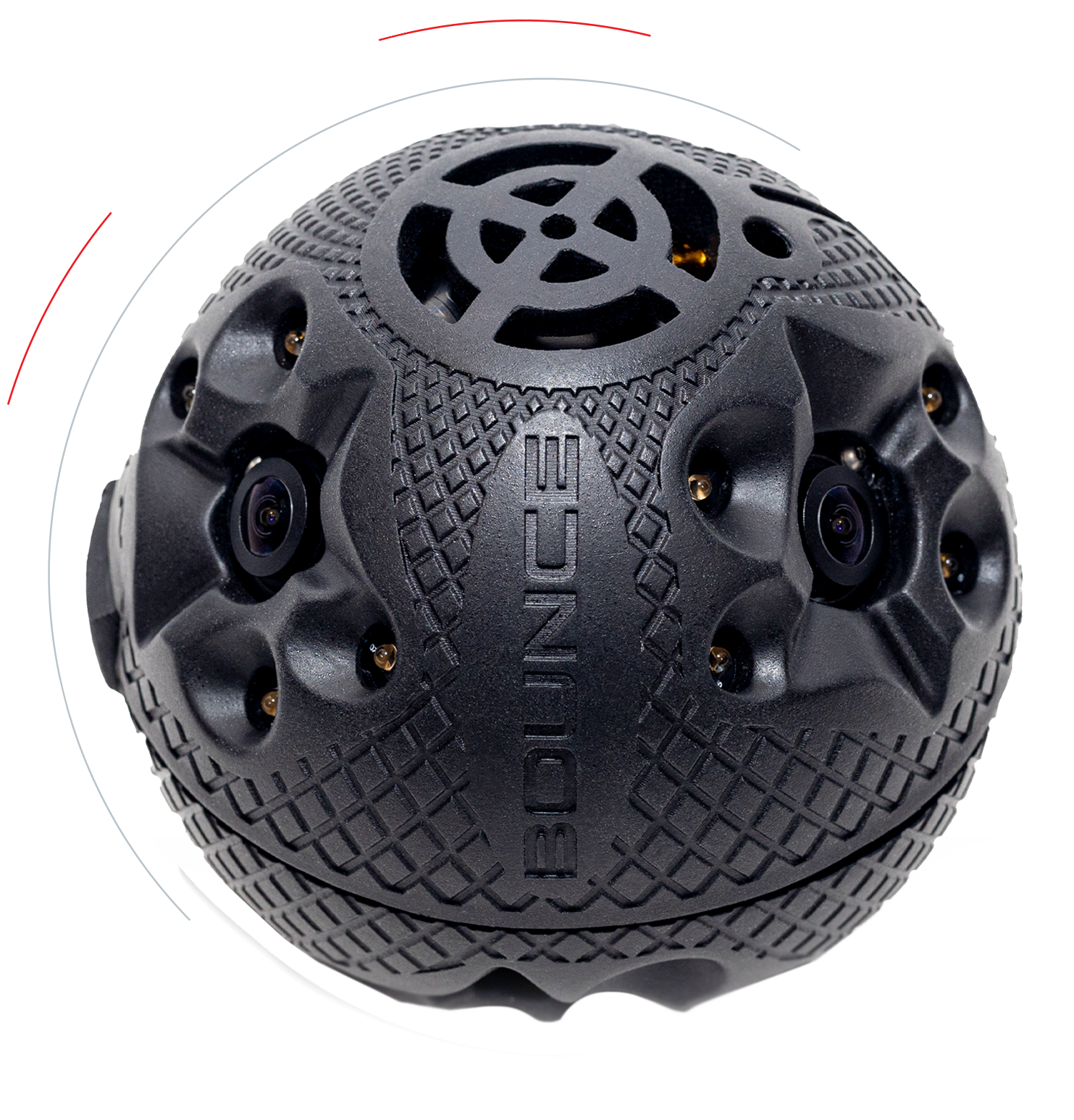
The whole product, basically: a ball that refuses to mind its own business. Six lenses, one throw.
A softball-sized camera, and the people who throw it for a living.
Somewhere right now, a tactical team is stacked against a wall outside a door nobody wants to open. One officer reaches back, pulls the pin of attention off the unknown, and throws a black rubber ball through the gap. A second later, six lenses are awake and a phone in someone's hand fills with the room - corners, ceiling, the shape in the doorway. Nobody has crossed the threshold. Everybody can already see inside.
That ball is made by Bounce Imaging, a roughly two-dozen-person company headquartered in Buffalo, New York. It builds throwable 360-degree cameras for police, firefighters, soldiers, and search-and-rescue crews. The pitch is almost rude in its simplicity: look before you leap. The execution is the hard part, and it is the part they have spent more than a decade getting right.
Our cameras see in all directions at the same time.
- Bounce Imaging, on the one feature that explains everything else
The company's customers include the FBI, the U.S. Marshals, the Department of Defense, and more than 450 state and local law enforcement and fire departments across the U.S., Canada, and Europe. Its newest device made TIME's Best Inventions of 2024. None of that was the plan, exactly. The plan started with an earthquake.
The problem they saw
The most dangerous moment is the one before you know anything.
In 2010, a magnitude-7 earthquake flattened much of Haiti. Rescue teams arrived to a landscape of collapsed concrete and the agonizing question that defines every search: is anyone alive in there, and is it safe to climb in and find out? The cameras that could answer it existed. They were also bulky, complicated, and expensive enough that the teams who needed them most rarely had them.
Francisco Aguilar was watching. The gap he noticed was not a technology gap - good optics already existed. It was an access gap. Professional situational awareness was a luxury good. The people walking into rubble, smoke, and stairwells were doing it half-blind, not because seeing was impossible, but because seeing was priced like a privilege.
Existing equipment was too bulky and complicated for the search and rescue teams to deploy - and it cost too much.
- Bounce Imaging's account of the problem that started the company
So the question reframed itself. Not "can we build a better camera?" - plenty of people build cameras. The question was: can we make seeing-into-danger cheap, rugged, and stupid-simple to use, so that an ordinary department on an ordinary budget can have it on an ordinary Tuesday?
The founders' bet
Bet that the answer was a ball you could afford to throw.
Aguilar started Bounce Imaging in 2012 out of MIT and the Harvard Innovation Lab. The bet was specific and a little contrarian: instead of a robot, or a drone, or a pole, build something a person could throw underhand into a space and trust to survive the landing. Wrap a cluster of cameras and LEDs in a thick rubber shell. Let it bounce, settle, and stream. Price it so a mid-sized police department could say yes without a grant.
The early target was a device under $500. That number was a thesis, not a spec sheet. It said the goal was reach, not exclusivity - the opposite of how high-end tactical gear usually gets sold.
An amazing group of engineers, motivated by making a difference in the world, working alongside the responders who actually use the thing.
- Francisco Aguilar, on what the team optimizes for
The world noticed before the revenue did. The Explorer was named a best invention by TIME, CNN, and Popular Science. The company won MassChallenge, took the $1M Verizon Powerful Answers prize, and in 2016 won Buffalo's 43North competition - which is how a Cambridge startup ended up building tactical cameras on a factory floor in western New York. Aguilar has since credited Buffalo's manufacturing heritage and a first-responder community that, in his words, received the company with a warmth that was amazing.
The short history of a thrown camera
Milestones
2010
The Haiti earthquake. Rescue teams lack affordable cameras to see into collapsed structures - the spark for the whole idea.
2012
Francisco Aguilar founds Bounce Imaging out of MIT and the Harvard Innovation Lab. The Explorer concept takes shape.
2013-2015
Named a best invention by TIME, CNN, and Popular Science. Wins MassChallenge and the $1M Verizon Powerful Answers prize.
2016
Wins Buffalo's 43North competition and relocates manufacturing to western New York.
2022
Raises a $4.2M Series A Prime round; former Pentagon Chief of Staff Eric Rosenbach joins the board. Becomes an In-Q-Tel portfolio company.
2024
Reveals the Pit Viper 360, the world's first thermal 360-degree throwable camera, at NTOA - then earns a spot on TIME's Best Inventions of 2024.
The product
One throw. Every direction. No flashlight required.
The flagship Explorer is the size of a softball and built to be hurled into rubble, rooms, and stairwells. Inside the rubber shell sit six lenses and LEDs that stitch a panoramic, real-time view and beam it - with two-way audio - to a phone or tablet. Because it captures every direction at once, several people can each look at a different angle simultaneously, and scroll the video back to catch the thing they missed the first time.
6Lenses, one sphere
360°Captured at once
450+Agencies deployed
2024TIME best invention
In September 2024 the company pushed the idea somewhere genuinely new. The Pit Viper 360 - named, with a straight face, after the heat-sensing snake - uses six thermal cores instead of standard lenses. It sees body heat in complete darkness, no added light at all. It is the world's first thermal 360-degree throwable camera, and it is the rare product whose name is also its instruction manual.
Flagship
Explorer 3.0
The original softball-sized throwable 360 camera. Rugged rubber shell, six lenses and LEDs, real-time omnidirectional video and audio to any phone or tablet.
New / 2024
Pit Viper 360
Six thermal cores create a 360 panorama from heat alone - it sees people in total darkness. The world's first thermal throwable camera.
Recon
RECCE360 / MINI
Compact tactical 360 cameras built for reconnaissance and clearing operations where size and speed matter.
K-9
Land Shark K-9 Camera
A camera that mounts on a police or rescue dog, giving the handler a remote view from the K-9's point of view.
When the customers are the FBI, the demos get serious.
Awards are pleasant. Procurement is the real review. Bounce Imaging's cameras are in the hands of the Department of Defense, the FBI, the U.S. Marshals, and the Massachusetts State Police, plus more than 450 state and local law enforcement and fire departments across three continents. In 2022 the company raised a $4.2M Series A Prime round - past its $3M target - and added Eric Rosenbach, a former Pentagon Chief of Staff, to its board. It is an In-Q-Tel portfolio company, which is the intelligence community's polite way of saying it is paying attention.
How the money came together
Approximate cumulative capital, by source · total ~$16.28M raised
Series A Prime
$4.2M
Prior VC rounds
~$11M
Verizon prize
$1M
Annual revenue
~$4.5M
Figures approximate, drawn from public reporting (Crunchbase, company releases). Bars scaled for comparison, not precision.
This investment will allow us to continue to expand our reach within the U.S. military and first responder community.
- Francisco Aguilar, on the Series A Prime round
Backers include the R42 Group, Good Growth Capital, Tanis Ventures, and Backstage Capital - alongside iRobot co-founder Helen Greiner and MIT entrepreneurship figure Ed Roberts. When the person who helped put Roomba in your living room invests in your throwable robot, the lineage is hard to miss.
The mission
Make seeing into danger cheap enough that everyone has it.
The stated mission is to keep first responders, warfighters, and civilians safer with low-cost, easy-to-use imaging and robotics. Strip the corporate phrasing and it is the same idea from 2010: the people who walk into the worst rooms should not have to do it blind, and they should not have to be rich to avoid it.
That is a quietly radical stance in a market that usually sells exclusivity. High-end tactical gear tends to flow to the best-funded units first. Bounce Imaging keeps aiming the other way - down-market, toward the volunteer fire department and the mid-sized police force - on the theory that the value of seeing first does not depend on the size of your budget.
The first-responder community in Buffalo has received us with a warmth and enthusiasm that has been amazing.
- Francisco Aguilar, on building hardware in western New York
Why it matters tomorrow
The next throw will see heat, then more.
Thermal was the obvious next frontier, and the Pit Viper 360 crossed it - a camera that finds people by warmth in total darkness. The roadmap points outward from there: more sensing, the same simplicity, the same insistence on a price that does not lock anyone out. The company has signaled interest in industrial safety too, where the same question - what is inside that confined space before I enter it? - has nothing to do with tactics and everything to do with going home at the end of a shift.
Go back to that team stacked against the wall. The old version of that moment was a held breath and a guess. The new version is a thrown ball and a screen full of answers. The threshold is still there. The blindness is not.
Bounce Imaging did not make the dangerous rooms go away. It made the moment before them survivable - and it made that moment affordable enough to share. A camera you throw, so a person doesn't have to be the one who finds out.