Imagine choosing a car, working out a monthly payment, then arriving at the dealership to explain the whole thing again. The vehicle has made it through the internet. Your homework has not. That small indignity is a useful way into Dealer.com, the automotive software business whose product stretches from the first advertisement to the beginnings of a deal.
- Dealer websites, advertising and online deal building, sold to automotive businesses.
- Cox Automotive connections supply shopping signals, inventory context and sales integrations.
- Software comes with marketing specialists. Results still depend on the dealership’s follow-through.
The car lot that learned to remember
Dealer.com’s roots lie in a much smaller problem. At Earthcars, a Vermont retailer, Mark Bonfigli experimented with a tool that remembered customers’ preferences and emailed them when a suitable vehicle arrived. As Seven Days later reported, the ambition was to sell cars without traditional salespeople. The useful discovery was that remembering what someone wanted could itself become a service.
Bonfigli built the business with Rick Gibbs, Mike Lane, Ryan Dunn and James LaScolea. Dealer.com dates its origins to 1997; later announcements describe its establishment in 1998. The original insight remains recognizable: a dealership’s inventory and a shopper’s intentions belong in the same conversation.
The company eventually became valuable enough for Dealertrack to acquire it in 2014. Later securities filings put the purchase consideration at $1.092 billion after adjustments. Cox Automotive bought Dealertrack the following year for approximately $4 billion. Dealer.com had joined a family whose other businesses already knew quite a lot about car shopping.
The family is part of the product
Today, Dealer.com sells personalized websites, advertising, managed marketing services and digital retailing. Its customers include dealerships, dealer groups, manufacturers and agencies. A dealer can put vehicles online, commission search campaigns, outsource content or let shoppers begin structuring a purchase before visiting. The company says its Accelerate My Deal retailing product serves more than 5,000 dealers.
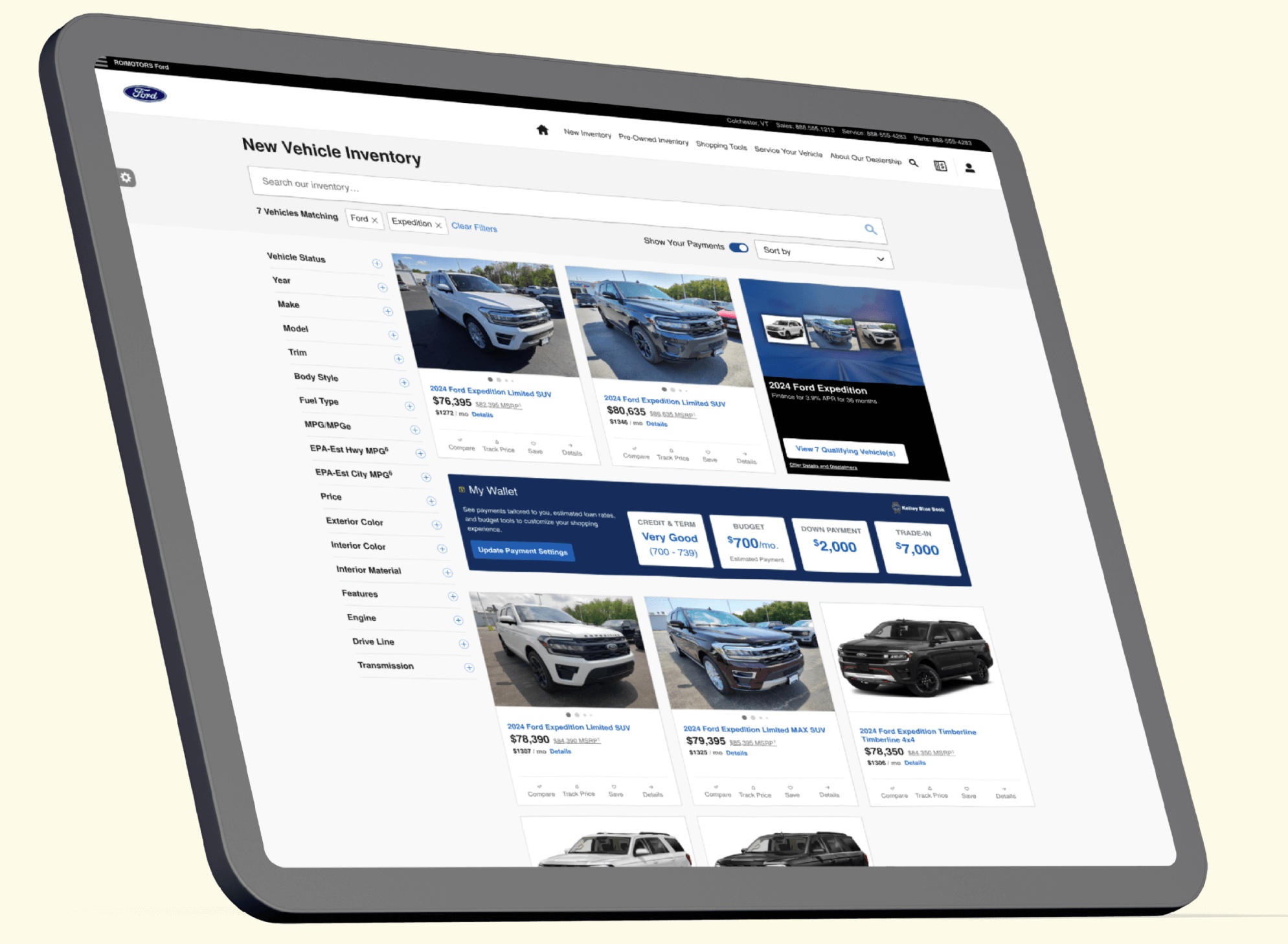
The family connections make the offer distinctive. Autotrader and Kelley Blue Book contribute shopping signals. vAuto supplies inventory context. VinSolutions connects the sales workflow; Xtime supplies service-related information. Dealer.com describes paid-search campaigns that use vehicle-market measures to prioritize inventory and integrate service pricing into ads. The pitch is specific: use what the wider organization knows to make the next interaction more relevant.
- 01FindAds + shopping sites
- 02ExploreDealer website
- 03BuildPayments + trade-in
- 04ContinueDealership team
DealerOn and Dealer Inspire also sell dealership websites and marketing technology. Attractive pages and search campaigns are competitive necessities here. Dealer.com’s argument rests on the connections around the page, plus people who help operate it. For a buyer already using Cox products, that deserves a close look. For another dealer, the practical test is whether the proposed integrations improve its actual workflow.
Follow the lead, then follow the bill
Consider Lithia Motors. In a historical Dealer.com case study, the group had 101 locations across the West and Midwest and needed a system that could accommodate both group strategy and local operations. Dealer.com reports that a connected website and advertising approach reduced cost per lead by 58% and increased website conversion by 10%.
Before = 100
Those are vendor-reported results from one customer example, not a forecast for every dealership. The useful lesson is the unit of analysis: website and advertising together. An ad buys a visit; the page must make that visit useful. Measuring each in isolation can conceal the expense of their awkward introduction.
The bill also has several moving parts. An older public Dealer.com advertising schedule listed a Standard management charge of 25% of media spend, subject to a minimum, plus a $149 monthly platform fee. At $4,000 in media spend, that arithmetic produces $5,149 before other charges. This is a historical illustration, not current pricing. It shows why comparing only ad budgets misses part of the purchase.
The person behind the dashboard
Dealer.com also sells time. Website updates, search optimization, creative work, social accounts and reputation management can be handled by specialists. Its published Brown Automotive Group example describes a website customer adding managed services to improve visibility and campaign coordination. The buyer is acquiring operating capacity as well as software.
A useful buying question follows: which tasks will your own team still own? Ask who updates offers, checks inventory feeds, reviews campaign results and responds to a submitted deal. A subscription changes the tools available; responsibility still needs a name.
People have long occupied an unusual place in the company’s story. In December 2012, Bonfigli announced he would leave the CEO role to concentrate on workplace culture, wellness and community engagement. His new title was chief Earthling. Gibbs became CEO in January. The title was funny; assigning a founder to culture was a concrete organizational decision.

“Rick has been my partner in creating this business”
Mark Bonfigli · CEO transition announcement, 2012
Current products tackle another human constraint: deciding what to change. Dealer.com’s Design Generator asks questions and drafts a homepage inside Composer, its editing environment. The company says dealers can otherwise retreat to familiar, older layouts when faced with too many decisions. Intelligent Website Optimizer turns shopper behavior into prioritized changes. Both put the recommendation near the place where someone can act on it.
Try buying your own car
There is a useful exercise here for any dealer, whatever software it buys. Open an advertisement on a phone. Find the advertised vehicle. Calculate a payment. Submit an inquiry. Then ask the sales team what arrived. Count repeated questions, missing context and promises the store cannot honor. That is an audit a real customer performs without writing a report.
The operating conditions matter. Inventory must be accurate, offers maintained and staff prepared to use the information shoppers submit. A store that ignores online deal details can spend heavily on continuity and still make customers start again. An integrated platform offers a shorter route; the dealership has to keep it open. Dealer.com’s most interesting proposition is that remembering the customer can be designed into the journey, one handoff at a time.