Fifteen dealerships in New Jersey are an unassuming place to begin a story about the future of car shopping. Yet that is where FordDirect started its first service in December 2000. The internet was making it easier to find a car and rather harder to predict who would own the relationship with its buyer. Ford dealers had a practical answer: build an internet company with the manufacturer, and give the showroom a stake in the machinery.
- The customers helped create it. FordDirect is a joint venture of Ford Motor Company and its dealers.
- It handles the connections. Factory data, inventory, advertising, websites and customer follow-up meet here.
- It also shops for the shops. The Shop offers vetted dealership vendors and pre-negotiated prices.
- Its appeal has boundaries. Brand integration helps most when a dealership has the people and processes to use it.
01 A business plan, rather than a surrender
In November 1999, members of the Ford National Dealer Council went to Dearborn concerned about the internet. Ford was considering buying or partnering with emerging online transaction businesses. Leo Hillock, then a dealer principal in Florida, preferred a company built jointly by Ford and its dealers. He returned the following month with a business plan and a name: FordDirect. By August 2000, the venture had been announced.
The original announcement made the division of work explicit. Customers would configure and begin buying a vehicle online; a local dealer they chose would complete the transaction. Ford would invest, while dealers would retain control. The commercial imagination was ambitious, but the underlying arrangement was conservative in a useful way: preserve the people who delivered and supported the car.
The network then widened. In December 2001, FordDirect announced coverage in all 50 states and more than 2,500 participating dealers. A contemporary Microsoft agreement sent new-Ford inquiries from MSN Carpoint to participating stores. Online intermediaries could therefore become distribution partners as well as perceived threats. The company was learning to work with the internet’s traffic, rather than waiting for every shopper to arrive at its own front door.
December 2000
December 2001
December 2001
Historical rollout figures, not today’s customer count.
02 The handoff is the business
FordDirect now operates in the crowded territory between automotive advertising and dealership software. Its customer is principally the Ford dealer or Lincoln retailer. The person browsing for a truck benefits indirectly, through a listing, a website, an online deal or a reply that reaches the right salesperson. Think of the company as a coordinator of the retail journey, with privileged access to Ford integrations.
The current solutions portfolio covers websites and social content, search and video advertising, CRM and lead management, reputation and listings, inventory insights, digital retailing and chat. A shopper can work through payments, trade-ins and credit applications online. The store can connect those steps to its sales process. None of those categories is unusual by itself. Their arrangement around one manufacturer’s dealer network is the interesting part.
A less glamorous example makes the value easier to see. FordDirect’s Canadian Integrated Lead Management service routes inquiries from Ford and Lincoln brand websites and certified dealer sites into a dealership’s CRM. ConsumerLINK remains a backup. The intended benefit is fewer separate logins and less data re-entry. Ford receives information about when and how the dealer responded, without receiving the contents of the reply. A handoff becomes something the network can inspect.
Search, social
and vehicle listings
Inventory imagery
and online deal tools
CRM routing
and dealer follow-up
A conceptual view of the retail workflow, not a measured conversion funnel.
That is also how to understand its expertise: automotive data integration, digital marketing and the everyday mechanics of dealer work. Its published partner roster includes Dealer.com, Dealer Inspire, DealerOn, VinSolutions and other suppliers. Some occupy categories a buyer might otherwise purchase independently. FordDirect can sit above and alongside those vendors, making the market less tidy than a list of competitors would suggest.
03 A car that arrives online first
The most vivid demonstration is VINReal, developed with eVN. An in-transit vehicle cannot report to a dealership photographer. Yet a buyer still wants to know what it looks like. VINReal combines Ford build information with three-dimensional vehicle models to generate images specific to the vehicle identification number. A photograph of the dealership can supply the background. The car gets a digital introduction before its physical arrival.
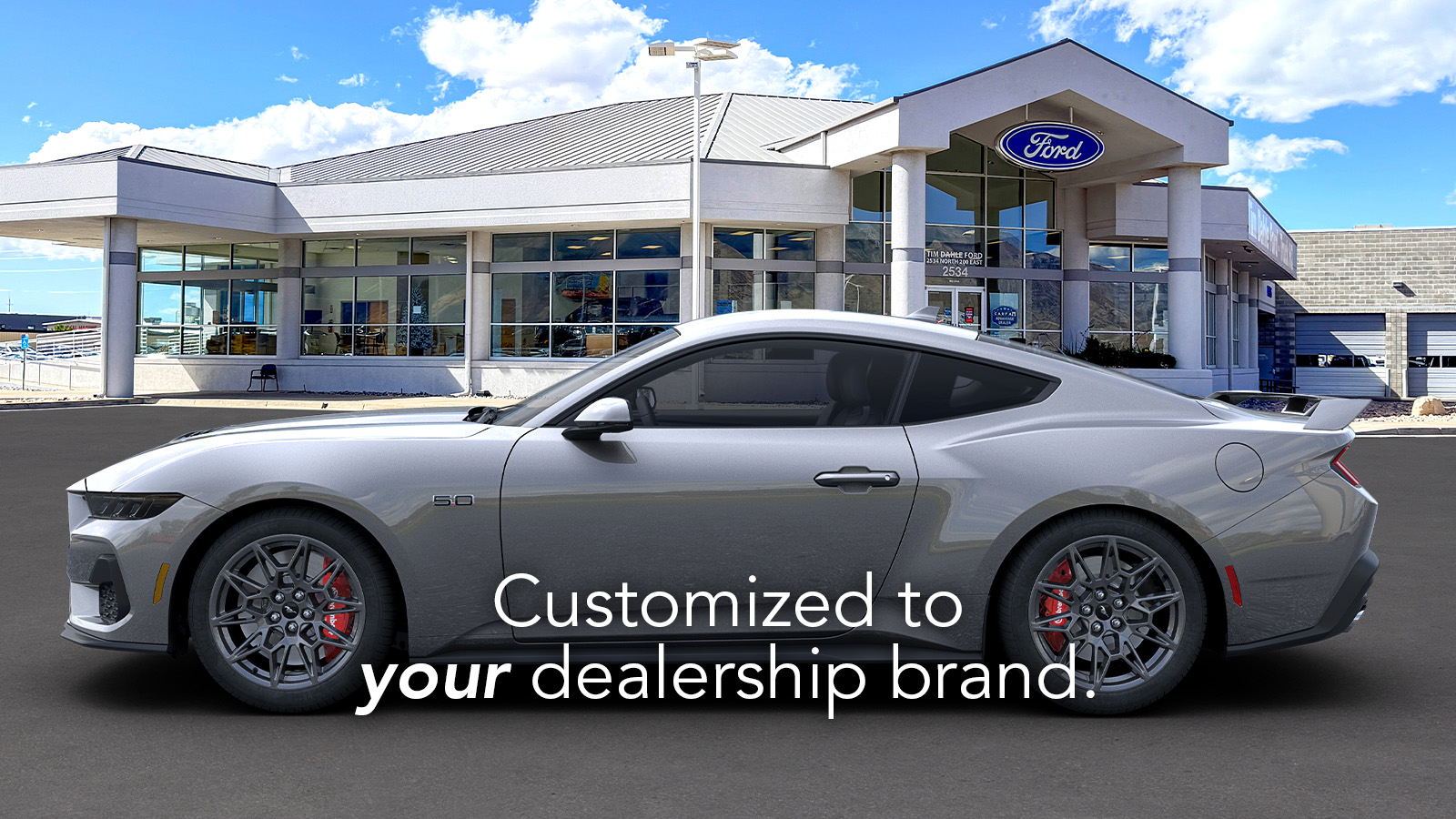
eVN says new inventory imagery is generated within 24 hours of in-transit status. Its video offering assembles VINReal images for new vehicles and dealer-supplied photographs for used ones. Qualifying dealers receive video functionality through the Digital Integration Fee; the full image program offers more customization. These are different products with different inputs. A rendered new car and a photographed used car should never be casually confused.
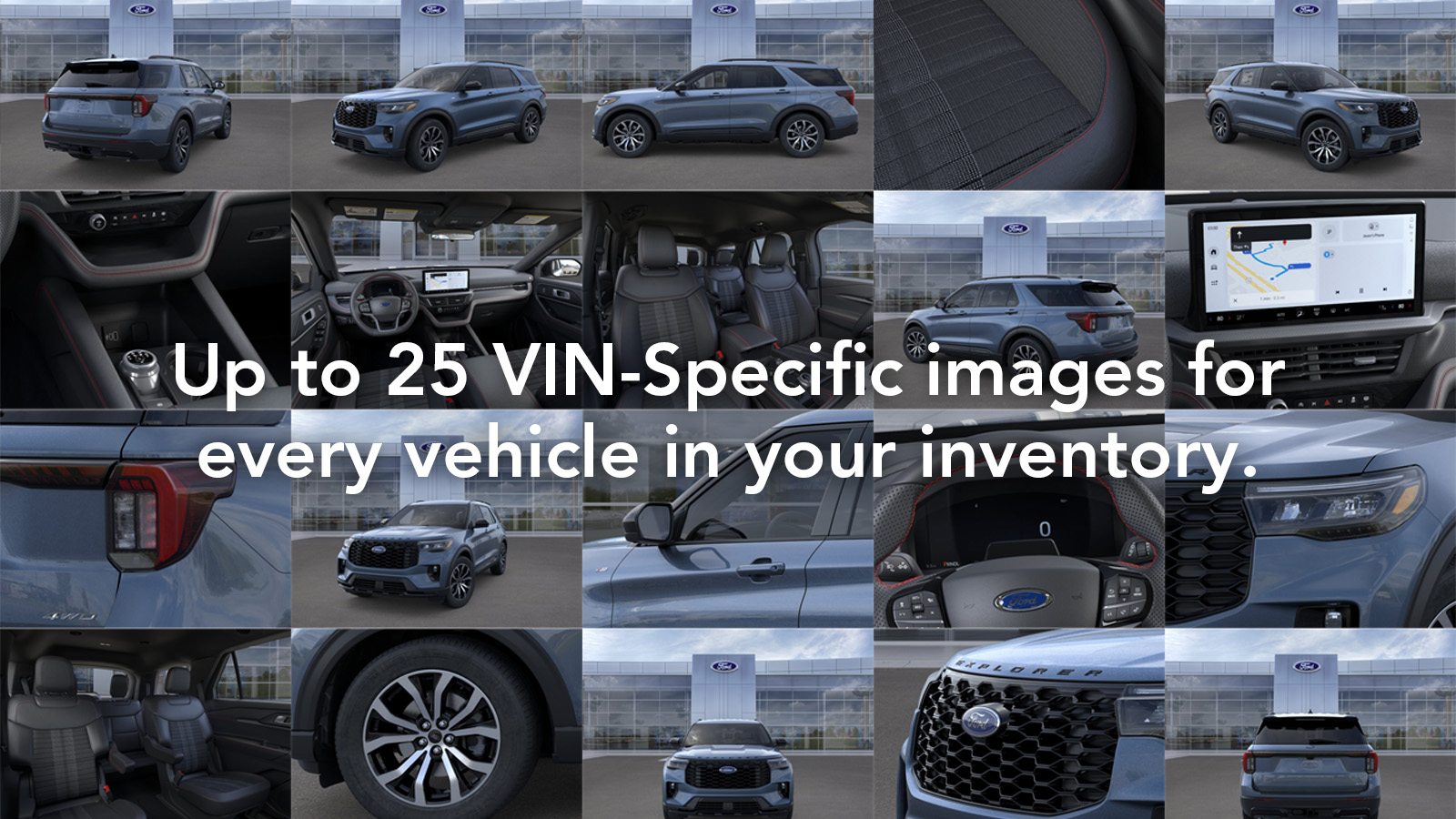
The practical constraint matters as much as the cleverness. Build-based imagery depends on supported models and usable data; the FAQ lists vehicle exclusions. Used inventory still needs photographs for the image workflow. Dealers should confirm coverage and inventory-feed settings before treating the service as a replacement for every camera on the lot.
04 The dealership goes shopping
In January 2024, FordDirect opened The Shop. Here the dealership becomes the shopper. The marketplace launched with eight vendors, including ComplyAuto, STELLA Automotive AI, WarrCloud and Work Truck Solutions. The proposition was to reduce the time dealers spent finding suppliers and negotiating rates, using vetted vendors and pre-negotiated prices.
The range reaches beyond advertising. A dealership has warranty claims, employee needs, compliance obligations and service operations to manage. The Shop’s current FAQ extends eligibility to Ford and Lincoln dealers and their group stores. A group with several franchises can therefore have a reason to visit even when the immediate problem does not concern a Ford advertising campaign.
By January 2026, FrogData had joined with service-operations analytics and hyperlocal service marketing. Its tools address labor-rate decisions, profit leakage and retaining customers after their warranties expire. The Shop’s September newsletter also featured payments, warranty processing and customer follow-up. The commercial logic is straightforward: the dealership’s work continues long after the vehicle sale.
05 The price of belonging
FordDirect’s business combines dealer technology, marketing services and a partner marketplace. For a dealer evaluating a purchase, the useful unit is the particular service. VINReal’s image subscription is priced in tiers based on annual sales volume. Dealer Teamwork publishes AdVantage packages for different media-spend bands, including $1,000-$5,000 per rooftop. That figure describes an advertising budget band, not the price of the entire FordDirect relationship.
Subsidies can change the decision too. A May 2018 Ford co-op notice revised an earlier proposal that would have reimbursed certain eligible third-party products at 50% when a FordDirect alternative existed. After dealer feedback and a FordDirect leadership change, Ford said eligible products from either channel would remain 100% reimbursable. Third-party websites and search marketing pointing to them remained excluded under that notice. These were historical terms, not a quotation of today’s reimbursement rules.
It is a revealing episode. Dealers valued shared infrastructure, but the economics of choosing a supplier still mattered. Collective purchasing works better when participants see a benefit in joining. A network has to keep earning their cooperation, even when it comes with a familiar badge.
06 What a dealer can borrow
FordDirect’s leadership changed in November 2025, when Chris Thornton succeeded Dean Stoneley as CEO. Tracy Noonan Fred became COO in January 2026, overseeing operations that include product, dealer engagement and analytics. The company’s stated culture emphasizes inclusion, trust and collaboration. That emphasis suits a business whose job requires manufacturers, independent stores and outside suppliers to work together.

“Helping our customers win at retail will be my focus”
Tracy Noonan Fred · January 2026
A dealer can start by choosing the troublesome handoff: weak listings, scattered leads, slow replies or too much vendor evaluation. Then compare a FordDirect program with direct supplier options, including integration requirements, media costs, enrollment terms and the staff time needed to operate it. The point is to purchase a better workflow, with an owner inside the store who can tell whether it improved.
Other businesses can borrow the founding arrangement: pool the expensive infrastructure while leaving the customer relationship close to the people delivering the service. It requires participants with enough shared needs to make cooperation worthwhile. A store outside the Ford and Lincoln ecosystem has less reason to value these specific integrations. A store that cannot answer its inquiries has a more immediate problem than finding another source of them. FordDirect’s enduring insight is that the internet journey and the local showroom have to meet somewhere useful.
Take the next turn
Explore FordDirect, its dealer solutions, The Shop and its articles and webinars.
Watch Building Confidence in Vendor Decisions, browse The Shop’s video channel, or see the VINReal video demonstrations.
Follow FordDirect on LinkedIn, X and Facebook, and The Shop on Instagram. Browse company announcements.