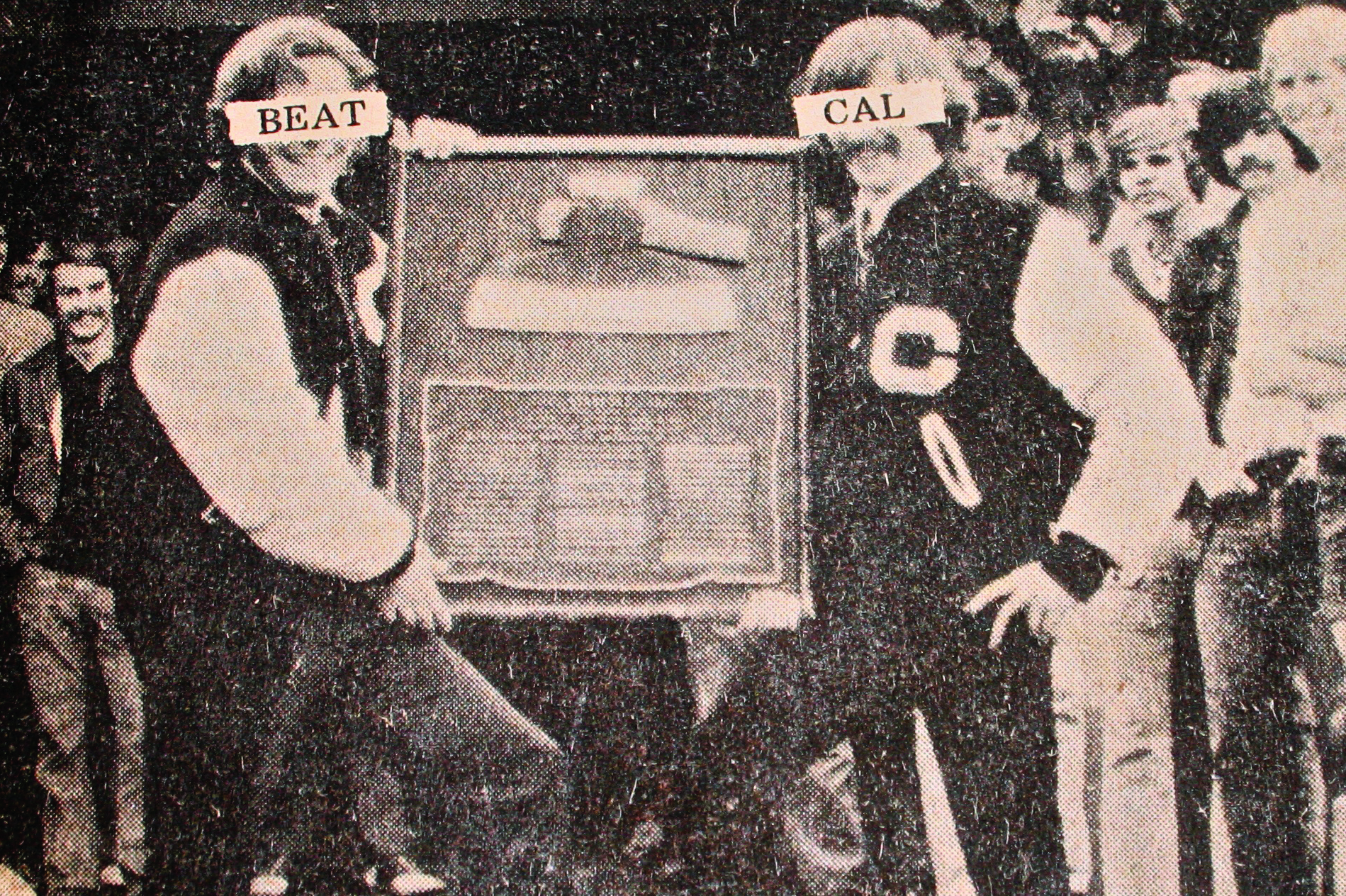
Before David Suliteanu had a beauty business to run, he had a stolen trophy to hide. In November 1973, he and his friends helped prise the Stanford Axe away from Cal. The destination was his grandmother’s apartment in Palo Alto. Her bed became, briefly, a rather effective trophy cabinet.
Suliteanu, a Stanford student in the class of 1975, had plotted the escapade with Tim Conway and Conway’s brother Matt. Their original summer brainstorm involved stealing USC’s horse mascot. A large white horse presented certain storage difficulties. They settled on the Axe, which at least could be carried.
The operation involved borrowed football-player identities, a telephone impersonation of Cal’s coach, and a handoff that dissolved into a scramble in a restaurant parking lot. The trio became the “Infamous Three.” The trophy went back before Big Game. Stanford won it back on the field.
Years later, at a Home Depot executive interview, Suliteanu mentioned the heist. His interviewer was a Cal alumnus and wanted details. Suliteanu got the job. A youthful indiscretion had aged into a conversational asset.
Forty years after the theft, Suliteanu and Tim Conway held the Axe again at a Stanford rally. What surprised them was its weight. Memory had apparently made the trophy lighter. The pleasure of carrying it had survived intact.
An orange apron enters the beauty business
By the time Sephora recruited him in 2000, Suliteanu had spent years inside American retail. He had been vice chairman and director of stores at Macy’s East before joining Home Depot in 1998 as group president of diversified businesses. He understood stores as places where employees, stock, rent, and customer expectations had to agree with one another. Eventually, the accounts would insist.
Sephora’s American operation gave him a particularly ornate problem. It had arrived in 1998 with a European aesthetic: striped stores, black uniforms, a single glove. The look was precise. Its translation into a workable American business was less so.
Suliteanu remembers trading his Home Depot apron for Giorgio Armani. A personal improvement, he jokes. The stores were opening quickly, the assortment leaned heavily on private label, and employees were expected to answer questions rather than actively guide shoppers. He describes a setting with the manners of an art gallery.
He went to Paris to ask questions. The French phrase “Le Beau” explained the emphasis on beauty. It did considerably less to explain how the American stores would make money. He returned convinced that several practical ingredients were missing.
The first instruction was to slow down
Suliteanu’s recollection is blunt: Sephora had opened 67 American stores in 30 months and was losing 90 cents for each dollar of revenue in 2000. Expansion needed a brake. Over the next two years, he says, the business opened 18 stores and closed 11. Its first profitable year followed in 2003.
Then came the investment that could be overlooked in a photograph: employee education. Science of Sephora, known as SOS, launched in summer 2001. It combined product knowledge with accessible service. Customers should be able to experiment, with someone nearby who knew enough to help.
Independent beauty founders brought another missing ingredient. Sephora could give their products a wider audience; their products could give Sephora a reason to exist beyond its own labels. The arrangement made room for discovery on both sides of the counter.
There was an appealingly practical connection to his previous employer. Home Depot sold nails. Sephora helped customers paint them. In either store, an employee who could explain the product was worth more than an employee who merely looked the part.
Then, a better reason to visit.
A headquarters with a supporting role
Mike Ullman was central to this chapter. Suliteanu describes four decades of friendship, partnership, and mentorship, and says his family moved across the country four times to work with him. Sephora was the last of those moves. Their trust would also underpin Sephora Inside JCPenney.
When Suliteanu asked Ullman whether the American team could make its own decisions, the answer was permission to get on with it. The freedom came with responsibility. In Suliteanu’s telling, there would be no rescue party riding in from elsewhere.
The company’s language reflected that allocation of responsibility. Headquarters was the field support center. The stores were where customers met the business; corporate employees existed to help that encounter succeed. Even the name put the office in its place.
By October 2013, as his departure from Sephora was announced, the retailer operated more than 330 North American stores and 400 JCPenney boutiques. Those were different ways to reach a shopper, built around the same question: what would make the visit useful enough to repeat?
Permission to be ridiculous
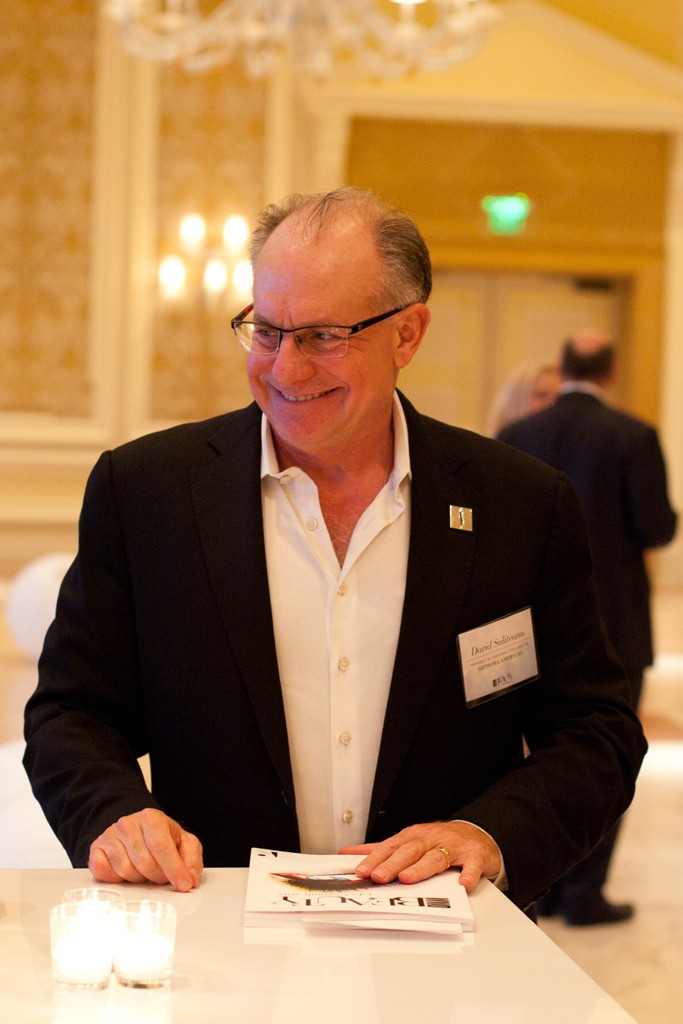
Suliteanu’s approach to employees included a duty seldom listed in a chief executive’s contract: occasionally make a fool of yourself. Each year, he and stores leader Christie Jack filmed a holiday message. There were business updates and seasonal priorities. There was also whatever comic idea he had decided to spring on her.
In 2010, that meant a rap. The surviving clip is a reminder that seniority does not confer musical ability, and that musical ability need not be the point. His explanation is straightforward: humor helps employees see the person inside the title. A little less starch, as he puts it.
He distinguishes this from standing up and telling jokes. The material is already in the daily absurdities of work. A leader can notice it, acknowledge it, and let everyone breathe a little.
That instinct extended to the company’s gatherings. At the 2005 conference, awards recognized stores, teamwork, and company values. The evening competitions involved pudding, pie, and a toilet-paper relay. These were unusually sticky accessories to an otherwise serious retail strategy.
The games make a useful companion to the store figures. Suliteanu wanted employees who cared about winning, but who also cared about one another. In his retelling, fun and motivation belong in the same business conversation as productivity. The pudding was not entered as revenue. The people covered in it would return to selling.
“Humor works. Seriously.”
David Suliteanu
The executive who knew when to step aside
Julie Bornstein joined Sephora in 2007 to lead its digital work. Suliteanu’s description of the existing ecommerce operation is a car that could get you to work but offered little speed or style. He needed someone who could rebuild it without waiting for him to become the expert.
Bornstein brought a different kind of retail imagination. Suliteanu credits her with spotting digital channels early and treating the online operation almost as a separate company. “The best thing I could do was get out of the way,” he says.
It is an unusually economical description of delegation. Hiring someone talented is only half the transaction. The other half involves allowing that person to make consequential decisions.
Bornstein remembers a lean organization where decisions could move quickly. Her team approached technology through practical customer problems: recalling a previous purchase, keeping track of loyalty points, or finding the right foundation while away from home. In 2009, they worked with recent Carnegie Mellon graduates to develop mobile experiences.
There is a family resemblance to the SOS training decision. A knowledgeable employee and a useful phone interface solve different parts of the same shopping problem. Both make the customer less dependent on guesswork.
“The best thing I could do was get out of the way.”
David Suliteanu, on Julie Bornstein
From stocking brands to helping build them
Kendo offered Suliteanu a different seat at the table. The beauty incubator began within Sephora; accounts of its creation place those roots in 2008. In 2014, it became independent from Sephora within LVMH, and Suliteanu became its chief executive. Instead of concentrating on where brands were sold, he could concentrate on how they were made.
The portfolio included names such as Ole Henriksen, Marc Jacobs Beauty, and the business then known as Kat Von D Beauty. Fenty Beauty brought Rihanna’s vision into that organization. Its 2017 launch put a particularly legible idea on the shelf: more customers should be able to find themselves in the shade range.
Fenty launched with 40 foundation shades. LVMH’s account of the brand records two years of development and a distribution footprint of 1,600 points of sale in 17 countries. Celebrity supplied attention. Product development had to supply something people could actually use.
The scale matters, but so does the allocation of credit. Rihanna founded Fenty Beauty. Suliteanu led the Kendo organization that worked with her. The company’s role was to help turn a founder’s perspective into products and an international launch.
He left Kendo in 2020, with Kristin Walcott succeeding him effective December 1. His Sephora and Kendo run spanned two decades. In 2022, he publicly celebrated Fenty’s arrival at Ulta, congratulating the teams behind it. His pride in the work continued after his authority over it ended.
A conceptual illustration of range, not a product color chart.
The plant that outlasted the job titles
One of Suliteanu’s longer relationships is with a houseplant. In 1983, a real-estate agent gave it to him when he bought his first home, a condo in Rancho Palos Verdes. A promotion to manage Bullocks Northridge soon left him with a punishing commute. The plant, at least, did not have to drive.
In a 2024 recollection, he traced its subsequent moves through Reno, Dallas, Houston, New York, Atlanta, and Marin. It had reached 41 years old. He said he did not know its species, and it had no name. For someone whose career involved memorable brands, that is a nicely durable exception.
Other people have preserved his tastes in more elaborate ways. His former executive assistant made a miniature street scene for his fifth Sephora anniversary in 2005. It included a good meal, wine, champagne, shopping, and a family pet. A later birthday surprise brought basketball player Baron Davis into the celebration. The executive’s life had details worth reproducing in miniature.
Suliteanu now tells stories about travel and family as well as stores. His public profile lists Corte Madera, California. In 2026, he shared African wildlife photographs and video by his sons Andrew and Benjamin. The same enthusiasm that once animated a company conference now finds plenty to notice outside an office.
Looking back at Sephora in May 2026, he made room for timing and circumstance alongside the team’s decisions. Consumers and the industry had offered an unusual opening, he wrote, and the company had taken it. His thanks went to the people in the stores.
The trophy heist remains a good opening story. The later career gives it proportion. Suliteanu could enjoy a prank, stop an expansion, invest in teaching, and leave a capable colleague alone to work. The useful part of mischief was the permission it gave people to try something. The retail work was deciding which experiments deserved to last.