Chris White turned up to a branding interview in a large dark-brown fur coat and retro ski glasses. It was 2017, and he was meeting a crew in Shinesty’s studio, surrounded by the sorts of garments that make getting dressed feel like accepting a dare. There were vintage ski suits and football-themed jackets. White had come to explain how to build a brand. His outfit had already made a respectable start.
White is the co-founder and CEO of Shinesty, the Colorado clothing company he launched with Jens Nicolaysen in 2014. The two started with vintage finds, developed their own apparel, and eventually made underwear a central part of the business. The path includes graduate school, a television series and a great deal of selling. It also poses a question that becomes more interesting as a company grows: how do you keep a joke funny when it has purchase orders?
The joke had a sales apprenticeship
Before the party suits, White sold knives. While attending DePauw University in Indiana, he worked in commission sales to help pay his way. His undergraduate studies were in Communications and Religious Studies; his working education included Cutco, vacation packages and custom clothing. A later podcast biography identifies his Cutco years as 2008 to 2011.
Those jobs put a practical foundation beneath an unconventional career. Selling means encountering somebody else’s priorities. You can be delighted with your own presentation and still leave empty-handed. For an apparel founder, that is useful preparation: the customer will ultimately decide whether an amusing idea deserves space in a closet.
White moved to Colorado in 2011 for graduate studies in law and business at the University of Colorado Boulder. He also worked in business development at SendGrid and University Tees. The combination makes his eventual choice less mysterious. He had experience with software businesses, with custom apparel and with asking people to buy things. Shinesty brought those interests into one particularly colorful room.
His graduate-school recollections include the Venture Capital Investment Competition, the Deming Center Venture Fund and four consecutive Boulder recreational softball championships. Halloween parties made the list too. White remembered the learning and friendships that happened after class. Looking at his subsequent career, the extracurricular wardrobe seems to have earned its keep.
When the wardrobe became a business
Shinesty participated in the 2014 Catalyze CU accelerator. Its early proposition was straightforward: find unusual vintage clothing and make it easier for customers to buy. The founders understood the appeal of dressing up for a party. The problem was obtaining enough of the right clothes to turn that appeal into a dependable business.
Vintage shopping has a built-in limit. Finding one splendidly absurd jacket does not produce a second jacket in a different size. Each sale can send the retailer back out hunting. In 2015, Shinesty began producing its own merchandise. Original designs gave the founders a way to keep the personality of a thrift-store discovery while making something they could sell again.
Attention could arrive faster than inventory. A late-2014 television mention by Al Roker generated orders the young business could not fully supply. It was an early lesson in the difference between making people want a product and having the product ready. An empty warehouse is a poor place to celebrate publicity.
The company’s 2015 fundraising page shows the arithmetic sitting underneath the exuberance: $546,000 in sales so far that year, a $95.36 average first purchase and a $17.32 customer acquisition cost. Those were company-reported snapshots, not figures for the business today. They show what White and his colleagues were measuring while the customer saw the costume.
Company-reported on Shinesty’s fundraising page. A party wardrobe with a spreadsheet behind it.
The same page introduced Nicolaysen as chief marketing officer and Michelle Frey-Tarbox as director of operations. White’s biography advertised his JD/MBA and described the mullet as his spirit animal. The joke and the qualifications shared the same paragraph. There was no reason to make either wait outside.
A costume company gets a camera crew
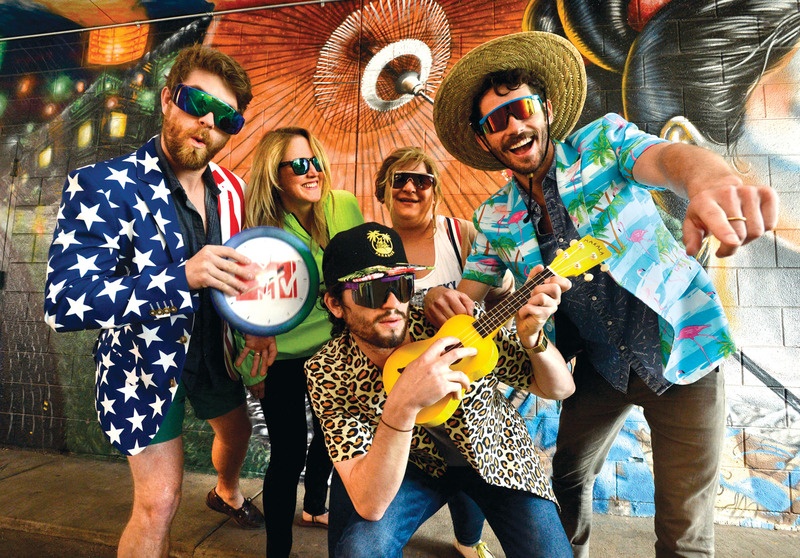
In October 2015, a producer at the Los Angeles company Critical Content wore a Shinesty suit with a zombie theme. The outfit made him curious about its makers. A demonstration shoot followed at the company’s headquarters in February 2016. Critical Content went on to film six episodes for a television series about the business.
By July 2017, Shinesty was on MTV2. The show followed White, Nicolaysen and the team as they devised ways to attract customers. Its opening episode featured the Shinebago, a mobile store, and a trip to a Denver mall. Selling attention-grabbing clothing had become attention-grabbing television.
For White, this put the company’s human machinery on display. A garment could suggest a character; a camera crew could introduce the people making the suggestion. There is a natural fit between a business organized around comic ideas and a show about the people arguing over those ideas. There is also plenty of room for distraction. A television episode can end with a laugh. The business still has orders to fill the following morning.
The laugh has to survive the second purchase
White’s product philosophy has a practical streak. In a 2018 manufacturing interview, he discussed the importance of quality and returning customers alongside the company’s deliberately ridiculous apparel. That combination matters more as the catalogue moves from party clothes to things people wear regularly.
A Christmas suit has a date in mind. Underwear has tomorrow in mind too. In November 2019, White said he wore Shinesty’s underwear every day. The business was offering matching family pajamas alongside its suits, dresses and sweaters, and was already thinking about the following Christmas. The jokes belonged to a production calendar.
By the founders’ August 2026 Operators appearance, the episode reported 14 million pairs of underwear sold. That is a reported cumulative figure, rather than annual sales. It marks how far the product mix had traveled from one-off vintage finds. The humor could still attract a buyer; a repeat purchase asked the actual garment to do some work.
“Entertainment... gives you an edge.”
Chris White, Operators, 2026
The evolution leaves White with a continuing editorial problem as well as an operating one. Each print and piece of copy has to sound like the company customers recognize. A larger catalogue offers more chances to make an impression, and more chances to become forgettable. The founder’s taste remains relevant long after the first product leaves the studio.
- 2014Vintage finds
Shinesty launches - 2015Own designs
Production begins - 2017On television
Six MTV2 episodes - 2022Inc. 5000
Ranked No. 1,360 - 2026Underwear scale
14M pairs reported
High fives, then the hard questions
White has described a daily ritual of greeting employees with high fives. He even developed individual handshakes. It is a modest detail in a business whose public personality is anything but modest, and it helps explain how he wants people to experience the workplace.
“I even have a secret/special handshake with many of them,” he wrote. The greeting makes recognition personal. A slogan about having fun is easy to put on a wall; acknowledging the people who arrive beneath it takes somebody’s time every morning.
His preferences also shaped Shinesty’s Denver headquarters. White wanted places where employees and visitors could gather, collaborate and find inspiration. The resulting rooms included a warm, berry-toned boardroom, a yellow kitchen and an aqua lobby. A neon “Stay Weird” sign faced the city view. The office carried the company’s taste into the space where the work happened.
The mood does not remove the ordinary demands of leadership. Shinesty earned a place on the Inc. 5000 in 2022, at No. 1,360. The Boulder Chamber also recognized White and Shinesty with its Startup of the Year award that year. A business that can appear carefree in a photograph has to keep accounting for its decisions outside the frame.
A joke can travel. Its voice needs a passport.
Partnerships show how White thinks about finding people who already understand the company. Denver Broncos kicker Brandon McManus bought Shinesty gag gifts for teammates before developing his own apparel line with the brand in 2018. The relationship began with enthusiasm for the clothes, a useful starting point for a company without a large sponsorship budget.
Other collaborations brought different settings into the catalogue. Jake Nodar served as guest art director for a 2022 Pride collection. In 2025, a Realtree camouflage collaboration touched something personal: White said he had worn the company’s patterns since childhood. His own history offered a reason for the pairing beyond an exchange of logos.
New customers can also require a different tone. White explained the separation of collegiate clothing brand Tellum + Chop as a way to keep Shinesty’s sometimes R-rated humor while pursuing college sports with a more family-friendly voice. The clothes could still be loud. Their social setting called for another approach to the joke.
That is where White’s story becomes more interesting than the familiar tale of a founder refusing to grow up. He has spent years changing what the company sells and how it reaches people. His attachment is to the personality running through the work, even when the work changes. The fur coat made an introduction. The business underneath it has had to learn new sizes.
Keep the conversation going
VISIT · WATCH · READ