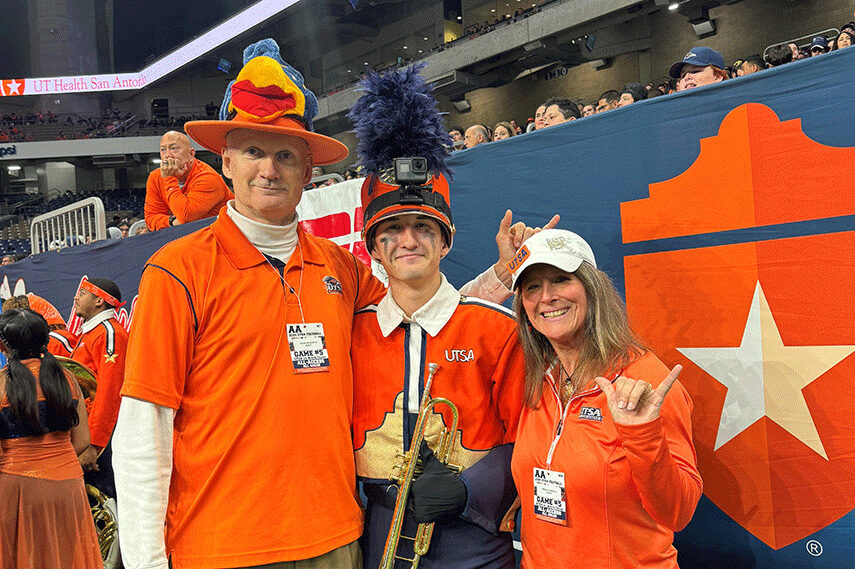
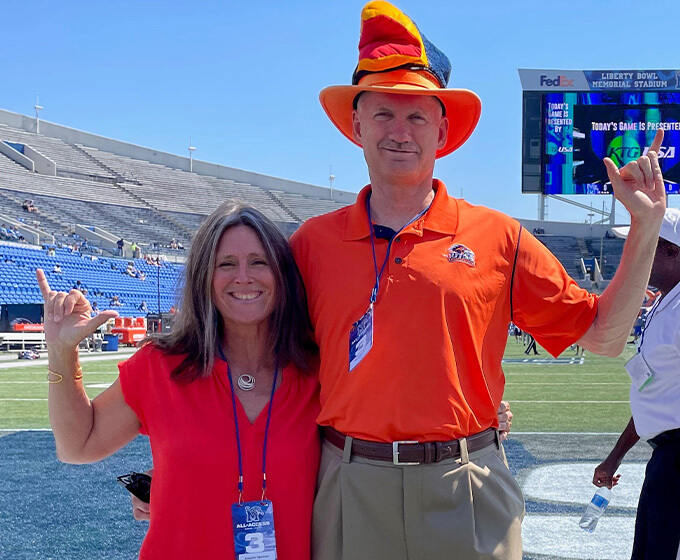
David Spencer has a photograph that makes the business biography look underdressed. He is at a UTSA football game with Jennifer, his wife, and their son Sam. The clothes are orange. Sam has his marching-band uniform. David has a hat featuring a Roadrunner. A $34 million software transaction appears elsewhere in the family history, but it would struggle to compete for attention in this picture.
The hat belongs in the story. Spencer’s public career runs through company formation, investment committees, banking and school governance. Beside those formal responsibilities sits a persistent interest in what makes people want to participate in a place. A university needs engineering students. It also needs somewhere those students can bring their friends on Saturday.
The sale that opened the next chapter
Long before Prytime Medical Devices, where he is co-founder and chief executive, Spencer founded OnBoard Software. The company began in late 1996 in San Antonio. Its work included hardware and software development for the U.S. Department of Defense and contractors, with customers connected to aircraft including the F-15, F-16, C-5 and C-17. There was considerable engineering behind the unassuming company name.
Spencer had studied electrical engineering at the University of Texas at Austin. OnBoard put technical capability inside a business he owned. Jennifer served as vice president and treasurer, an essential detail in a story easily reduced to one founder and one exit. The family’s later philanthropy also bears both their names.
On January 19, 2005, MTC Technologies announced an agreement to acquire all OnBoard’s stock. The announcement described about 75 employees and anticipated approximately $15 million in 2004 revenue. The consideration included $34 million in cash payments. Spencer agreed to stay as president after the transition. Selling the business still involved turning up for work.
Cash payments in the acquisition terms. A company transaction, not a measure of personal net worth.
It is tempting to use an acquisition as the full stop in a founder’s biography. In Spencer’s case, it works better as a hinge. What followed extended his involvement from a business he controlled to other founders, public institutions and the region in which they worked.
Planting companies in Texas
After OnBoard, Spencer formed Mandelbrot Ventures, which invested in Texas seed-stage technology companies. His civic work has also included serving as a founding board member and co-chair of the San Antonio Technology Accelerator Initiative, known as SATAI. By the time he appeared at Startup Grind San Antonio in 2013, the conversation could range across operating a company, financing one and helping organize a technology community.
Those are different jobs. An operator has customers and payroll. An investor must decide whose judgment to back. A local advocate has to think about the conditions that allow several businesses to emerge, including businesses they will never own. Spencer’s career gave him a seat in each discussion.
In September 2005, Governor Rick Perry appointed him inaugural chair of the advisory committee for the Texas Emerging Technology Fund. The fund began with a $200 million state appropriation. Its economic-development task included helping technology businesses already in Texas grow, bringing private industry, universities and state government into the same effort.
Speaking about that task in 2006, Spencer used the image of planting: “plant seeds that turn into viable, fast-growing companies with high-paying jobs.” It is a useful statement of his public ambition at that point. The object was a continuing supply of companies and jobs across Texas, with regional infrastructure strong enough to support them.
“plant seeds that turn into viable, fast-growing companies with high-paying jobs”
David Spencer · 2006
The local institutions accumulated alongside the investments. He helped found The Bank of San Antonio in 2007. From 2006 to 2014, he served as an elected trustee for Comal Independent School District. In 2008, he founded Texas Intrepid Ventures. Prytime followed in 2011, co-founded with Christopher Banas. The chronology has overlapping commitments rather than a tidy succession of abandoned interests.
An endowment with places to go
The engineering connection acquired a lasting institutional form in 2007. David and Jennifer established the distinguished chair for UTSA’s engineering dean through a $1 million gift. An endowed chair sounds pleasantly immovable. The activities supported by this one have included students building things, entering competitions and taking their work beyond a classroom.
A 2009 account described support for a student-built formula race car and competition expenses. It also described energy projects that taught students about commercialization. That last word supplies a direct link to Spencer’s business interests: taking a technical idea and finding a route into the world requires experience as well as coursework.
The chair gives the dean discretion to strengthen teaching, research and outreach. That flexibility matters to the nature of the gift. A donor cannot know every opportunity a future class will encounter. Leaving room for decisions by the people working with students lets the support travel into circumstances its founders could not have itemized in advance.
Current chair-holder Eric Brey describes support for student organizations, leadership, community and national competitions. The enduring object is opportunity to practice. Students have to organize themselves, divide the work, represent their university and see how an idea behaves when somebody outside the classroom examines it.
David and Jennifer Spencer’s founding gift for the engineering chair, established in 2007.
In 2018, UTSA’s Alumni Association recognized Spencer with its Distinguished Service Award. The award includes friends and supporters of the university as well as graduates. That distinction fits his connection precisely: Jennifer is the UTSA alumna, while David’s engineering degree came from Austin. His university loyalties have made room for a second campus.
The case for a very orange Saturday
Then there is the BruteSquad. The name suggests an organization with a complicated initiation ceremony. Its public proposition was rather friendlier: engineering advisory council members and other supporters hosting tailgates, displaying student projects and making campus life more sociable. An engineering T-shirt could be a student’s admission ticket.
At these gatherings, student groups brought race cars, concrete canoes and catapult-competition work. Spencer explained their purpose as support for engineering and the overall student experience. The group also raised more than $18,500 in the season described in a 2013 university account, distributing the money to engineering and spirit groups.
There is good conversational sense in putting a concrete canoe near a football crowd. Its very existence raises questions. Students get to explain what they have made to someone who has not spent the semester making it. The resulting conversation can begin with curiosity rather than a request for a grade. Tailgating supplies a wonderfully informal exhibition hall.
David and Jennifer also made an early $250,000 commitment to UTSA Athletics. When it was announced in 2010, the football program was still preparing for its first season. Part of the commitment involved a suite purchase over five years. Spencer’s explanation connected football with giving students an enjoyable campus experience. He was willing to back that argument before the team had played its first home game.
The support continued. In 2020, the couple contributed another $250,000 toward the Roadrunner Athletics Center of Excellence. Their university interests have extended to cybersecurity, scholarships, the Honors College and the marching band. Over time, an institution can become part of a family’s routine as well as its giving.
Sam supplied a particularly personal connection. By November 2024, he was a UTSA freshman studying music education and playing in the Spirit of San Antonio Marching Band. The family photograph brings years of campus support down to the scale of parents standing beside their son. There is plenty of institutional history behind it. There is also an unmistakably proud family in front.
The work that keeps him close
Spencer remains listed as Prytime’s chief executive. His connection to UTSA also reaches into hiring and internships: in the university’s November 2024 account, four of the company’s 35 employees were UTSA graduates. Those are dated figures, but they offer a concrete example of university support and local employment meeting inside the same career.
The exchange with students has also included speaking. In March 2022, UTSA announced an entrepreneurship boot camp with Spencer among the scheduled presenters. The program brought business planning, early-stage investment and company formation into a public university setting. Registration was free for the university community and the general public. For someone who has occupied several positions around a startup, an event like that offers a place to share experience before a student has a company of their own.
His name also appears on UTSA’s Development Board roster, an organization concerned with broadening resources and advocating for the university. It is another ongoing connection alongside the named chair and the football commitments. Read together, these activities give the university relationship several forms: financial support, organizational involvement, opportunities for students and family participation. A large gift is easy to mark on a timeline. The recurring involvement is what gives that date company.
He has a small working habit that suits this crowded biography. In 2017, he described choosing one priority for the following day, then spending the first 15 to 30 minutes on it before opening communications. The practice gives a task a brief head start on everybody else’s demands. Even a career full of organizations still arrives one morning at a time.
“What’s good for UTSA is good for San Antonio,” he has said. The sentence is short enough to carry across the different parts of his work. The software company changed ownership. The university support continued. Another class entered engineering, another student group built a project, and the family found another reason to put on orange.