Bill Greehey had already built a refining company when a television program gave him another construction project. In December 2005, as his time running Valero drew to a close, he watched a local report about homelessness in San Antonio. The people on the screen lived in the city where he had made his career. Their difficulties were close enough to drive past. He decided they were close enough to do something about.
What followed required several years, a coalition of public officials and private donors, and a campus that cost about $101 million to build. Haven for Hope became fully operational in June 2010. The leap from petroleum refining to helping people find stable lives looks considerable on a résumé. Look at Greehey's career a little longer, though, and a familiar habit emerges: he kept accepting problems that came with an inconvenient number of moving parts.
A college degree, paid for in parking spaces
He was born in Fort Dodge, Iowa, in 1936. His father worked in a gypsum mill; his mother cleaned houses and tried running small businesses. There was affection at home and little money. Later, when he described that childhood, Greehey placed particular value on the neighbors who helped one another and the church around which community life revolved. The financial account and the emotional account had very different balances.
The Air Force brought him to San Antonio. After military service, the GI Bill helped him attend St. Mary's University, where he studied accounting. He had a family to support and worked nights and weekends parking cars at the Nix. College was fitted around the work that paid for college. In 1960, he graduated with a business administration degree and went into accounting himself.
At Price Waterhouse, his first salary was $450 a month. His father observed that the mill or a meatpacking plant could have paid more. It was an entirely respectable piece of arithmetic, with one missing variable: where the job might lead. Greehey moved to Exxon's internal auditing operation and then, in 1963, to Coastal States Gas. An accounting qualification had given him a route into an industry he would eventually help reshape.
At Coastal, an unglamorous assignment became an opening. The company needed someone to understand the terms attached to a bond issue. Greehey learned them well enough to explain them to the board. For an ambitious young accountant, a difficult document had one advantage over an impressive job title: it gave him something useful to say in a room full of senior people.
Valero began with an argument
The company's subsidiary LoVaca Gathering had contracted to supply natural gas it could not deliver. Texas customers, including cities, took legal action. Greehey was put in charge during the crisis. The eventual settlement was valued at $1.6 billion and produced a new enterprise. On January 1, 1980, Valero Energy Corporation began life as LoVaca's corporate successor. Its name came from Mission San Antonio de Valero, the Alamo's original name.
A company born from a settlement hardly arrives with the romance of a garage startup. It arrives with paperwork, bruised relationships and people who would like their gas delivered. Greehey's founding task was to make an operating business out of that inheritance. The starting point matters: Valero's subsequent expansion grew out of a pipeline company whose earlier difficulties had demanded negotiation as much as financial expertise.
Refining became the central bet. Valero commissioned its full-scale Corpus Christi refinery in 1984. Later, the company separated its natural gas business from its refining assets. Three refineries acquired from Basis Petroleum in 1997 changed its scale; the purchase of Mobil's Paulsboro plant took it into New Jersey the following year. A company with Texas roots was acquiring a much wider address book.
The growth was neither automatic nor comfortable. In the mid-1980s, the Corpus Christi investment ran into difficult market conditions, and Valero carried heavy debt. Asset sales and a restructuring of its pipeline interests helped it through. That episode gives the later acquisitions some necessary weight. Greehey's appetite for refining survived an expensive lesson in how quickly a promising industrial calculation can become a problem for the balance sheet.
At the end of 2005, he stepped down as chief executive; he left the chairmanship in 2007. By then, the business had become a major North American refiner. His next corporate chapter was NuStar, the pipeline and storage company that separated from Valero in 2007. He remained its chairman until October 2022. Retirement, in his case, had acquired rather a long appendix.
A different sort of campus
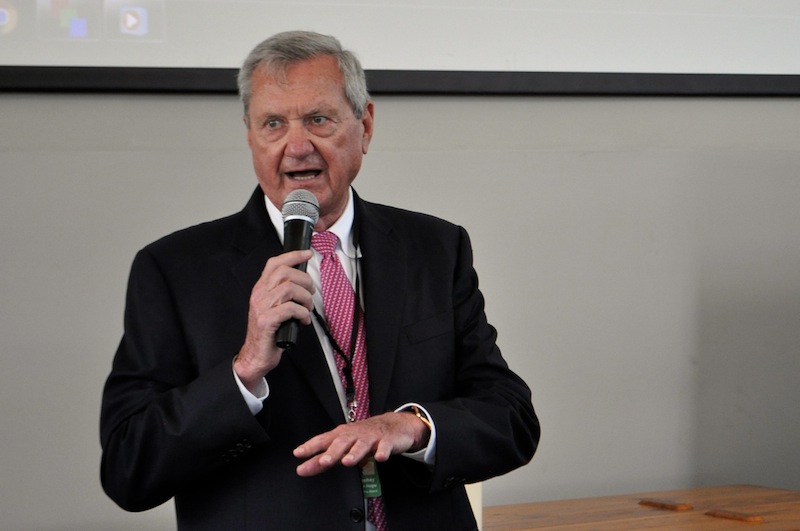
For Haven for Hope, the organizing problem was painfully practical. San Antonio already had organizations helping people experiencing homelessness. Their offices were spread around the city, their administration disconnected. Someone without dependable transport could face a complicated journey merely to reach help. Agencies could ask for the same information repeatedly. Good intentions, distributed across town, still left a person with a bus journey and another form.
Greehey worked with city leaders, including Mayor Phil Hardberger, on a more connected arrangement. The planning effort examined more than 200 shelters over 18 months. The resulting design brought providers together on one campus. The ambition was tangible: fewer gaps between the organizations offering assistance and the people trying to use it. Research preceded construction, an orderly sequence that public enthusiasm does not always manage.
The campus covered 22 acres. More than 60 percent of its construction funding came from the private sector. Greehey's contribution involved persuading other people to put money into the project as well as giving his own. Business experience was useful here in a very direct way. A building needs financing, partners need an agreement, and someone needs to keep turning a proposal into a place.
Original campus fundraising effort
Historical construction figures, not an annual operating budget.Its purpose also demanded patience beyond opening day. A campus can bring services within walking distance; it cannot manufacture enough affordable housing outside its gates. In a later television interview, Greehey pointed to people waiting for housing vouchers, including veterans. That concern puts a useful boundary around the achievement. Haven could improve access to assistance while the city still needed places people could afford to live.
He stepped down as Haven's board chairman in November 2022, with Barbara Gentry succeeding him. His continuing title is founder and chairman emeritus. The change gave the organization a new board leader while keeping its founder connected to the work. For a project so closely associated with one person's persistence, leadership beyond that person is part of the construction too.
The scholarship goes back to the beginning
At St. Mary's, Greehey's giving circles back to the opportunity that changed his own prospects. A $25 million gift in 2005 led to the naming of the Greehey School of Business. The institution now puts his gifts and pledges above $40 million. His connection has included service on its board of trustees as well as financial support. The former student who parked cars became someone able to pay for other students' opportunities.
The Greehey Scholars Program makes that connection specific. It offers renewable four-year scholarships covering tuition, with stipends for study abroad and funding for program activities such as business travel. Ethical leadership, professional preparation and community service sit alongside the academic work. The design gives students both financial room and responsibilities. A scholarship can remove a bill; this one also asks its recipients to consider what they owe their surroundings.
“You're never a success unless you share that success.”
Bill Greehey
In May 2026, Lois Traynor became the first student from South San Antonio ISD accepted into the program. She planned to study accounting after meeting a St. Mary's accounting professor. There is a pleasing echo in that detail: another prospective accountant, another arrival at the same university, several decades after Greehey's own. Her achievement belongs to her. His gift helped make the next stage possible.
His education giving also reaches Iowa. A $1 million foundation gift supported scholarships for first-generation students at Iowa Central Community College. Greehey had been a first-generation college student himself. Supporting students in Fort Dodge gives the story a geographical loop as well as a financial one. The place he left to find opportunity remains a place where he has helped finance it.
Leaving the work in other hands
Bill and Louree Greehey established their family foundation in 2003. Its giving centers on San Antonio and Bexar County, supporting nonprofit organizations and educational opportunity. In May 2026, it appointed Kim Harle Solis as its first executive director. The current board lists Lisa Rosenbloom as chair and president, with Bill as founder and chair emeritus. The family name is staying attached to an institution with other people doing the daily leading.
That arrangement fits the public intention he expressed when he left NuStar's board: to stay involved in philanthropy and support Haven and other local nonprofits. His corporate titles had changed. The commitments continued. The latest chapters of this life are visible in an operating foundation, a student beginning college, and a campus whose board no longer needs its founder in the chairman's seat.
Greehey's career can be told through transactions, plant acquisitions and dollars raised. Those are useful measures. They also lead back to a smaller scene: a student working nights so he could sit in class by day. He learned what one institution could make possible for a person. Decades later, he had the money, the contacts and the inclination to build a few more.
Follow the work
Organizations, interviews and further reading.
The Greehey Family Foundation ↗Greehey at Haven for Hope ↗A new Greehey Scholar, May 2026 ↗Watch: The Founder and the Faithful - KSAT ↗Watch: Valero's company history - YouTube ↗Haven for Hope's board transition ↗Valero's history ↗William Greehey on Wikipedia ↗