Zohar Zisapel had an unusual use for a corporate website. Alongside the business of connecting computers, he offered visitors difficult mathematical riddles. Solve one, and there might be money in it. An engineer’s leisure activity had wandered into the sales department, where it was apparently quite comfortable.
That small detail helps explain a career usually told through company names. Zisapel, who lived from 1949 to 2023, co-founded RAD with his brother Yehuda. He spent decades working on technology, backing ventures and helping other people become founders. Yet the familiar picture of an executive assembling an ever-larger organization never quite suited him.
He enjoyed beginnings. The next problem. The next capable person. The possibility that a promising idea deserved a business of its own. Follow those preferences, and the story becomes less about a tower with his name on it than about the doors he helped other people open.
A modem, and a reason to make it
He was born in Tel Aviv in 1949. His parents, immigrants from Poland, ran a shoe shop on Herzl Street. There were three children. Zohar went on to earn bachelor’s and master’s degrees in electrical engineering at the Technion, then an MBA at Tel Aviv University. The route from the shop to the laboratory was also a route through education.
His early experiments were more entertaining than an academic résumé suggests. He assembled a stereo system and tried his hand at manufacturing lighting for discotheques with Effi Wachtel, whom he knew from the Technion. Long before data networks, there were people who wanted a dance floor to flash at the appropriate moment. Electronics could solve that problem too.
He later led the Ministry of Defense’s Electronic Research Department and received the Israel Defense Prize in 1979. Yehuda, meanwhile, had built Bynet around selling communications equipment. The brothers had complementary experience: one close to the technology, the other close to the customer.
They founded RAD in 1981. Zohar later recalled that he began work after leaving military service in January 1982. The ambition was concrete: manufacture networking products in Israel and sell them abroad. Bynet helped finance the beginning; their own sales would have to support what followed.
RAD’s early commercial success was a miniature modem. A later version earned a place in the 1992 Guinness Book of Records for its small size. In a business concerned with linking machines, compactness gave the brothers something distinctive to sell. The object was modest enough to hold. The market lay well beyond Israel.
There was a marketing problem before there was a marketing triumph. Foreign buyers associated Israel with agricultural exports. Zisapel remembered hearing, “we’re buying oranges, not modems”. A small country’s new export sometimes has to introduce itself twice: first as a product, then as evidence that the country makes such products at all.
Let the next idea have its own address
As opportunities accumulated, the brothers supported independent companies. Their shared experience could help a new venture with sales, manufacturing and human resources. Those services had costs, but a young company could obtain them more economically than by assembling everything alone. Independence came with practical assistance.
Zohar’s explanation was refreshingly plain: “I don’t like big organizations.” He preferred starting ideas in smaller ones. By 2009, he described a rhythm of roughly one new company a year. There was a limit to how much the brothers could responsibly undertake. Even an enthusiasm for beginnings needed a calendar.
The model makes sense when viewed from an engineer’s desk. A new product can demand a different customer, a different team and a different way of selling. Giving it a separate company creates a place for those differences to be taken seriously. The founder gets an undertaking to own; the original company need not stretch into every adjacent market.
The partnership also made room for disagreement. Zohar described Yehuda as stronger in sales and marketing, himself as more technically oriented. They divided responsibility between companies. When both brothers agreed, he felt the idea had passed through two different sets of instincts. Family resemblance was less useful than a second opinion.
A good mentor answers the kitchen question
For Ofer Ben-Noon, the relationship was close enough to involve frequent calls and trips between floors of the same building. His recollections make mentorship sound wonderfully unceremonious. Questions concerned hiring, office spending and even the kitchen. Zisapel treated them as decisions worth discussing.
Over time, the calls became less frequent. Ben-Noon also grew more willing to depart from the advice. The two disagreed, with some amusement, about just how often he did the opposite. There is something reassuring about a mentor whose pupil can argue about the score.
The photograph of them celebrating Hanukkah catches another part of that relationship. Company histories usually show launches, signing ceremonies and executives arranged around a table. Here, the table has candles. Business connections had become part of ordinary life.
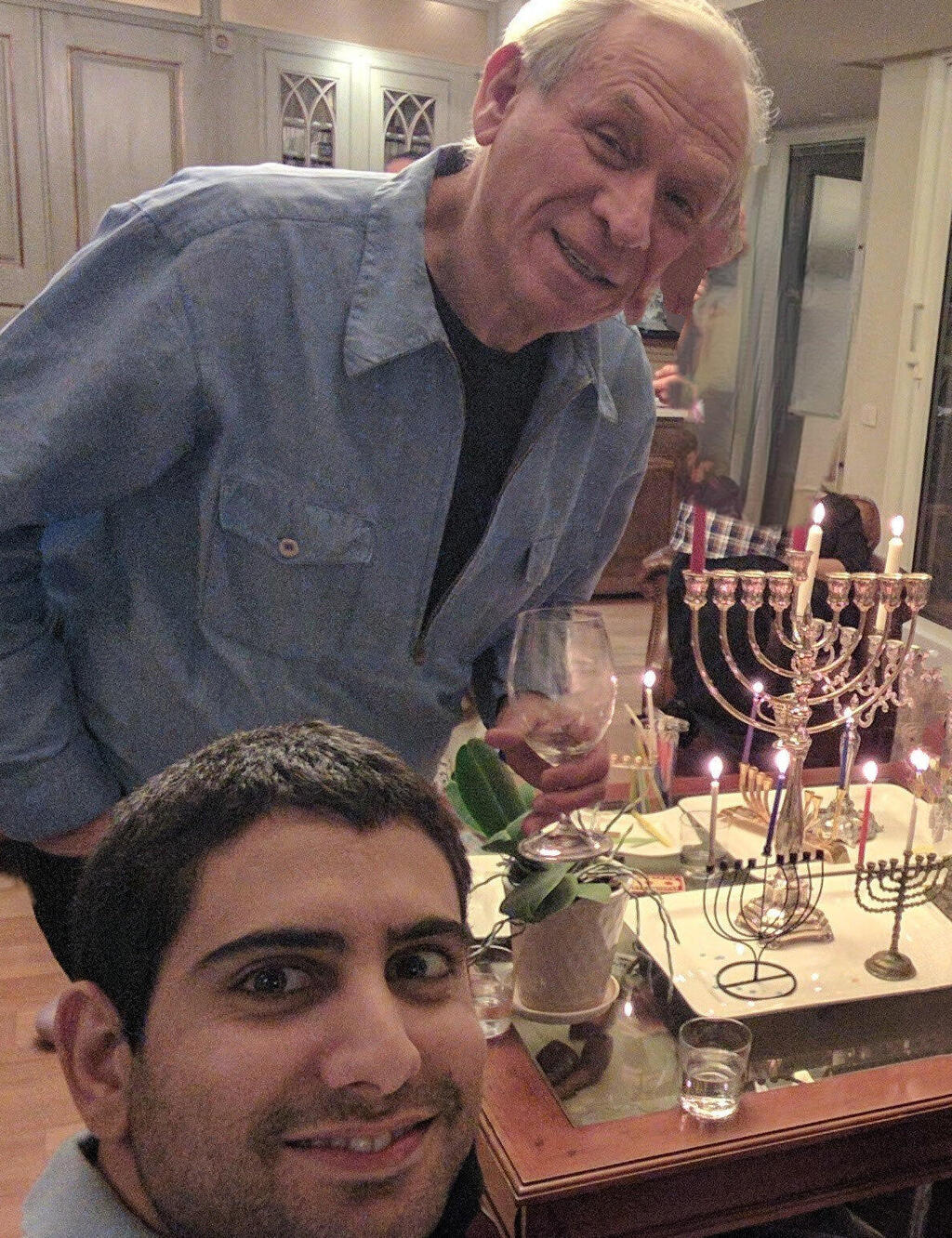
Others remembered a similar availability. Hailo identified him as its first investor and chairman, and recalled his approachability and encouragement. Ceragon chief executive Doron Arazi remembered conversations that could be both calming and empowering, even when the two did not agree. Advice can be forceful without making its recipient feel small.
The riddle beside the product catalog
“I’ve always loved brainteasers - the more difficult the better,” Zisapel said. His circle of puzzle enthusiasts enjoyed finding answers for themselves. The pleasure lay in the work between the question and the solution, a stretch of time that an impatient person might consider entirely avoidable.
RAD’s public competitions gave that interest a wider audience. The harder problems carried larger prizes. In 2005, an unresolved advanced challenge prompted the company to extend the deadline and offer $1,000 to the first correct respondent. A telecom company was asking the public to think harder, and putting cash behind the request.
By 2006, one difficult mathematical problem had offered $5,000 for its highest level. Three people solved it. The organizer’s interest extended to whether the winners might continue their studies. A puzzle on a commercial website could unexpectedly become a conversation about education.
There is an appealing lack of polish about the pastime. A product catalog tells you what a business wants to sell. A difficult riddle tells you what its founder likes doing when nobody has asked him to sell anything. Both belonged on the same website.
“I don’t like big organizations.”
Zohar Zisapel · 2009
Pictures on the walls, books by the window
Zisapel collected visual art over decades. Much of the collection was displayed in RAD Group offices; works were also loaned to museums, individuals and other technology companies. The pictures had a working life beyond a collector’s private rooms.
An office can be an efficient place to keep a painting, provided one accepts that its audience will sometimes be thinking about an entirely different problem. Engineers passing between tasks get to encounter something without a specification sheet. A useful room does not have to contain only useful objects.
His daughter Klil became a writer and artist. An early portrait of his office noted stacks of her books by a window. It is a lovely domestic detail inside a business story: the founder who had many professional undertakings also had a daughter whose work he wanted close by.
His long-term partner, entrepreneur Heli Bennun, belonged to that world of both personal and professional relationships. The photograph of them together offers a quieter counterweight to a résumé crowded with companies. Nobody’s life is adequately described by the boards on which they served.

The next engineer needs a place to start
He and Yehuda also helped put computers into educational institutions serving disadvantaged young people. That is a practical intervention: equipment gives a student something to use, while an opportunity to study gives the equipment a purpose.
Their connection to the Technion continued long after graduation. They supported the Sara and Moshe Zisapel Nanoelectronics Center, named for their parents. The center was dedicated in 2007. An education received by two brothers became part of the facilities available to others.
In 2019, the brothers announced support for another building at their engineering faculty. The gift addressed the institution where they had learned their trade. Funding a place to train engineers connects the beginning of a career to the beginning of someone else’s, without requiring the donor to know what that student will eventually build.
The new Electrical and Computer Engineering Building was inaugurated in June 2022: eight stories and 5,400 square meters. Space can sound like an oddly prosaic achievement next to a startup. Yet teaching and research need rooms. Students need somewhere to sit. Ambition occasionally requires a floor plan.
Eight stories for electrical and computer engineering, made possible by the brothers’ donation.
That same month, the brothers received the Technion Medal. Zohar had already received an honorary doctorate in 2001. The later recognition drew together their industrial work and their educational commitment. The connection was visible in the building itself: the people trained here might someday need a place to begin a business.
Who gets to build next?
His interests kept moving. Telecommunications led into cybersecurity, automotive technology and artificial intelligence. In 2019, he described doing his own investment research because learning about a company was part of the enjoyment. Paying someone else to take over the interesting part would have rather defeated the purpose.
When he died in May 2023, RADCOM remembered a co-founder who had served on its board since the company’s beginning in 1985. The years matter because they show continuity behind the appetite for new ventures. Starting something else did not automatically end the relationship with what came before.
Near the end of his life, Zisapel resisted being assigned sole parentage of Israeli high-tech. “High-tech has dozens of fathers,” he said. He described people establishing companies, then their employees doing the same. The story kept acquiring authors.
It is a fitting way to read his own career. A small product made a business possible. A business gave people experience. Some of those people built again. The classroom, the patient conversation and the independence of a new company all helped someone take the next step. Zisapel liked beginnings. He left plenty of people equipped to make their own.