A coffee shop is a perfectly sensible place to begin a company that will eventually treat a billion gallons of water a day. There are tables. There is caffeine. And, for a little while, nobody expects you to have installed any industrial equipment. David Sisk remembers Streamline Innovations beginning in just such a place. By November 2025, he was describing a business with more than 70 VALKYRIE units deployed and a daily water-treatment footprint exceeding a billion gallons.
The distance between those two scenes is the interesting part. Sisk, the San Antonio company’s co-founder, chief executive and director, has built his working life around things that must function outside a presentation: engineering, military service, energy operations and industrial technology. Streamline carries that history into a decidedly unglamorous assignment. It removes hydrogen sulfide from gas and water. There is no elegant way to put a treatment vessel in your pocket. The attraction lies in what happens when it works.
Company-reported milestones, November 2025. Gas and water operations are separate measures.
Engineering, with a detour through theology
Sisk’s education makes an unusual reading list. He holds a bachelor’s degree in mechanical engineering from the United States Military Academy at West Point, a master’s in historical theological studies from Redeemer Seminary, and an MBA from the University of Texas at Austin’s McCombs School of Business. Mechanics, history, theology and finance are a fairly substantial set of lenses through which to inspect a problem.
He served eight years as an engineer officer across the U.S. Army and Army Reserve, including service in Iraq and Afghanistan, and received the Bronze Star. Those are concrete parts of his biography; they also place his subsequent business career in a wider frame. Before customers, capital structures and treatment systems came the responsibilities of an Army engineer.
His civilian résumé includes Pioneer Natural Resources and a role directing product strategy at WellAware, which brought data and intelligence to oilfield operations. He also worked as a management consultant at Harris Preston & Partners. Seen together, these jobs describe a route through physical infrastructure, information and investment. Each would later have a place in a business that combines chemistry, machinery, software and the money to deploy them.
The useful thing about an old reaction
Streamline dates its founding to 2016. Its central commercial proposition concerns a familiar industrial nuisance: hydrogen sulfide, generally shortened to H₂S. Sisk’s company builds systems to remove it from gas and water streams across energy, industrial and municipal applications. His opportunity was to make an established area of treatment work better as a complete operation.
Consider the gas-treatment process. VALKYRIE uses Streamline’s TALON chemistry in a reduction-oxidation reaction, converting hydrogen sulfide into elemental sulfur. The chemistry is regenerated, then circulated again. Sulfur is separated out. The treated gas continues through the system. Repetition is the point: a working cycle can reduce the need to keep consuming and discarding treatment materials.
The recovered sulfur can be used as an agricultural soil amendment. That is a pleasingly literal change of occupation for a troublesome constituent of an industrial gas stream. It also gives Sisk a concrete way to discuss environmental performance. There is a material entering a process, a treatment taking place and a recoverable output leaving it. The argument has pipes attached.
↶ Regenerated chemistry returns to the treatment cycle
A control room is part of the invention
The chemistry tells only part of Sisk’s story. In 2024, he described taking a technology with roughly half a century behind it and adding patented automation and process control. The combination allowed plants to operate remotely and automatically. His point was refreshingly practical: industrial innovation can consist of making an existing process easier to run, in more places, with better oversight.
“We have a control room in San Antonio,” he explained. That room gives the business round-the-clock operational control over plants around the country. The geography matters. Treatment equipment has to sit where the gas or water is; expertise can be connected to it. San Antonio becomes an operating base for assets that are physically elsewhere.
Streamline’s VALKYRIE Intelligence Platform connects local monitoring and automated controls with remote supervision. Its service packages include performance calculations, process optimization and cloud-backed operating data. Operators can monitor systems through phones as well as the control room. The company also provides technicians and operating support, up to taking responsibility for the entire operation.
There is something revealing about this arrangement. Sisk’s product-strategy background at an oilfield data company and his later treatment business occupy adjoining territory. Both involve understanding what is happening in an industrial setting and making that information useful. The connection is visible in the work itself, without requiring a tidy conversion story or a single flash of inspiration.
His name is in the patent paperwork, too
Sisk’s involvement extends beyond the chief executive’s title. He is named alongside Peter Photos and other collaborators on patents assigned to Streamline. A 2023 grant concerns separating sweet gas from a sour gas stream. The invention addresses the behavior of foam and emulsions within the treatment equipment, using staged separation and automatic level control.
It is an admirably specific problem. A company may describe its mission in expansive language; inside a vessel, the foam still needs somewhere to go. Patent records offer a different scale for understanding the founder’s work: dimensions, flow, separation and the awkward conduct of materials. Growth depends partly on getting these small, physical arguments settled.
Another granted patent, from 2022, names Sisk and Photos on a well-bore energy-storage unit. It describes an energy-storage device installed in an earthen well. A patent establishes an invention’s recorded claims, rather than proving a commercial installation. Even with that distinction, the subject shows an engineering interest extending beyond the treatment system for which Streamline is known.
The customer buys an operating answer
In describing the business in December 2024, Sisk emphasized its scope of responsibility. Streamline could handle plant construction, operation and maintenance together. He discussed ten plant variants and continuing work on the chemistry, alongside expansion from oil and gas into renewable natural gas, including landfill and dairy applications. The recurring contaminant supplied the connection between otherwise different customers.
His explanation of customer relationships was equally operational: regular communication, updates and attention to problems. That detail gives the machinery a human dimension. Somebody still has to answer when conditions change. A regenerative reaction does not regenerate a customer’s patience; the service organization has to do its own work.
For Sisk, the environmental and commercial arguments travel together. He talks about waste reduction, uptime and the costs of running a facility. His stated ambition has been to apply the technology more widely, including international markets such as the Middle East. The proposed route includes partnerships with businesses already established in gas processing and in new regions.
A trophy, followed by a change in ownership
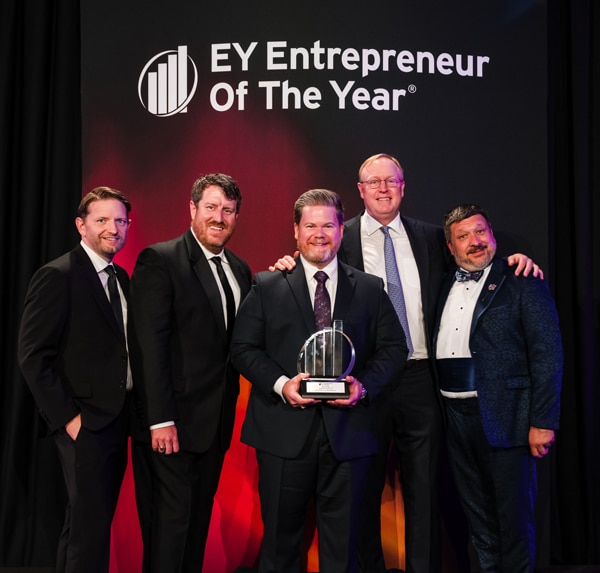
In June 2025, Sisk became an EY Entrepreneur Of The Year Gulf South regional award winner. He accepted the recognition on behalf of the Streamline team, crediting its work and persistence. The ceremony supplied the photograph: a founder holding a trophy, flanked by colleagues. For a business built around shared technical and operating responsibilities, it is an appropriate group portrait.
Two months later came a different kind of milestone. Streamline announced a recapitalization involving equity from Eldon Pass, strategic investment from Select Milk Producers and its affiliates, and a unitranche loan arranged and led by Proterra Investment Partners. The transaction also redeemed the majority of existing equity holders and simplified ownership.
The dairy connection had industrial logic. Sisk had already identified renewable natural gas as a growth market, with dairy farms among its applications. A relationship with Select Milk placed a dairy cooperative among the company’s stakeholders. He described opportunities through that relationship while saying Streamline would continue to operate independently.
The financing was intended to support expansion in energy and additional industrial markets and regions. For a chief executive, that stage brings a different assignment from designing a treatment process: maintaining relationships with earlier backers, bringing in new stakeholders and deciding where to put the next resources. The coffee-shop table had acquired a considerably more complicated seating plan.
What comes after the milestone?
By November 2025, Sisk was an EY national finalist, selected from that year’s regional winners. He returned to the coffee-shop origin when describing the journey and again put the team at its center. His reaction to the scale already reached was to look toward the work ahead.
“I still feel like we are just getting started.”David Sisk, November 2025
In March 2026, the Aspen Institute named him to its new class of Henry Crown Fellows. The fellowship gathers established entrepreneurial leaders for four weeks of structured retreats over two years, exploring values, leadership and the society they want to help build. Each fellow also undertakes a leadership venture with a public or community purpose.
That adds a new setting to Sisk’s biography. Alongside the engineer’s technical problem and the executive’s commercial problem sits an explicit invitation to consider a wider contribution. The class spans businesses far removed from gas treatment. It puts him in a room where knowing how to run a plant is useful experience, though hardly the only subject on the agenda.
Sisk lives in San Antonio with his wife and five children. He is also listed as a venture partner at Mission 3A, adding another connection to founders and company building. His life now includes a treatment business operating across multiple sectors, an entrepreneurial network and a fellowship asking what leadership is for. The question ahead is how he uses those responsibilities. The equipment, meanwhile, has work to do.