Before Shane O’Kelly had thousands of auto-parts stores to think about, he had a used 1982 Toyota Celica Supra. He grew up in rural upstate New York, where getting a driver’s license meant gaining access to a much larger world. The car belonged to that early discovery of freedom. Decades later, announcing his arrival at Advance Auto Parts, he reached back to it to explain why the job felt personal.
There is something useful about beginning his story with a used Toyota. The automotive aftermarket exists because people keep cars going. A replacement part is a small purchase with consequences beyond the receipt: a vehicle back in service, a job finished, a day recovered. O’Kelly’s task is to make a sprawling business dependable at precisely that small, consequential moment.
He became Advance’s president and chief executive officer on September 11, 2023, succeeding Tom Greco and joining the board. He arrived from HD Supply with years of experience moving products through complicated networks. His new employer needed that experience. Enthusiasm for cars was a welcome addition to the résumé; the job would require considerably more than enthusiasm.
A driver with room for the dogs
His automotive tastes have room for both the racetrack and the school run. In a 2024 conversation, O’Kelly described having owned a Porsche 911 that he drove at Road Atlanta. He also described an Audi commute and a Honda Odyssey minivan, the latter explained by three children and two dogs. Even a car enthusiast eventually encounters the persuasive mathematics of seating capacity.
He followed endurance racing at Le Mans and NASCAR, too. “For me, driving is relaxing,” he said. It is an appealing detail for someone whose working days involve the less relaxing business of making sure other people can drive. The pleasure of a car and the practical necessity of maintaining one sit comfortably together in his account.
The same 2024 profile pictured him doing Advance’s red basket challenge with store driver Reese Markell in Hesperia, California. The exercise trains employees to assemble related products for customers’ projects. It is a modest scene, and a revealing one: the chief executive learning through the actual contents of a customer’s basket.
- 1990-1997U.S. Army infantry officer
- 2011-2018PetroChoice CEO
- 2020-2023HD Supply CEO
- 2023 onwardAdvance Auto Parts CEO
Seven years before the business suit
O’Kelly studied mathematical economics at the United States Military Academy at West Point and served seven years as an Army infantry officer, from 1990 to 1997. He completed Airborne and Ranger schools, and held responsibilities as a rifle platoon leader and company commander. His military service included deployments with the 1st Cavalry Division and the 325th Airborne.
One memory has stayed with him across the change of uniform. In a public recollection in 2022, he described arriving at his first Army assignment, the 3/325 Airborne, under Lieutenant Colonel John P. Abizaid. Members of the unit received a page of advice about responsibility, learning and admitting mistakes. Thirty years later, he was still passing its ideas along.
That recollection gives the military chapter a particular texture. Alongside schools and commands, he remembered a sheet of paper about how to behave. Its usefulness had survived a succession of jobs. In a business career full of changing organizations, it offered a portable set of expectations about the person doing the work.
He earned an MBA at Harvard Business School, worked at McKinsey, and joined Home Depot in 2003 as director of strategic business development before becoming a regional vice president. Consulting and store operations brought him into different kinds of decisions: how a business should work, and how it works when employees and customers arrive.
The education of a distributor
From 2008 to 2011, O’Kelly led construction-supply distributor A.H. Harris & Sons. Then came PetroChoice, where he was chief executive from 2011 to 2018. The products changed, but the recurring business problem remained recognizable: customers needed supplies, and a network had to get those supplies to them reliably.
By July 2017, PetroChoice had completed 16 acquisitions during his tenure and operated 51 locations serving 32 states. Those numbers describe a different challenge from simply opening more doors. Acquired businesses arrive with people, practices and customer relationships. Growth creates the work of making those pieces function together.
That year he joined the Petroleum Quality Institute of America’s advisory board. The institute tests lubricants and reports on their quality. His involvement extended the distribution story beyond where a product goes to whether it meets the standards expected of it. Delivery and trust belong to the same transaction.
He subsequently led Interline Brands, which became Home Depot Pro, and then HD Supply after Home Depot acquired it in 2020. At Home Depot’s 2023 investor conference, he described the integration of Interline and HD Supply into a single maintenance, repair and operations platform. It was an argument built around the practical benefits of combining businesses.
In that presentation, the network offered next-day delivery from 160 distribution points. A national footprint mattered because it could support a local promise. Viewed across these jobs, O’Kelly’s career has a consistent shape: putting scale to work for customers whose needs are specific, immediate and seldom improved by a complicated organizational chart.
What a parts counter asks of a CEO
At Advance, that experience met a business serving two overlapping audiences. Professional installers need parts to complete customers’ repairs. Do-it-yourself customers need parts for vehicles they maintain themselves. Advance’s blended box approach serves both. Making that model work requires decisions about inventory, distribution and the service available at the store.
The shorthand is almost disarmingly plain: right part, right place, right service. In an April 2026 DriveTime interview, O’Kelly discussed availability and delivery speed as central customer concerns. Behind the language sit choices about which products to stock nearby, how stores obtain less common items and how quickly an order can reach the person waiting.
O’Kelly’s turnaround also involved subtraction. Advance agreed in August 2024 to sell automotive-parts wholesaler Worldpac to Carlyle for $1.5 billion. The sale was intended to simplify the company and concentrate attention on the blended box business. Separately, a three-year plan announced that November included closing 523 corporate stores and exiting 204 independent locations.
The closures made the strategy consequential for employees and communities as well as investors. A smaller footprint may make a network easier to operate, but a closed store is a local event. Any assessment of O’Kelly’s tenure has to hold those effects alongside the promised improvements in merchandising and distribution.
The quiet person gets a turn
On May 7, 2025, O’Kelly sat down with lecturer David Moura at Elon University’s Lessons from Leaders event. Among his advice was a practical suggestion for quieter students: arrange regular individual conversations with a supervisor. Visibility, in that account, can be earned through a steady working relationship rather than through the volume of a contribution in a crowded meeting.
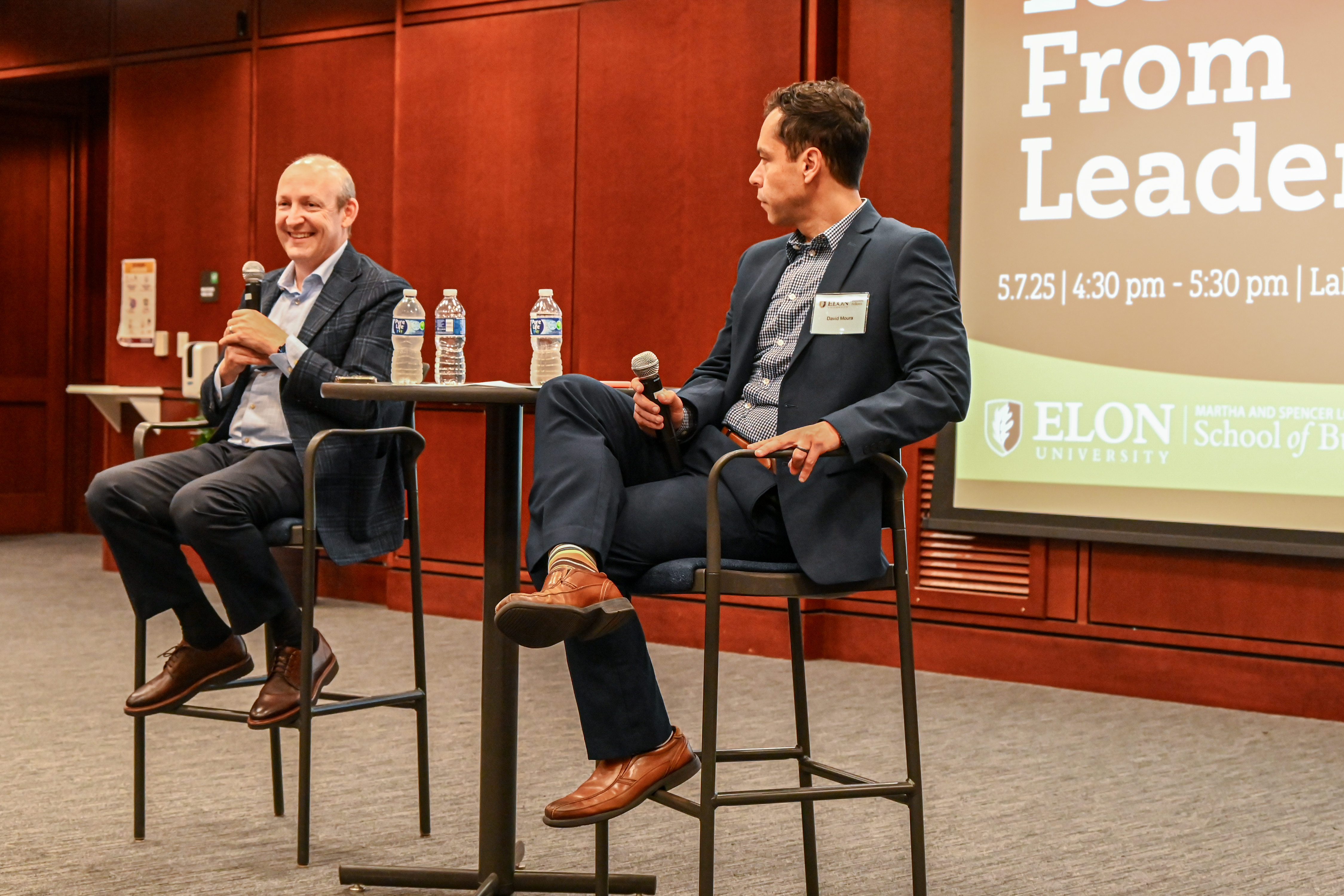
He also recalled the first time he dismissed an employee and connected that experience to the importance of careful hiring. Students asked about the economics of using specialist manufacturers for private-label batteries. He explained that owning production could absorb capital better directed toward customers. The conversation moved easily between managing people and deciding where money belongs.
“Work hard, stay humble, listen well.”
Shane O’Kelly, speaking at Elon University, May 2025
His public field reports offer another view of those priorities. He described time in South Carolina stores observing service to professional customers. An earlier account from HD Supply’s San Jose operation singled out warehouse, driver and sales teams working together. Both accounts put attention on the people carrying out the promise after the strategy has been announced.
Service after service
In August 2024, O’Kelly became chair of Mission Roll Call’s board. The nonpartisan veterans’ advocacy organization gave him another setting for work connected to his Army background. Its purpose is to bring veterans’ views into public decision-making, and his role includes strategic guidance and oversight.
He has also made a business case for hiring veterans. In a November 2025 essay, he emphasized decision-making under pressure, adaptability, teamwork and technical experience. He pointed to Advance’s partnerships with Hire Heroes USA and the Honor Foundation. Carquest independent stores had raised $100,000 for Hire Heroes USA that year, with a matching donation from the Advance Auto Parts Foundation.
In January 2026, he added a directorship at Stanley Black & Decker, serving on its compensation and talent development committee and corporate governance committee. The appointment brought his distribution experience into a tools business whose customers also include professionals and people doing jobs themselves. The overlap is practical: understanding how products reach people who put them to work.
A recovery measured at the counter
By the second quarter of 2026, Advance’s results offered evidence of progress and reasons for restraint. Adjusted operating margin reached 5.6%, compared with 3.0% a year earlier. Comparable store sales declined 0.5%. The quarter also included $26 million in tariff refunds, a benefit that belongs in any reading of the improvement.
O’Kelly described growth among professional customers alongside weaker do-it-yourself demand as household budgets tightened. He highlighted a return to positive year-to-date free cash flow after two years of outflows. These are milestones in an ongoing repair, with different parts of the business moving at different speeds.
That leaves him with a task well suited to his experience and resistant to a tidy ending. A distribution network earns its reputation repeatedly, through ordinary orders fulfilled well. The used Toyota explains the appeal of the road. The working career explains his attention to everything that must arrive before someone can get back onto it.
Continue the conversation
- Advance Auto Parts
- Shane O’Kelly on LinkedIn
- Watch: Lead the Team with Ben Fanning
- The car enthusiast and the turnaround
- Leadership conversation at Elon
- His essay on hiring veterans
- Mission Roll Call appointment
- Stanley Black & Decker appointment
- Advance’s quarterly results
- The HD Supply chapter
- PetroChoice’s expansion