Brad Beckham thought he had missed an interview. A district management job had gone to somebody else, and the young store manager wanted to know why. His boss offered a rather less comfortable explanation: the interview had been happening every day. Beckham’s work was the application. There was something in it that needed attention.
He had assembled a capable team and grown comfortable keeping it together. The company needed him to prepare people to run other stores. He was reluctant to let good colleagues go. Seen from his own counter, retaining them made life easier. Seen from the next district, it left jobs waiting for people he ought to have trained.
It is a useful complication in a career often compressed into two pictures: a teenager with a broom, then a chief executive. The distance between those pictures contains a manager discovering that his own ambition could get in the way of somebody else’s. A company growing through its people needed him to make room.
Beckham eventually got the larger responsibilities. On January 31, 2024, he became O’Reilly Automotive’s fourth CEO. The old rebuke still gives his ascent a point sharper than persistence alone. He had to learn to send talent out of his store before he could be trusted with more stores.
A Camaro was a beginning
Before any of that, there was Oklahoma. Beckham grew up around Muskogee and liked working on cars more than sitting in a classroom. A 1968 Camaro and a dirt track car gave him an interest to follow. They also gave him enough confidence to discover, once employed, how much more experienced parts people knew.
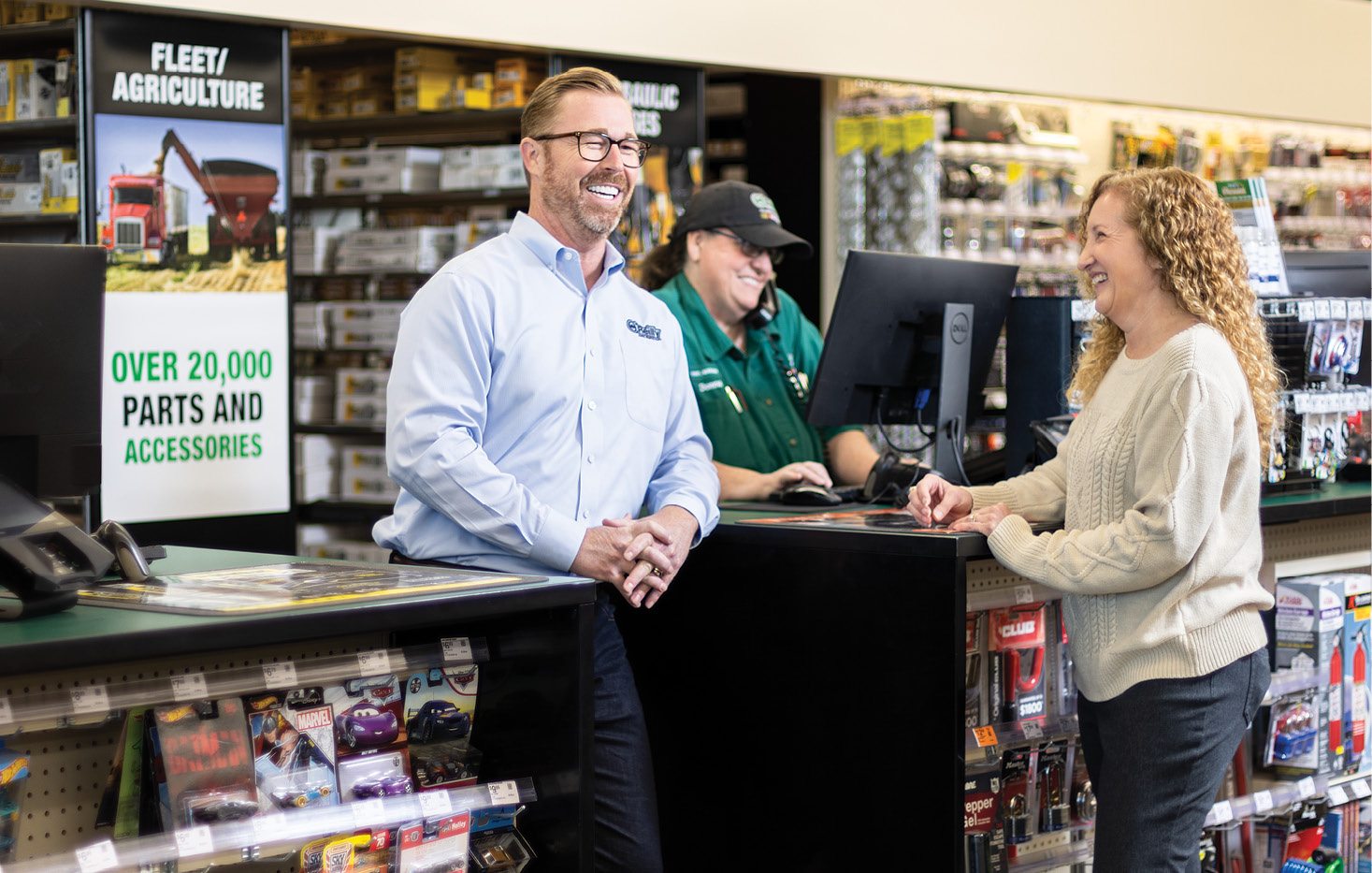
In 1996, at 17, he joined the Wagoner O’Reilly store. His first tasks were sweeping and shelving stock. The work offered a practical introduction to a business where knowing where something belongs is a useful preliminary to knowing what it does. Enthusiasm got him interested; the inventory required him to become useful.
He moved through counter work, night management and assistant management. One detail he remembers is the counter’s 16 feet of paper catalogs. Before the search result, there was the practiced hand finding the right book. Automotive knowledge occupied physical space, and a newcomer could see how much of it there was to learn.
The appeal of this beginning is its specificity. He liked cars, needed a job and entered a place where colleagues could teach him. There was no reason, at the time, to read the broom as a prediction. It was a broom. The important development was that he stayed interested after discovering his limitations.
The people who do the promoting
His responsibilities widened from a store to a district, a region and a division. Eventually he worked across eastern and central operations, then became an executive vice president, chief operating officer and co-president. The sequence matters because these jobs put different distances between a decision and the customer who experiences it.
A store manager can see a queue forming. A regional manager has to hear about it, ask useful questions and decide whether the problem is local or repeated elsewhere. At each step, familiarity with the work helps. At each step, familiarity alone becomes less sufficient. Somebody else must be able to do the job well.
Ted Wise, a senior O’Reilly leader, gave Beckham another way to think about promotion: a changed title would mean little until his new team trusted him. That is an awkward instruction for an ambitious young manager. The appointment can arrive in a day; acceptance takes as long as the people doing the work require.
Beckham’s account leaves space for imperfect bosses as well as helpful mentors. He has described learning from both. The point is practical: waiting for an ideal manager would have put his development in somebody else’s hands. His own conduct remained available for improvement, including on days when the person above him was disappointing.
- 1996Parts specialist
Wagoner, Oklahoma - 1998Store manager
- 2022Chief operating officer
- 2024Chief executive officer
What a parts counter teaches
O’Reilly serves two customers with different working days: the person repairing a vehicle themselves and the professional repairing one for somebody else. The company established its dual-market strategy in 1978. Beckham inherited that approach, along with the responsibility to make it work across a much larger organization.
The common requirement is wonderfully unforgiving. A part has to be appropriate, available and delivered when it is needed. A pleasant conversation cannot make an incorrect component fit. A good price is less persuasive when the item arrives after the repair was supposed to be finished. Service here has a material test.
That helps explain the emphasis on experience inside the company. In his 2025 DriveTime interview, Beckham said all 650 district managers and all 75 regional managers had advanced internally. Those are figures from that interview, rather than a current headcount. They describe a management system built by repeatedly moving store experience upward.
For Beckham, this gives a familiar phrase, promotion from within, a concrete meaning. A manager carries knowledge of the counter into decisions made farther away from it. The difficult part is keeping that knowledge alive while allowing new ideas in. Longevity supplies memory; a growing business still needs the curiosity of a newcomer.
A much bigger map
The CEO appointment was announced in July 2023, giving the transition a public timetable. Greg Johnson would retire the following January; Beckham would take over, and fellow co-president Brent Kirby would become president. David O’Reilly, Greg Henslee and Johnson were among the leaders Beckham credited as examples when the succession was announced.
His first year as CEO also brought a wider North American business. O’Reilly entered Canada through Montreal-based Groupe Del Vasto, which operated as Vast-Auto. The purchase agreement had been announced while Beckham was co-president. He explained then that Mauro Cifelli and the existing management team would continue running the operation.
That detail fits the people question running through his career. An acquisition arrives with employees who already know customers, routes and local expectations. Keeping experienced leadership gives the combined company something it cannot manufacture merely by changing a sign. Expansion needs people who can translate a larger plan into a familiar working day.
The original Canadian network included two distribution centers, six satellite warehouses and 23 company-owned stores. It also served independent partners and professional customers. For Beckham, the map had become more complicated than a collection of retail dots. It included businesses relying on the network to keep their own promises to customers.
The warehouse behind the promise
By December 2025, O’Reilly was describing a network of 32 large distribution centers across the United States, Mexico and Canada, including Puerto Rico. A new 550,000-square-foot facility in Stafford County, Virginia, was intended to support Mid-Atlantic customers. More than 225 team members were already working there when the company reported on its opening.
The building combined familiar warehouse work with automation. A dense storage grid brought smaller parts to employees after they entered order details. Traditional shelving, forklifts, conveyors and manual picking remained part of the operation. The result was a mixture of systems and human work, all behind the seemingly simple answer that a part is available.
Beckham’s expressed ambition was forward-looking: “most of our growth is still ahead of us.” It is an aspiration, with plenty of work attached. More stores require supply. More supply requires space, equipment and people who know how to use them. The service promise gets larger only if its supporting machinery can keep pace.
That is the less photogenic side of the former store worker’s job. The customer sees the counter. The chief executive has to concern himself with what will reach it. A warehouse may be several steps removed from a conversation about a repair, but it helps determine whether the answer to that conversation is useful.
“most of our growth is still ahead of us”
Brad Beckham · December 2025
The numbers have a date
On July 29, 2026, O’Reilly reported second-quarter sales of $4.89 billion and comparable store sales growth of 6 percent. The company had 6,695 stores at June 30. Beckham said both professional and do-it-yourself business had grown, and the company raised its full-year comparable sales outlook to a range of 4 to 6 percent.
These are company results produced by a large organization. They give scale to Beckham’s responsibilities without turning every dollar into a personal accomplishment. They also distinguish the business he leads today from the business he joined. The test now includes preserving a working method across thousands of locations he cannot personally supervise.
The same release counted 110 net new stores during the first half and retained a target of 225 to 235 for the full year. The distinction between completed openings and an annual target matters. A chief executive’s calendar contains both results already earned and commitments still waiting to be met.
The next person at the counter
There are more public stages now. MEMA selected Beckham to give the customer keynote at its April 2025 Vision Conference in the Chicago area. His experience had become something suppliers wanted to hear about, from the person who had once been learning the parts business one shelf at a time.
Under his leadership, O’Reilly also entered a multiyear title sponsorship of NASCAR’s secondary national series, announced in August 2025 and taking effect in 2026. The announcement came from the company and NASCAR, with president Brent Kirby speaking for O’Reilly. A teenage dirt track enthusiast’s employer now had its name on a national racing series.
The symmetry is enjoyable. It would also be easy to let it obscure the more useful thread. Beckham’s career depended on people teaching him, correcting him and eventually trusting him with other people’s work. His advancement made those same obligations his own. The next capable employee needs an opening, just as he once did.
The missed promotion remains the story’s useful irritant. Keeping a good assistant might make tomorrow’s shift easier. Helping that assistant advance might make the company better. Beckham had to understand why the second choice belonged in his job description. Thirty years after he started putting away stock, that decision still offers a way to understand the work.
Keep the conversation going
- O’Reilly Auto Parts
- Brad Beckham on LinkedIn
- Watch: DriveTime conversation
- Listen: Auto Care ON AIR
- January 2024 profile
- The CEO succession announcement
- North American company history
- Canada acquisition announcement
- The Stafford distribution center
- July 2026 results
- MEMA keynote announcement
- The NASCAR partnership