Imagine a car occupying a repair bay while its mechanic waits for a radiator. The diagnosis is finished. The tools are ready. Somewhere, somebody has the replacement. The remaining problem is distance. Until the part arrives, a perfectly capable workshop has acquired an expensive parking space.
That is the business opening behind 1-800 Radiator & A/C. The company distributes aftermarket automotive parts through more than 200 locations in the United States and Canada. Its name advertises hardware. Its operating model addresses the awkward interval between knowing what a car needs and having it within reach.
- Local stock: warehouses put replacement parts near the people installing them.
- Shared intelligence: purchasing and inventory tools support independent franchise operators.
- Repeat business: a correct part delivered promptly gives the repair shop a reason to call again.
A warehouse with a deadline
The company began in 1982 as Radiator Express Warehouse in Union City, California. A history published by one franchise operator describes the opportunity: radiator replacement was gaining ground against radiator repair. A second warehouse followed in Sacramento in 1989. The useful insight was that a replacement market needed a different kind of intermediary.
Today, the customer list includes repair shops, collision shops, parts stores, dealerships and fleets. Retail and do-it-yourself buyers also have ordering routes. For a professional installer, the attraction is practical: find the correct component, establish availability and get it to the workshop without sending a technician on a parts expedition.
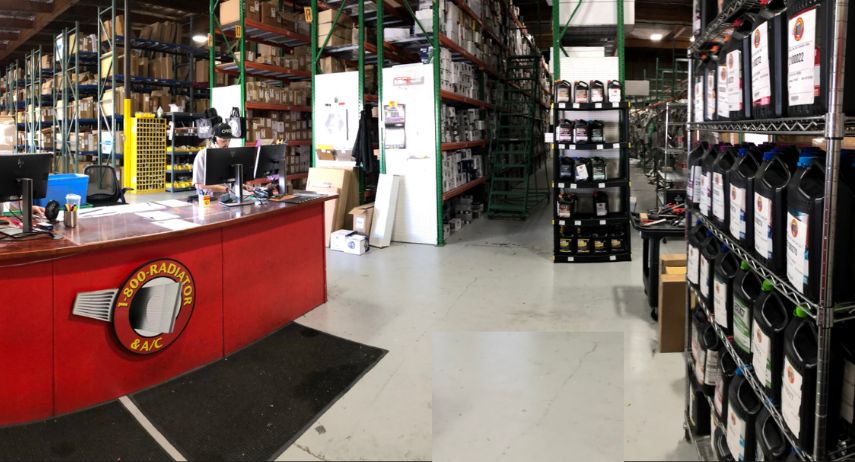
The franchise website advertises local deliveries often within one to two hours. Treat that as a description of the intended service, dependent on stock and location. A rural address or an unusual application changes the arithmetic. Speed begins with a purchasing decision made before the customer calls.
- 01AnticipateChoose local inventory
- 02MatchIdentify the right part
- 03MoveDeliver to the shop
The franchise support page assigns owners an account manager and describes help with stocking, accounting and ongoing training. That division of labor matters. A local business can know its neighborhood well while still needing assistance with purchasing and operations. The network promises to supply those capabilities across independently run locations.
The second trip is the expensive one
A quick delivery can still be useless. A component that does not fit sends the job back into the queue. In a September 2024 presentation for Meineke’s purchasing organization, 1-800 Radiator showed how it evaluates individual parts using warranty and return information. An example for the 2001-2005 Honda Civic marked several high-return items as blocked.
The presentation’s memorable distinction was between “good parts and bad parts.” A manufacturer’s reputation alone would not settle the buying decision. The company described adjusting its inventory as actual performance revealed problems. The implication is sensible: a supplier can make one component worth stocking and another worth avoiding.
“Shops buy from suppliers who deliver a quality part fast.”
1-800 Radiator & A/C franchise FAQ
Its range now extends to condensers, compressors, fans and related cooling components, with fuel, exhaust and heavy-duty lines also offered. This is a specialist distributor expanding into adjacent purchases. The same workshop that needs a radiator today may need an A/C component tomorrow. Products and coverage vary by market.
Someone has to pay for the shelf
The franchise arrangement divides the work. Local owners run warehouses and customer relationships. The wider organization supplies purchasing infrastructure, software, training and support. Customers pay for parts; franchise operators carry the practical burdens of stock, staffing, premises and delivery. The franchisor collects franchise and ongoing fees.
Those shelves require capital. The December 2025 amended franchise disclosure document estimated $463,500 to $1,314,000 to begin a new warehouse. The franchise website’s advertised $45,000 fee is one component of the commitment. It would be a poor substitute for a budget.
$1,314,000
Total estimated initial investment. A dated range, not a quotation or an earnings forecast.
This explains the competitive position better than a claim about cheap radiators. A nearby specialist competes with other local distributors, broadline parts suppliers, dealer counters and online sellers. Each can win a particular order. When time matters, stock and delivery may outweigh a lower advertised price elsewhere. When it does not, that advantage becomes less persuasive.
Capital also shaped the company itself. NXT Capital announced $20 million in senior secured recapitalization financing in 2013. Driven Brands announced its acquisition agreement in June 2015, naming founders Mike and Joe Rippey as continuing advisers. The brand remains in the automotive group’s portfolio.
For a prospective owner, the sensible investigation is local. Which shops are nearby? What do they struggle to obtain? How many stops can a driver make without turning an urgent order into an afternoon journey? The franchise FAQ itself recommends a territory-specific competitor profile during due diligence.
First, fix the questions
There is a quieter software story here. A 2017 analytics essay linked from the company’s press page describes a team pausing to reconsider its work. It had been handling ad-hoc requests. The author, Ryan Stauffer, described a shift toward reusable business tools, acknowledging that the change caused short-term organizational friction.
The essay also describes testing graph databases when established approaches made customer-targeting questions difficult. The useful lesson is the willingness to revise the tool when the question changes. A dashboard earns its place by helping someone decide what to buy, whom to visit or where to spend time.
That fits the franchise proposition. Inventory tools shape warehouse choices; customer-management software records contacts and sales. The website says automotive experience is not required of prospective owners. It emphasizes relationship building. Technical infrastructure is meant to leave the operator with more attention for customers.
A reader running another distribution business can copy the sequence without copying the software: identify a recurring decision, build a small tool around it and watch whether the next decision improves. Counting completed reports is easier. Seeing whether fewer orders require a second phone call is more useful.
More branches, shorter distances
In June 2026, Alfar Capital announced an investment in a Canadian multi-unit franchise operator. That business had nine branches in Ontario and Alberta and a distribution hub in London, Ontario. Its founders planned to reach twenty or more locations by fiscal 2030. That is an expansion target for the operator, separate from ownership of the wider brand.
The plan brings the story back to geography. Borrow the discipline: track the missing part, the return and the extra trip, then change the next stocking decision. Dense routes and repeat trade customers help the economics; sparse demand and idle inventory strain them. The test comes when a mechanic calls and the answer can include an arrival time.