A broken bearing is a tiny object with an enormous talent for ruining a day. It can strand a driver, occupy a mechanic’s lift and send a parts-store employee into a catalog maze of model years, manufacturer codes and near-identical components. Somewhere behind that counter sits Rolemar Distribuidora de Autopeças, a Brazilian wholesaler built to make the maze less punishing.
The company’s origin story is almost too neat. Rolemar began in 1989 in Cornélio Procópio, Paraná, as a small shop selling bearings and seals. There were two employees. The name itself still carries an echo of rolamentos, Portuguese for bearings. From that narrow starting point, Rolemar grew into a link between parts manufacturers and the independent businesses that keep Brazil’s cars moving.
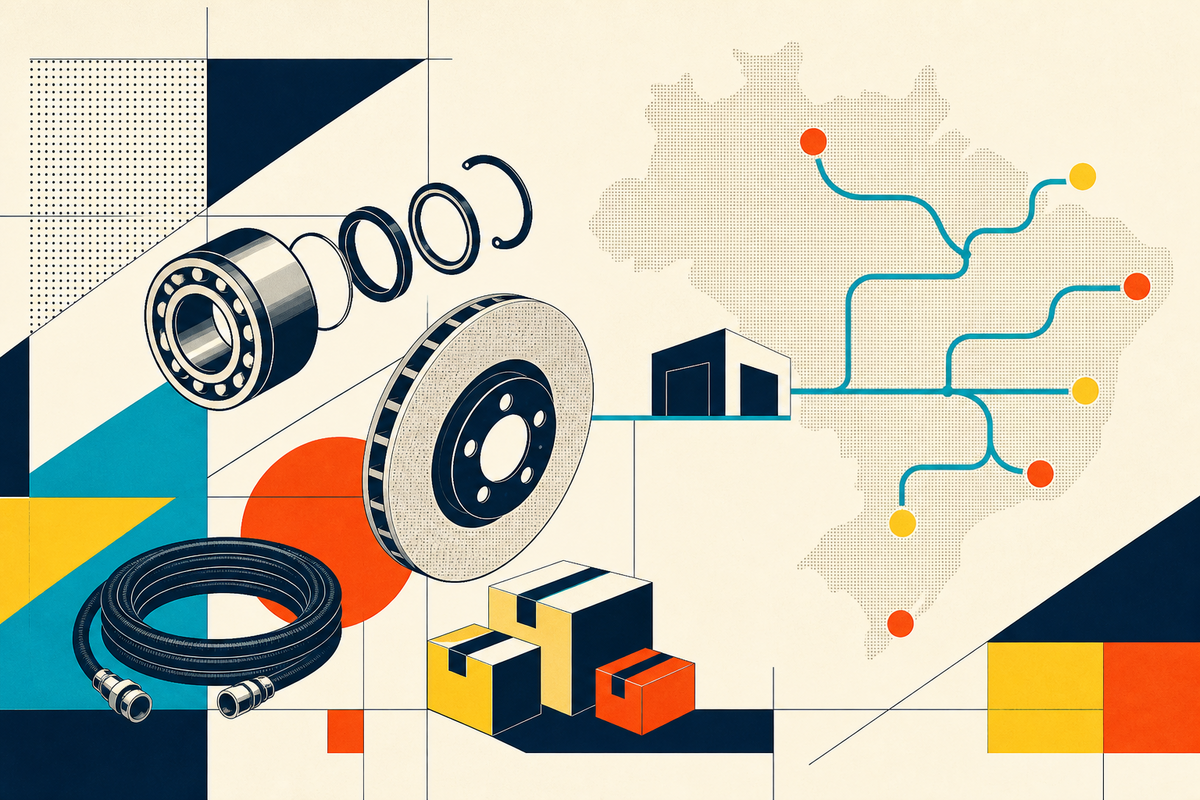
Today, the privately held company is legally Girando Comercio de Pecas Ltda and is headquartered in Londrina. Rolemar says it has more than 800 employees, 16 distribution centers, over 35,000 items and more than 150 automotive product lines. Its anniversary material places roughly 100,000 square meters of stock across the network. Those figures describe a big wholesaler. They do not quite describe the job.
The business is certainty
Rolemar’s customers are not chiefly drivers browsing for a weekend upgrade. They are auto-parts retailers, repair shops and autocenters buying for resale or installation. Their problem is not merely finding a brake disc. It is finding the correct brake disc, from a credible brand, at a workable price, in stock, near enough to arrive before the customer loses patience.
That turns wholesale distribution into a bundle of promises. The catalog must be broad enough to cover a diverse vehicle fleet. Inventory has to sit in the right region. Search data must match parts to applications. A salesperson needs to answer when software cannot. Delivery should be visible. And if a component fails, the warranty process has to preserve the retailer’s relationship with the motorist.
A car waiting on a lift is a timer. Rolemar’s business is built around shortening it.YesPress analysis
The product range stretches through suspension and steering, brakes, transmission, engine, cooling, filters, cables, hoses, bearings, fuel and ignition systems, electronic injection, chemicals and accessories. It covers light and utility vehicles and increasingly reaches across adjacent categories through branded partnerships. In late 2025, Valeo Service and FTE brought cooling, visibility and clutch-system products into the catalog. Reserplastic added molded components. Early 2026 posts highlighted LOCTITE and Radnaq in adhesives and automotive chemicals.
A warehouse with a software layer
Rolemar’s most revealing product is not physical. Rolemar Master is its customer-only B2B catalog and ordering platform. A counterperson can search by vehicle, automaker, brand, product name, manufacturer code or barcode. On mobile, the camera can scan that barcode. Searches expose applications, technical information and possible substitutes, helping reduce the expensive little disaster of sending the wrong piece across town.
The system understands the interruptions of a parts counter. It permits four simultaneous carts, so one quote need not be abandoned when another customer appears. Different logins can be assigned to counter, catalog and manager roles. Its Venda Mais feature lets the retailer make a branded proposal with contact details, margin and labor cost, then turn an approved proposal into a Rolemar replenishment order.
This is where Rolemar differs from a bare online marketplace. The platform is not detached from inventory, regional delivery, credit terms or a human commercial team. It is the interface to those assets. The company earns money in the conventional way - buying from manufacturers and reselling wholesale - but the digital layer makes that repeat purchase faster and stickier. Clube Master adds points and rewards to eligible brand purchases. Daily promotions and negotiated payment conditions address the cash constraints of small retailers.
Do not digitize only the checkout. Digitize the awkward work around it: fitment, parallel quotes, permissions, margin, labor, loyalty and the path from customer approval to replenishment.
How the money moves
The economics are those of a specialist middleman, not a subscription software company. Rolemar purchases parts from a wide roster of manufacturers, earns a wholesale margin when business customers reorder and uses scale to spread warehousing, transport, product-data and sales costs across thousands of items. Capital is tied up on the shelf before an order arrives, which makes selection as important as selling. A popular filter should be close to demand; an obscure component should still be findable without quietly turning every branch into a museum of slow stock.
The model rewards recurrence. A parts store does not replenish brakes, belts or bearings once. It buys continually, often under time pressure. That gives Rolemar an incentive to make the next transaction easier than the last. Account history informs the relationship, promotions can pull demand forward, payment terms help a retailer manage cash, and points give participating brands another reason to stay in the basket. The platform does not need a monthly fee to produce value. Its payoff is a larger share of those repeated wholesale purchases.
For customers, the practical benefit is leverage. A small shop gains access to an assortment, supplier network and logistics footprint it could not economically reproduce alone. It can quote a motorist before buying the part, keep less speculative inventory and lean on Rolemar when fitment or warranty questions become complicated. Rolemar, in return, gains a view of demand across many counters. Managed well, that loop improves buying and availability. Managed poorly, it produces the familiar distributor’s graveyard: cash frozen in the wrong boxes. The entire operation depends on keeping that loop honest.
The unglamorous moat
In automotive distribution, catalog size is impressive only when it is usable. A 35,000-item warehouse can become 35,000 opportunities to mispick, overstock or disappoint. Rolemar’s moat is therefore operational: purchasing relationships, demand forecasting, regional inventory, product data, delivery routes, trained salespeople and claims handling. Competitors include national and regional distributors such as Pellegrino, Pacaembu, Fortbras, Scherer, Comdip and the marketplaces that make price comparison effortless.
Rolemar’s response is to compete on the full transaction. The company describes its purpose as generating results for customers and its mission centers on excellent service and durable ties among clients, suppliers and employees. That language can sound generic until it reaches a warranty desk. Rolemar has explained that items in an “accepted” category can be handled immediately, before a manufacturer’s final response; a 2022 company article said 85 percent of products fell into that category at the time. Other claims remain under manufacturer analysis, with status visible online.
For a retailer, that speed matters twice. It gets a replacement moving and protects the counter’s credibility. For the driver, the difference between a distributor and a good distributor may be measured in days without a vehicle. Warranty service turns a manufacturer relationship upstream into trust downstream.
Closer to the factories
A 2025 move shows how Rolemar thinks about the market. The company opened a purchasing center at its São Paulo branch, placing buyers closer to many of the manufacturers, representatives and industry decision-makers who shape Brazil’s aftermarket. The goal was to speed commercial decisions, find new product families and deepen supplier relationships while the established buying operation in Londrina continued.
“We are where everything happens,” commercial director Itamar Mesatto Filho said of the move, framing proximity as a route to new partnerships. The sentence is useful because it flips logistics around. Distribution is usually described downstream, as the movement from a warehouse to a customer. The São Paulo office is about moving information upstream faster: which categories are growing, which brands fit the portfolio and where availability may tighten next.
That intelligence grows more important as the Brazilian fleet evolves. Electrification will alter some replacement categories, while a large installed base of combustion vehicles continues to demand familiar filters, belts, brakes and cooling parts. Independent repair remains fragmented. The winning distributor has to serve the old fleet reliably while learning the new one early enough to stock it sensibly.
A company between companies
Rolemar fits in the middle of the aftermarket, a position that is easy to overlook because its brand is often one step removed from the final driver. Manufacturers need reach without building a sales and delivery operation for every independent shop. Retailers need selection without opening dozens of supplier accounts or holding every slow-moving item. Rolemar aggregates both sides, carries inventory risk and makes many small orders economically possible.
Its culture reflects that intermediary role. The company describes a family base, investment in training and a preference for long-term relationships. Public materials also describe support for community projects in culture, sport, health and education. None of this replaces execution. In a distribution business, values are tested in ordinary moments: whether the invoice matches, whether the box arrives, whether someone answers and whether the warranty moves.
The clever part of Rolemar’s evolution is its refusal to choose between old and new. It retains representatives, warehouses and brand relationships while building search, ordering, quoting and tracking into software. The physical network gives the platform something real to promise. The platform helps the physical network make fewer, faster decisions.
That is why the little bearing remains a fitting emblem. It is not the loudest piece of a car. When it works, almost nobody notices it. Yet it reduces friction, carries load and keeps the larger machine in motion. After thirty-six years, Rolemar has built much the same kind of business.