A delivery has a curious social life. Before it arrives, everybody wants to know where it is. Once it arrives, nobody is much interested in its biography. There is work to do, something to make, another order to fulfil. The successful shipment disappears into somebody else’s successful day.
Ashutosh Dhar has built his career around that disappearance. His work has taken him through ITC, Nokia, Accenture Strategy and Becton Dickinson, and into a job where the machinery behind everyday business becomes the business itself. In August 2025, ProcMart appointed him Chief Business Officer, with responsibility for expansion, partnerships and the teams that turn prospective customers into continuing relationships.
It is a commercial title with an operational backstory. Before taking it, Dhar had spent more than twenty years working across procurement, distribution, supply chain transformation and business strategy. His new brief includes Southeast Asia. The question running through the move is easy to state: how do you sell reliability at a larger scale without wearing it out?
Three clocks in the same room
One of Dhar’s more useful observations concerns speed. Discussing digital procurement in 2020, he described technology as the fastest-moving part of an organisation, established processes as slower, and people as the hardest part to change. A transformation has to account for all three.
That argument has a wonderfully inconvenient implication. Buying software cannot, by itself, settle the timetable. A screen can acquire a new function overnight. A purchasing routine has to be rewritten, understood and used. Someone who has spent years getting an order through one particular way needs a reason to trust another.
Dhar gave a concrete example from his organisation: shipment tracking was connected to forecasting to improve inventory management, followed by the work of bringing people into the changed process. He also emphasised user training. The sequence matters. Information becomes useful when it changes a decision; a changed decision becomes dependable when the people making it know what they are doing.
“Embrace technology with adequate training to users”
Ashutosh Dhar, on digital procurement
There is a small comedy in every software demonstration. The presenter knows precisely which button to press. The person who will use it on a busy Tuesday has other obligations. Dhar’s emphasis on adoption addresses that Tuesday. It gives the ordinary working day a vote in the grand plans for transformation.
Tools can change quickly.
Routines need revision.
Adoption takes practice.
Before the chief business title
His education puts engineering beside commerce. Dhar holds a bachelor’s degree in electrical engineering and an MBA in Marketing and Trade from the Indian Institute of Foreign Trade in New Delhi. He studied there from 2003 to 2005, was general secretary of the student body and played on the college’s volleyball and basketball teams.
The combination makes a pleasingly crowded student diary. Lectures, student representation and two team sports would each have supplied a different kind of appointment. They are useful details because they put a person back into a résumé otherwise crowded with organisations and functions. A business school also contains people who need to agree on things, and a court contains people who need to move together.
His subsequent employers span consumer goods, technology, consulting and distribution. At Nokia, his responsibilities included a role as Head of Materials Availability, Packaging and Print. The wording carries its own reminder: even a technology business depends on very physical things being available at the right moment.
His projects include direct raw-material vendor empanelment in 2009 and the insourcing of direct procurement activities to India from global locations in 2012-2013. Those are different problems. One concerns who is allowed into the supply network. The other concerns where the work of buying is done. Both sit upstream of the delivery a customer eventually sees.
The colleagues who worked with him at Nokia add a more personal view. Dan Jiang described experience of Dhar leading teams and executing complicated projects in global print and packaging supply chain management. Jukka Härkönen recalled a colleague who learned quickly, applied new information at work and combined reliability with presentation and people skills.
Those recollections bring the professional vocabulary down to the level of working together. Someone learns the problem. Someone explains it clearly. Other people can depend on them to follow through. Procurement has plenty of formal documents, but it also relies on these smaller exchanges between people who need one another to finish a job. Dhar’s colleagues describe that side of the work.
Read together, these assignments give the later commercial role some texture. Procurement involves suppliers, rules and relationships long before it involves a finished transaction. Growing a procurement business means taking those arrangements seriously enough that another company can entrust its own routine to them.
The plan behind the parcel
In 2020, Dhar described a period when warehouse closures, transport restrictions and unavailable passenger flights complicated the movement of products. His account concentrated on preparation: an updated business continuity plan, scenario exercises and a view of the supply network that extended beyond the immediate supplier and customer.
He described mapping the chain from a supplier’s supplier through to a customer’s customer, using a control tower to follow stock through the network. He also described daily contact with colleagues working remotely, to guide them, support them and acknowledge their work.
The detail about daily contact belongs beside the detail about stock. A map helps reveal where an operation is exposed. A conversation helps establish who can act on it. Organisations often speak about visibility as though it were a property of a dashboard. In practice, visible information still needs someone to recognise its significance and tell someone else.
Scenario exercises have a similarly practical charm. They let a team encounter a possible difficulty before a customer encounters the actual one. The rehearsal is allowed to be untidy. Questions can be asked without holding up a consignment. Preparing alternatives creates room to decide when the ordinary route becomes unavailable.
- Supplier’s
supplier - Supplier
- Operations
- Customer
- Customer’s
customer
A result has to survive the day
At Becton Dickinson, Dhar served as Director of Supply Chain and Distribution Management for India and South Asia. His work there was credited with a 20% improvement in On-Time-In-Full deliveries and more than $1 million in annual cost reductions, alongside a major enterprise resource planning transformation.
The delivery measure is satisfyingly demanding. “On time” asks whether the order met its promised timing. “In full” asks whether the complete requirement arrived. Either condition on its own leaves an opening for disappointment. An early delivery with half the order missing offers a customer an unusually punctual inconvenience.
On-Time-In-Full deliveries
reductions
Reported career results, August 2025. The delivery figure is an improvement, not an absolute delivery rate.
An ERP project touches the records and routines through which a company coordinates its work. A business transformation and ERP implementation project for BD India ran from January 2017 to November 2018. It offers another example of his career moving between systems and the everyday activity those systems are supposed to support.
A useful way to read the delivery and cost figures is as two obligations held together. Customers care whether the order arrives. The business cares what it costs to make that happen. An operation has to answer both questions repeatedly, after the project meeting ends and its slides have been put away.
Taking the operating habit to market
ProcMart’s territory is indirect procurement, including maintenance, repair and operations supplies and packaging. These purchases support a company’s ability to keep working. A tool or a packaging requirement may receive less public attention than the product it supports, but it still has to be sourced, ordered and delivered.
The company describes operations across more than thirty Indian cities and expansion into Malaysia and Indonesia. Dhar’s responsibility is to help broaden that business through new revenue streams, partnerships and relationships with clients. His remit also includes mentoring business development, sales and client management teams.
The connection with his earlier work is practical. A procurement provider’s sales conversation makes a promise about service. Its operating system has to make the promise repeatable. Expanding into another market adds more conversations and more commitments; it also adds the task of making delivery feel dependable to a customer who is meeting the provider for the first time.
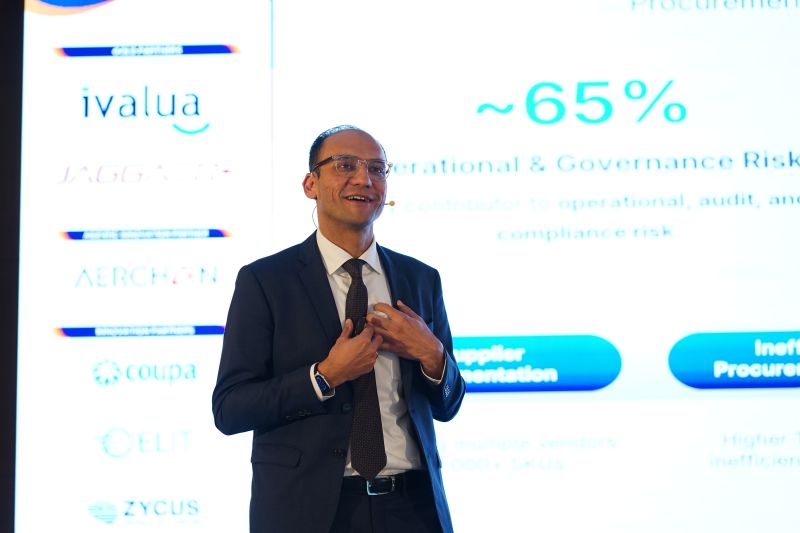
His public conference appearances follow that widening geography. He was listed for a December 2023 panel about the right mix of transport modes and a November 2024 discussion about AI-powered supply chains. By 2026, he was sharing his participation in the Middle East Procuretech & Supply Chain Innovation Summit and expressing interest in further relationships across the UAE and GCC.
That last point is an intention, with the future still attached. A conference conversation can open a door; a continuing relationship requires further work. For Dhar, the commercial opportunity now extends beyond the internal organisation of a supply chain to the people who might choose ProcMart to help run theirs.
At ProcMart’s HR meet, shared publicly in July 2026, he discussed operational projects, organisational priorities and structural changes alongside fellow executives. It is a modest but telling continuation of the people-and-process theme. Expansion has an internal audience as well as an external one.
When he joined ProcMart, Dhar said he wanted results reaching “beyond efficiency, towards true business impact”. In this corner of business, that ambition has a remarkably everyday test. An order is complete. A team knows what to do next. A customer can get on with work. The parcel arrives, and earns the privilege of being forgotten.
Continue the conversation
Ashutosh Dhar on LinkedIn His conversation about digital procurement The August 2025 appointment announcement Dhar’s Middle East summit post ProcMart’s 2026 HR-meet updateFROM HIS ORGANISATION
ProcMart website ProcMart on LinkedIn ProcMart on X ProcMart on Facebook