A replacement car part looks like an ordinary thing to buy until somebody has to buy the right one. The model, the production year, the precise assembly, the supplier’s description: each can change the answer. A bargain that does not fit is an expensive object. For a workshop, the customer is waiting while the purchasing department solves the puzzle.
- Find the part. CassMall turns vehicle information into supplier inquiries and orders.
- Follow the demand. CassChoice uses workshop data to inform bulk procurement.
- Watch the margin. The biggest revenue stream contributes a surprisingly small slice of gross profit.
CassTime, founded in Shenzhen in 2015, chose this awkward moment as its entry point. Its customers are the businesses behind a repair: workshops, distributors and manufacturers. The company’s proposition is practical. Help people identify a part, compare available supplies and complete a purchase with clearer quality and warranty arrangements. The car owner benefits further down the chain.
01 / First, translate the workshop
Co-founder and CEO Jiang Yongxing, also known as Overmars Jiang, spent nearly fifteen years at Huawei. Fellow founders Yang Shangfu and Zhang Wei brought experience from Huawei and Foxconn. This was a team familiar with information systems entering a trade in which information was often scattered across people, catalogues and telephone conversations.
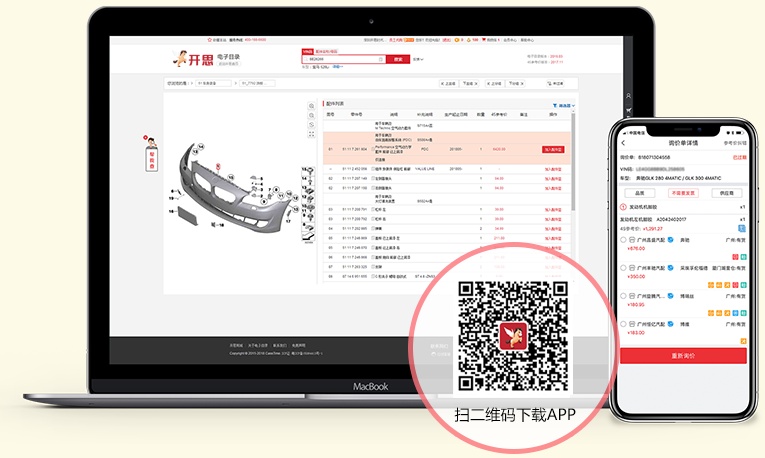
The first failure point in the purchasing workflow comes before payment: identification. CassMall’s VIN decoder uses the vehicle identification number to help match compatible parts. Supplier matching then considers inventory, location, quality requirements and purchasing history. The marketplace earns a commission when a transaction is completed. Its expertise sits between a workshop’s imperfect request and a distributor’s very specific stock.
The delightful detail is the language problem. Workshops in different regions use different colloquial names for the same component. CassTime recognizes those names and translates them into technical terms. It also reads scanned handwritten work orders and lets users circle a component’s location on a vehicle illustration. A mechanic should not need to become a catalogue librarian to place an order.
02 / The catalogue is only half the job
A search result cannot guarantee that a part arrives correctly or survives installation. CassTime adds qualified suppliers, tracing tools and warranty arrangements to the transaction. Eligible low-frequency parts for contracted workshops can receive coverage of up to 30 months. That qualification matters: the headline promise is not a blanket warranty for every item.
“Your Auto Parts, Your Peace of Mind”CassTime’s stated mission
Against a local wholesaler, CassMall offers access to a wider supplier network and structured vehicle-parts data. Against a stand-alone software package, it also helps execute the purchase. A familiar local supplier may still be the sensible choice for an immediately available item. CassTime’s advantage becomes more useful when compatibility, availability or sourcing crosses the limits of that familiar relationship.
At the end of 2025, the company reported more than 375,000 registered workshops across 329 Chinese cities. Average monthly active workshops on its app were 155,800 that year. Registration shows reach; activity shows use. Keeping those measures separate makes the network easier to understand.
03 / Then the shopping lists flowed upstream
CassTime launched desktop CassMall and Workshop No. 1 in 2016, followed by its VIN decoder in 2017. CassChoice arrived in 2022. The sequence matters. Workshops create demand. Their purchases reveal which parts are needed. CassChoice aggregates that demand, buys from manufacturers and resells to distributors, including parts that sell infrequently and are difficult to stock economically.
This is the useful lesson for another founder: begin where the costly decision happens, then use the information it produces to improve adjacent work. It requires accurate compatibility data, reliable suppliers and enough repeated demand to make aggregation worthwhile. A broad catalogue without dependable fulfillment leaves the workshop with the same waiting customer.
The company has also moved toward the repair experience itself. CassCertified, launched in 2025, certifies workshops and supplies operating standards, digital tools and marketing support. By year-end it had certified and served 146 workshops. Workshop No. 1 provides subscription management software. These additions extend the relationship beyond the parts order.
04 / Revenue has a misleading silhouette
Here is the financial surprise. CassChoice generated 70.8% of CassTime’s 2025 revenue, but its gross margin was 3.1%. CassMall contributed 23.1% of revenue at a 92.0% gross margin. Parts resale records the sale of goods; a marketplace records its commission. The percentages describe different economics, so comparing them as though both businesses sell the same thing would be a mistake.
Rounded shares of group totals. Value-added services account for the remaining 6.1% of revenue and 17.2% of gross profit.
CassChoice produced roughly RMB20.3 million in gross profit; CassMall produced RMB197.6 million. The business that looked smaller on the revenue chart contributed far more toward paying the company’s bills. Dependable purchasing can support both models, but the financial reward is distributed unevenly.
Building the network has been costly. In 2025, sales and marketing expenses were RMB191.6 million and R&D expenses were RMB55.9 million. Group revenue reached RMB929.5 million, while the annual loss was RMB399.1 million. The company’s adjusted loss, a non-IFRS measure excluding specified items, was RMB44.7 million. The statutory loss should not be treated as a cash-spending figure.
05 / The repair follows the car
CassTime submitted a Hong Kong listing application in April 2026. Its next moves include overseas expansion and deeper service coverage. A May company update described cooperation with Denso China, while an April update covered Tesla-focused technician training with Yichebang. Parts, technical knowledge and workshop standards are becoming more closely connected.
The constraint is concrete. Better search cannot repair a weak supplier network, and bulk purchasing needs sufficient demand to justify inventory. Electric vehicles add new technical requirements to that equation. CassTime’s experiment is to make the information travel with the transaction, all the way toward the repair bay. Its next test is whether that useful connection can earn enough to support the machinery behind it.