David A. Schreiber was introducing himself on a podcast when the executive biography gave way to the family census. Five children: two young adults, two teenagers, and another approaching the teenage years. His fellow guest, Claudia Welke, had three. Between them, the co-founders of Compass Health Center could supply a respectable dinner party without inviting anybody from work.
The exchange, published in January 2026, had a pleasing lack of ceremony. Here were two people who had spent years building an organization, discussing the ordinary complications of being parents. Schreiber mentioned a late night with one of his children. There was no suggestion that a senior title had persuaded the household to operate on business hours.
That introduction supplies a useful way into his life. The company has grown outward, acquiring locations and colleagues. The family story brings the scale back down again. A founder can become an abstraction surprisingly quickly: a name beneath a photograph, a title beside a quote. Schreiber’s five-child introduction restores a person with several places to be.
“So I guess we’re always up with our children.”
David Schreiber, January 2026
Two names on the beginning
Compass began in 2011, founded by Schreiber and Welke. Its original team numbered 11. Family Action Network’s biography of Schreiber describes an organization that subsequently grew to more than 800 professionals. Those two figures establish the distance traveled, although a pair of numbers can scarcely describe the intervening work.
Eleven is a number a person can picture. You could write the names on a single sheet of paper with room left over. A company of hundreds has a different texture. There are colleagues a founder will know well, others working in different places, and responsibilities distributed among people whose names do not appear in the headline. The interesting question becomes how the original partnership sits inside that larger organization.
Schreiber remains CEO and co-founder. Welke remains chief medical officer and co-founder. Their names still appear together in the company’s account of its beginnings. The continuity is worth pausing over. Fifteen years after the founding year, the story retains both people who started it.
Welke has described starting Compass while raising three small children. In a 2021 interview, she spoke about the pressure to be perfect at work and at home, and about learning to stop measuring herself against other working mothers. That is her experience, rather than an account of Schreiber’s household. It does, however, place their shared business history in a recognizably human setting: the founders were building careers while families had claims on their time.
People on the original Compass team.
A small enough number to remember individually.
The long way to a founding date
Before there was a company anniversary to celebrate, Schreiber had followed a substantial course of professional education. He earned his degree at Albert Einstein College of Medicine in New York, continued his training at Yale, and completed a fellowship at NewYork-Presbyterian Hospital. His public education history spans 1999 to 2008.
The sequence puts the 2011 founding in perspective. The company arrived after years inside established institutions. Moving from that world to a new organization meant adding another kind of responsibility to an already developed professional life. A qualification belongs to its holder. A growing employer brings other people’s working lives into the picture.
His career distinctions include a teaching award at Yale and a Physician of the Year award at NewYork-Presbyterian. Those recognitions belong to the earlier part of the story, before the later map of Compass locations. They give the biography a prehistory: there was work, training, and recognition before the familiar CEO title.
Founding dates are convenient because they fit neatly on timelines. Preparation is less tidy. Schreiber’s route through New York and New Haven makes it possible to see the years before the launch as part of the launch’s story, rather than as small print beneath it.
A company acquires a map
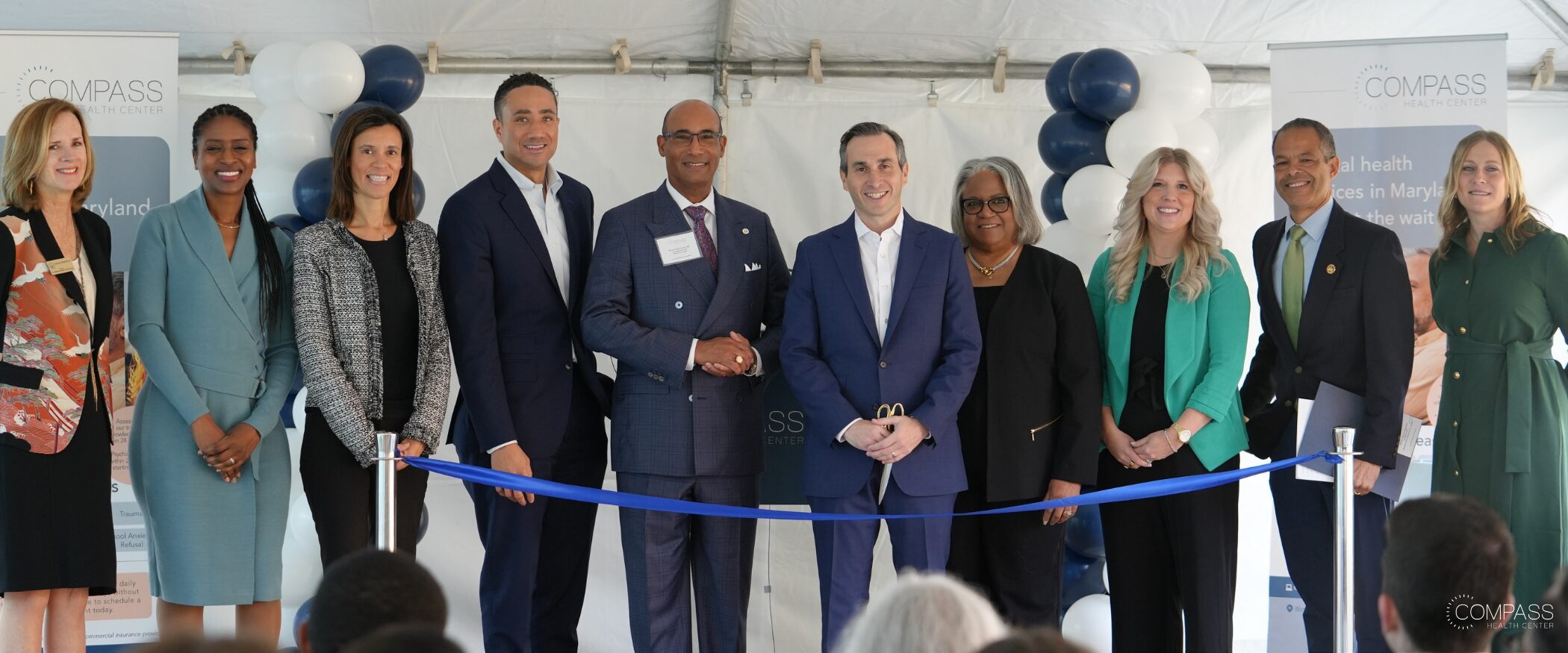
One revealing photograph comes from Compass’s Maryland opening in November 2023. A blue ribbon stretches across the foreground. Schreiber stands with colleagues and community representatives, holding the scissors. The picture obeys the usual rules of an opening ceremony: balloons, formal clothes, everyone temporarily arranged in a line.
Look longer and the group becomes the point. Welke is there. So are local leaders and members of the Compass team. A founder’s portrait removes the surrounding people; an opening photograph puts them back. The company’s arrival in Silver Spring was a collective occasion, with Schreiber occupying one place among several.
The opening announcement also attached an employment figure to the move: 100 new jobs in Maryland. It was an announced contribution to the local economy, rather than merely another pin on a company map. Expansion becomes easier to grasp when it involves workplaces and people who will spend their days in them.
Wisconsin added another chapter. In 2025, Compass announced a Brookfield opening for September, with more than 57 new jobs planned. The location placed the organization in the greater Milwaukee area. For Schreiber, it extended a company that had begun in Chicagoland into another Midwestern community.
Golden Valley followed in February 2026. The Minnesota announcement named a local leadership team, including executive director Dianne Burd. That detail deserves space in a founder’s profile because it shows the practical shape of growth: a company enters a place, and people based there take responsibility for its daily work. The founder’s title travels across the map; the work has local names.
- 2011Schreiber and Welke found Compass.
- 2020Compass Virtual launches.
- 2023Silver Spring, Maryland, opens.
- 2025Brookfield opening announced for September.
- 2026Golden Valley opens; a Virginia lease is announced.
Ambition, measured in square feet
In August 2026, the next stage acquired precise dimensions. Compass announced a long-term lease for 22,203 square feet in Falls Church, Virginia. The planned location is at 3160 Fairview Park Drive. Real estate has a helpful way of making expansion language concrete: eventually somebody has to specify the floor space.
The distinction between signing a lease and opening a location matters. Falls Church was announced as the company’s first physical Virginia site, with the opening still ahead. A business biography should leave that next chapter in the future tense. The commitment is real; the ceremony is a separate event.
The Virginia plan also follows an earlier change in the organization’s shape. Compass Virtual launched in 2020. By 2026, Schreiber’s company story involved both physical locations and a virtual offering. One part of the map is made of addresses. Another developed without requiring a new building for every extension.
There is an aspiration visible in those decisions: taking an organization established in one region into others. It is an ambition expressed through leases, local teams, and successive openings. Each is specific enough to examine. The dimensions of the Falls Church space are almost comically exact beside the broad language usually used to describe a founder’s vision.
The interviewer’s chair
Schreiber’s public calendar contains a different kind of appointment, too. In May 2025, Family Action Network paired him with author and University of Michigan professor Ethan Kross. In February 2026, it paired him with Richard V. Reeves, author of Of Boys and Men and founding president of the American Institute for Boys and Men.
The Reeves event was scheduled as a free public webinar. Its subject reached into education, work, and family life. In that setting, Schreiber appeared as a conversational partner to a writer examining social change. The role broadened the view of him beyond company announcements and opening photographs.
It is useful to keep the roles distinct. An author brings a book and an argument. An interviewer helps make the conversation available to an audience. Schreiber’s participation does not make every argument in the book his own. It does place him in a public exchange about how people’s lives are organized, alongside the executive life in which he helps organize a company.
The people who count
In a July 2022 letter, Schreiber described the Fourth of July as his favorite holiday. He wrote about the start of summer, parades, fireworks, and barbecues. He had joined a community parade with two of his daughters, moving at a pace he characterized as closer to jogging than marching.
The surrounding letter concerned the Highland Park shooting and its impact on the community. One detail concerned his staff: he thanked team members who had helped establish the safety of all 618 Compass employees. The headcount in that passage served a very particular purpose. Each person had to be accounted for.
That moment gives the numbers elsewhere in his biography a different weight. Eleven at the beginning. Hundreds later. Five children in his introduction. A new location has dimensions; a working life has relationships. Schreiber’s story becomes more legible when both remain visible.
Return to the Maryland photograph. The ribbon is still uncut, the group is assembled, and the scissors have their brief appointment with history. The founder stands among the people who make the occasion possible. It is a useful place to leave him: recognizable, responsible for something that has grown, and sharing the frame.