The telling detail in Cleaning Business Today’s first birthday report was a spreadsheet. Its most-watched video explained employee turnover. Its most-viewed article-and-download package compared eight software systems. A publication about cleaning had found readers interested in the machinery of management. The mop was already familiar. Choosing software, keeping people, and understanding what a job earned were another matter.
- A trade publisher for cleaning company owners, with a strong residential focus.
- Articles, newsletters, webinars, and interviews turn operating problems into business lessons.
- Its useful habit: make an everyday frustration specific enough to measure.
The room after the cleaners leave
A clean room tells a customer that the work is finished. It tells the owner considerably less. Did the team take longer than expected? Will the same technicians return next week? Did the price cover the labor? Those questions are the territory of CBT, a business publication whose subject happens to involve cleaning.
Tom Stewart and Derek Christian founded it in 2013. The first issue appeared that April. Both brought operating experience: Stewart through Castle Keepers and Christian through My Maid Service, after a career working on household cleaning products at Procter & Gamble. Their perspective gave the publication a particular center of gravity. Readers were people responsible for making the whole service work.
That distinction matters in a market full of advice. A consumer cleaning tutorial can end when a stain disappears. An owner still needs to recruit the person doing the work, price the visit, organize the route, and persuade the customer to book again. CBT gives those decisions room alongside cleaning science and industry news.
One software comparison became its most-viewed article-and-download package.
Historical reader interest, not a current audience measurement.A promotion, a mileage claim, a problem
Consider an October 2026 contribution by MaidCentral educator Ajia Holiday. Newly promoted into management, she noticed discrepancies in a former cleaning partner’s mileage submissions. Comparing the claims with Google Maps showed that mileage was nearly doubled on many days. Knowing the person made the conversation harder. It did not make the figures correct.
The response included a repayment arrangement and, eventually, a different submission process. The useful detail is the sequence. Personal familiarity had been carrying work that a reliable process should have handled. The discrepancy forced a decision; the revised process reduced the opportunity for guesswork. Readers can borrow that move: inspect the records, address the specific case, then repair the procedure.
This is where specialized publishing earns its attention. A general management article might recommend accountability. Here, accountability has a route, a reimbursement claim, and an uncomfortable conversation with someone who remembers you as a colleague. The lesson arrives with enough texture to recognize it at work.
“Knowledge is a key vehicle on the road to growth.”Tom Stewart / announcing an educational partnership, 2013
Put a number on the disruption
CBT’s workforce coverage connects staffing to the customer experience. Its November 2025 turnover article recommends consistent geographic scheduling, clearer career paths, competitive compensation, and listening to employees. These are interventions an owner must evaluate against local conditions and costs. A newsletter cannot decide what a particular company can afford.
An October 2025 absenteeism explainer makes a related point: an absence travels through the operation. Someone adjusts the schedule; another technician covers a gap; a customer sees a different face. Before comparing rates, it advises checking how the software treats approved time off. A benchmark becomes much less impressive if two businesses count different things.
At an assumed $25 an hour: $6,500 in administrative time.
Our example, not a measured CBT customer result. Excludes overtime and lost bookings.The reader can start modestly: choose one recurring disruption, define the measure, and track it consistently before making a change. Then compare the next few periods. That approach requires records and follow-through. It offers little to an owner who reads an explanation, nods, and changes nothing.
The magazine learned to travel
The format changed with its audience. By its sixth anniversary in 2019, CBT described a publication that had grown beyond a flip-page e-zine into a web library, email newsletter, and social channels. It had surveyed subscribers about preferred subjects, channels, and frequency. Listening to readers was part of deciding what to deliver next.
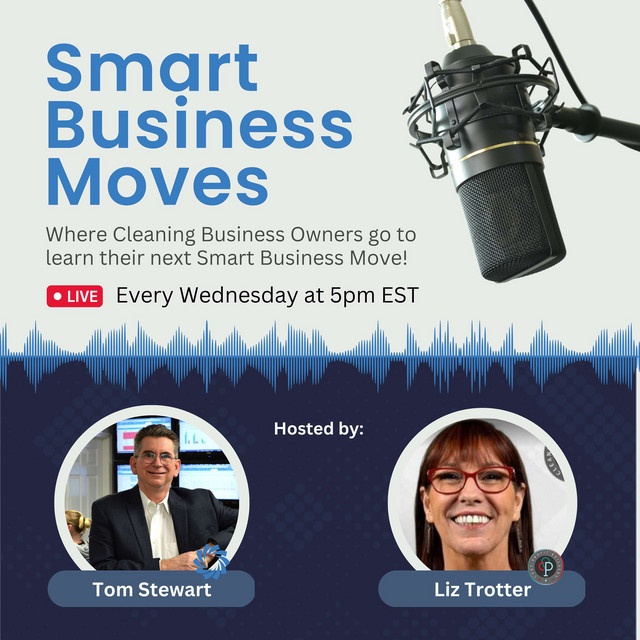
In 2020, the pandemic supplied urgent operational, financial, and legal questions. Smart Business Moves began in response. Hosted by Stewart and Liz Trotter, the series subsequently broadened into management interviews. In May 2025, it shifted toward current events and longer sessions, including Protecting Your Profit in a Shifting Market.
Useful advice has a business model
CBT also has customers who want access to those readers. Its advertiser offering includes sponsored articles, directory listings, webinars, newsletters, product features, and press-release opportunities. Public articles and an open newsletter signup bring owners in; commercial placements give suppliers ways to reach decision makers. It is a recognizable trade-publishing arrangement with a tightly defined audience.
Its archive also contains paid educational offers. A 2016 pricing article promoted a Cleaning Times & Bill Rates class at a $149 list price, with a temporary discount. That historical offer shows how editorial instruction could lead toward a deeper course. It should not be read as today’s price.
The publication’s connections are relevant context. Stewart also leads MaidCentral, and its educators contribute to CBT. Readers get operating and software expertise from that relationship. They should assess a vendor-related recommendation with the same care they would bring to any other business purchase.
Recent coverage offers a sensible place to begin. A September 2026 preview of Professional Cleaning Index research stresses comparisons by company size and operating model. An industry average can conceal very different businesses. Find the peers whose constraints resemble yours, decide which number deserves attention, and put the next decision on firmer ground. That is a useful reason to open a cleaning publication, even when every room is already spotless.