David Politis spent an afternoon watching an IT director work. There was no elaborate research apparatus. He wanted to understand the job, so he sat alongside someone doing it. The browser supplied the plot: an extraordinary number of open Chrome tabs, each a small administrative obligation, each demanding another switch of attention. Here was the cloud’s promise of convenience, arriving at somebody else’s desk as a very long checklist.
He would later describe that visit as the moment he understood the opportunity for BetterCloud’s multi-application platform. A business could buy excellent software for every department and still leave its IT team stitching the pieces together. Each application had its own controls, users and permissions. The tools were multiplying. The person responsible for them still had only one afternoon.
That scene offers a useful way into Politis’s career. He has spent years around the practical consequences of cloud computing: phone systems, Google applications, software administration. His recurring interest is what happens between the promise on the box and the person expected to make it work. Sometimes the useful business idea is sitting in plain sight, somewhere around browser tab number forty.
The apprenticeship came by blind copy
Long before BetterCloud, Politis was watching his father work. Victor Politis’s businesses took him from New York real estate to projects abroad, and his son came along. At eight, David was being included in meetings. By college, he was receiving blind copies of his father’s business correspondence. Other students had reading lists. He had an entrepreneur’s sent folder.
What stayed with him was the cadence: how to prepare for a meeting, how to follow up, how to make an email useful. He traced his own preference for concise messages and bullet points back to Victor. He also noticed that his father’s manner carried across countries and settings. Business relationships belonged to the same life as dinners, travel and family.
There was another early classroom. Politis earned a taekwondo black belt at twelve and began teaching classes with students of different ages. Years later, talking about leadership, he returned to that experience. Authority had arrived before a conventional career could confer it. Teaching required him to make something happen through people who did not necessarily resemble him, including people considerably older.
First the phones. Then the office.
Politis studied economics at Emory University. His subsequent operating career put him inside companies selling new ways to do familiar work. At Vocalocity, a cloud telephone business later acquired by Vonage, he was a founding employee and general manager. His responsibilities ranged across daily operations and product strategy, a fairly comprehensive education in what customers actually need from a service.
At Cloud Sherpas, later acquired by Accenture, he led small-business solutions and worked on SherpaTools, an administrative product for Google Apps. That combination mattered: selling cloud services while building tools for the people administering them. He was learning both the appeal of moving work into a browser and the unglamorous work required to keep it there.
He founded BetterCloud in 2011. Its initial focus was the Google application environment, a narrower starting point than the multi-application business it would become. A founder’s biography can make successive jobs look like a carefully laid railway. Here, the continuity is more practical: each stop exposed another task that businesses had to manage after adopting cloud software.
The expensive part of listening
In December 2016, Politis announced a platform intended to bring data, settings, privileges and users from different SaaS applications into one place. He described two years of engineering work behind the launch. The ambition was to automate complicated checklists and give IT teams useful alerts across an increasingly scattered software estate. An application-by-application approach was giving way to a view of the whole workplace.
The difficult part followed. Politis has described early 2017 as a period when the rebuilt product failed to find the sales momentum the company needed. He went back to customers and asked his sales and customer-success teams to identify the reasons people would not buy. Pricing, missing integrations and usability all became matters to address. By the fall, he said, sales were improving.
There is little romance in that list. Nobody puts “simplify the pricing” on a commemorative plaque. Yet it captures the less photogenic side of paying attention. Discovering an opportunity requires observation; selling a solution requires accepting inconvenient answers. The person who has spent years building a product must still listen when a customer explains why it is awkward to purchase or use.
A company with instructions included
Politis applied a related idea to colleagues. At a New York Times work conference in 2016, he encountered Adam Bryant’s session on the CEO’s user manual: a written explanation of how someone prefers to work. He took the exercise back to BetterCloud and extended it beyond the chief executive. People throughout the company could write their own guides.
It suited a business trying to remove needless friction. Colleagues ordinarily spend months discovering preferences by trial and error, with the occasional unfortunate email serving as experimental evidence. A short guide makes some of those preferences available before a misunderstanding becomes office folklore. Politis did not invent the exercise. His contribution was to treat it as useful for everybody.
His own manual, updated in 2025, includes a pleasingly specific admission: he repeats himself while thinking ideas through. A pitch-deck discussion may keep returning to the opening slides as he checks the flow. He also describes himself as an introvert, despite the energy people see in group settings. He explains that time alone restores his energy. The manual makes room for the person behind the presentation.
“I get my energy from being by myself.”David Politis, his 2025 user manual
Even the hoodies got a hearing
His interest in communication also reached the company meeting. In 2016, he wrote about refining BetterCloud’s all-hands gatherings through anonymous feedback collected every six months. The meeting itself was meant to let people share work, explain challenges and be seen beyond their immediate teams. Its format needed the same scrutiny as any other company process.
Anonymous questions made space for employees who might hesitate to speak into a room. Some questions were about career development across departments. One concerned his favorite BetterCloud hoodie. There is something reassuring about a company culture in which the merchandise can briefly demand executive accountability. The important point was that employees had a way to ask what they wanted to know.
Customer service received similarly concrete attention. BetterCloud monitored usage logs to spot problems and reach out while a customer was encountering them. Support tickets were also reviewed by peers, with feedback returned to the agent. These are small systems for noticing things sooner: a customer’s frustration, an unanswered question, a colleague who could use a better explanation.
The calendar behind the company
BetterCloud’s growth overlapped with the formation of Politis’s family. He started the business before marrying Jess; their two sons arrived during the company’s early expansion. In an October 2026 reflection, he described 2018 as a year of more than a hundred flights and estimated roughly two hundred days away from his family. The company’s progress had a second ledger, kept in days.
He brought his children into the office and let them sit in meetings, repeating part of his own childhood. Yet his account also allows the costs to remain visible. He has long wanted to make a documentary, an ambition that never found space while he was running the company. Today he lives in New York with Jess and their sons, with more time available for family.
Politis’s own count of a year spent building BetterCloud across airports and meeting rooms.
An exit, then a different kind of work
Vista Equity Partners announced its strategic growth investment in BetterCloud in June 2022. The following year, BetterCloud announced that Jesse Levin would become CEO and Politis would move to executive chairman. The business had grown into an organization with more than three hundred employees. The founder’s job was changing again, this time through an explicit handover.
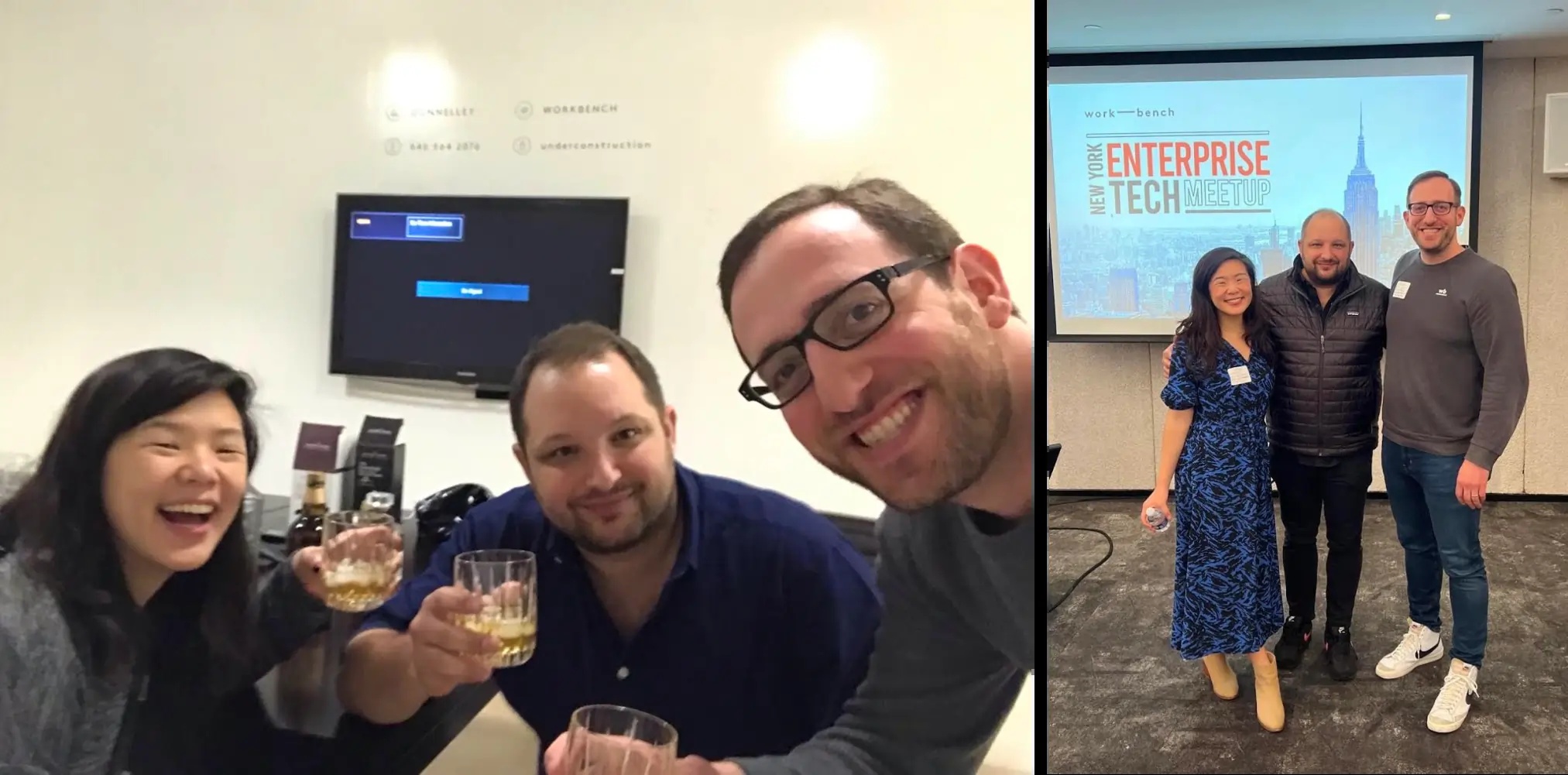
In August 2024, Work-Bench announced Politis as its CEO-in-residence. The relationship stretched back to a 2013 enterprise technology meetup where BetterCloud had demonstrated its product. Work-Bench described seeing him in its office helping founders think through sales strategy and senior hiring. He had returned to the room with experience that an early product demo could not have supplied.
CoreStack acquired BetterCloud in March 2026. Politis’s current chapter includes strategic advisory work following that acquisition. His broader practice is deliberately close to operations: recurring conversations, work with leadership teams, interviews and preparation for difficult decisions. The subject matter has expanded from software administration to company administration. There are still plenty of moving parts.
The next meeting is someone else’s
With Nicholas Freund, an early BetterCloud colleague who later founded Workstream.io, Politis is also building Not Another CEO. Its podcast and writing make company-building experience available beyond an individual advisory engagement. He interviews founders, chief executives and investors about decisions that are usually tidied up by the time they become public success stories.
The partnership gives failure a place in the conversation. Freund’s startup closed, and his experience became part of the project’s rationale. Politis has also written two volumes of The IT Leader’s Guide to SaaSOps. Teaching has become a substantial part of the work, whether the audience is an IT professional, a startup leadership team or a founder listening between meetings.
The child who once received his father’s business correspondence now invites other people into the conversation. The details remain his preferred territory: a meeting’s structure, a difficult hire, the first slide of a pitch, the actual work behind a customer’s complaint. His career has supplied bigger stages and different titles. The useful question is still close at hand: what happens if you sit beside someone and watch?
Keep the conversation going
Read Politis’s writing, hear the conversations, or follow the next chapter.