Colleen Alaimo was looking at a software renewal for 300 users. Then she checked who had actually signed in recently. The answer was 180. Kin Insurance renewed 200 licenses, leaving a cushion above observed use, and saved more than $100,000, according to BetterCloud’s account of the customer’s results. The clever part was asking a question the invoice had no interest in answering.
- Follow the seat: connect what was purchased to who is using it.
- Follow the departure: automate account changes across applications.
- Follow the file: review access that survives the work it was meant to support.
BetterCloud is built around these untidy connections. It gives IT teams a place to see applications, users, permissions and spending, then carry out administrative actions across connected services. Its appeal becomes easier to understand when you stop thinking about software as a collection of products and start thinking about it as a collection of obligations.
The renewal had 100 seats to spare
Kin had other reasons to seek help. Its Google Drive environment contained millions of files, and the IT team struggled with visibility and unapproved applications. Yet an early financial return came from a few integrations and a renewal review. Alaimo, Kin’s senior IT manager, already knew BetterCloud from previous employers. The new evidence changed the purchase quantity: fewer seats, with room to spare.
The distinction matters. Recent sign-ins are evidence, not a verdict on whether somebody needs a tool. Kin retained more licenses than the activity count. The lesson to copy is the comparison: examine the contract alongside use before committing to another term. Negotiating the price of unnecessary seats is a rather expensive form of tidiness.
“BetterCloud instantly paid for itself.”
Colleen Alaimo / Kin Insurance
The work between the apps
Now consider an employee leaving a company. Their departure has to become changes in several applications: access withdrawn, group memberships revised, ownership dealt with, licenses reviewed. Each application may be perfectly manageable by itself. The trouble is getting all the applications to agree that the person has left.
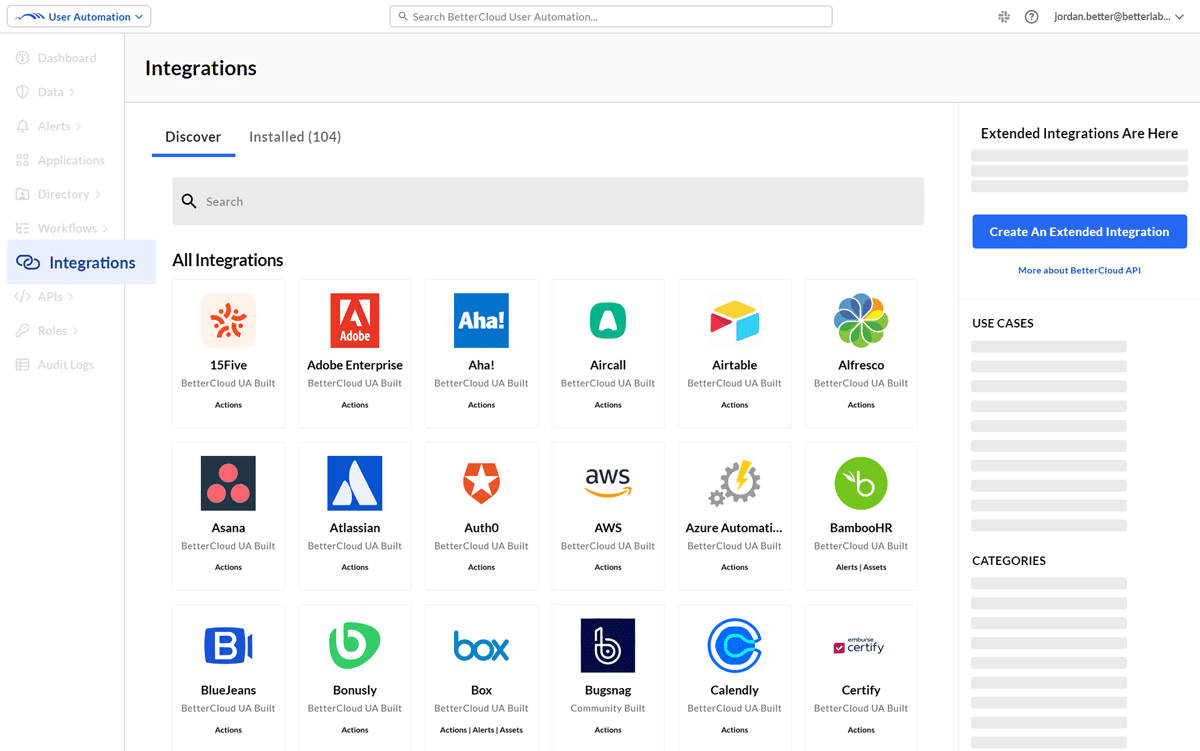
This is where BetterCloud’s User Automation module operates. A no-code workflow connects actions across services. Conditional logic, dynamic fields and custom attributes let administrators account for different people and circumstances. The company advertises more than 100 integrations and over 1,000 ready-made actions. Those numbers indicate breadth; the actions your particular process requires determine usefulness.
Pie Insurance’s customer story gives the abstraction a stopwatch. Its team had used checklists and logged into numerous applications for onboarding and offboarding. BetterCloud says those multi-hour processes fell to 20 minutes, recovering more than 600 hours annually. The reported IT-to-user ratio moved from 1:100 to 1:160, allowing the existing team to cover more people.
The checklist was becoming a bottleneck. Pie’s response was to encode recurring steps in workflows, including out-of-office replies and license administration. That moves effort toward defining and maintaining a process, instead of repeating it for every person. The work has an owner; the owner has fewer boxes to tick.
A company-published customer result.
Google was the beginning, not the boundary
David Politis started BetterCloud in 2011. In a 2020 SaaStr interview, he described watching enterprises move collaboration and productivity into the cloud while at Cloud Sherpas. His initial expectation was to manage one SaaS platform: Google Apps, later called G Suite and now Google Workspace.
That starting point explains the company’s continuing attention to Google administration. It also reveals a limitation of the original scope. Companies could choose different services for messaging, storage and sales, leaving IT with several environments to govern. The management problem followed the customer’s collection of applications.
BetterCloud introduced its rebuilt multi-SaaS platform in 2016. Bain Capital Ventures’ investment account describes the expansion toward Office 365, Salesforce, Dropbox, Box and Slack. Bain led a $60 million Series E in 2018; Warburg Pincus led a $75 million financing in 2020. Vista Equity Partners announced a strategic growth investment in 2022.
The widening remit makes the business interesting. BetterCloud had found a specific customer, the administrator responsible for keeping cloud work orderly. It could expand the territory that person managed without abandoning the job they needed done.

A bill, a permission, a shared link
Two acquisitions in 2024 added different kinds of evidence. G2 Track arrived in March, bringing spend management capabilities and a strategic partnership with G2. BetterCloud could bring contracts, usage and expenses into the same conversation as application administration.
Tricent followed in November, adding file-sharing governance. The underlying problem is familiar: sharing a document takes a moment, while remembering to withdraw access may depend on somebody remembering why it was shared in the first place. BetterCloud positioned the acquisition around more granular, automated control of Google and Microsoft shared files.
These purchases join operational and financial questions. A dormant account can represent both unnecessary spending and access that should be reconsidered. A completed project can leave external collaborators attached to its files. BetterCloud’s proposition is to make those relationships visible, then give an administrator a way to act on them.
Another subscription, with a job to do
BetterCloud sells subscriptions as a platform or individual modules. Its pricing page bases custom quotes on license count, connected apps, modules and add-ons. Spend Optimization Basic is listed at $0 per month. For the broader paid offering, the useful calculation is the cost of deployment and subscription against savings and administrative time that the organization can actually capture.
That calculation should separate a reduced bill from a recovered hour. A lower renewal becomes a purchasing saving. An hour released from administration becomes valuable when the team uses it elsewhere. Counting both is reasonable; pretending they are interchangeable cash is less so.
Buyers also have choices. Native admin consoles and internal scripts can handle parts of the work. Identity providers already participate in access management; BetterCloud lists Okta among its technology partners. Zluri emphasizes identity visibility and governance, including human and non-human identities. These approaches overlap without making every product interchangeable.
BetterCloud’s particular case rests on combining workflows, spending evidence, Google administration and file controls. Compare a real departure process or renewal against each option. A catalogue full of integration logos is pleasant to look at. The needed permission, supported action and reliable exception path are what make the purchase earn its keep.
Now the account can be an agent
CoreStack acquired BetterCloud on March 31, 2026, announcing a governance strategy spanning cloud infrastructure, SaaS and AI. Raj Kunnath became BetterCloud’s president in April; Politis joined as strategic advisor. The ownership change places SaaS administration inside a broader enterprise governance ambition.
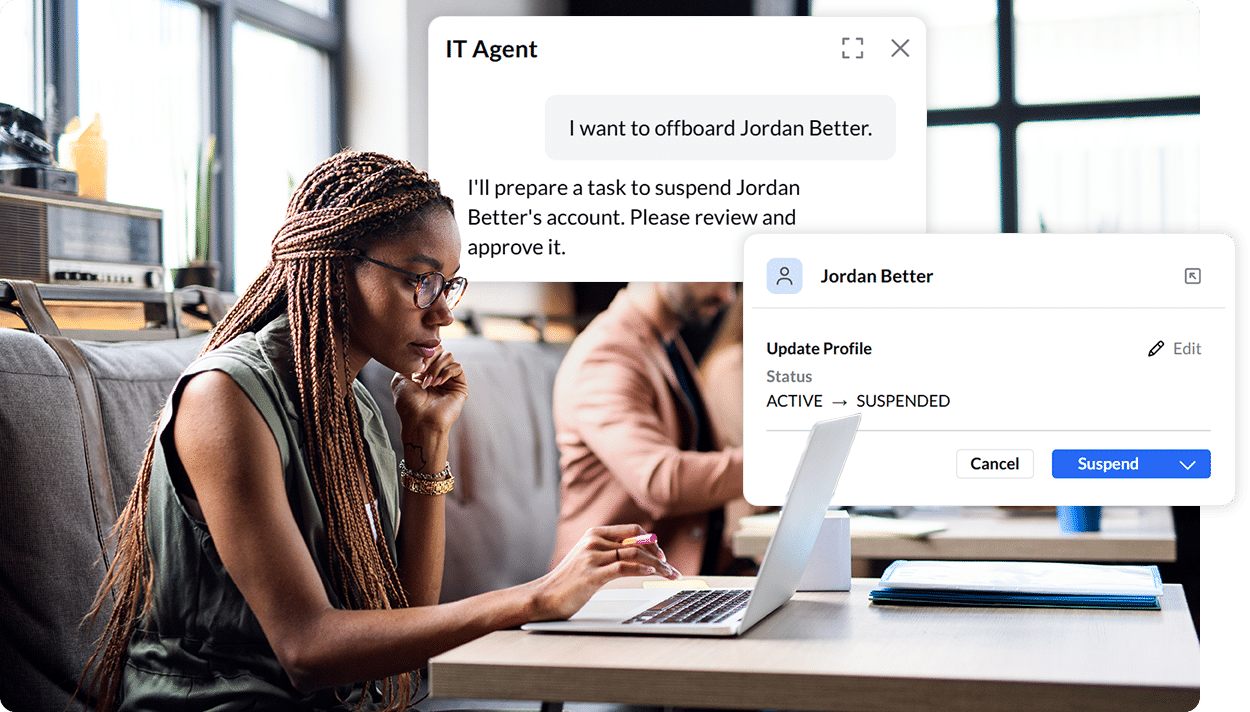
In June, BetterCloud announced a next-generation platform rolling out in phases throughout 2026. Its IT Agent lets administrators use natural language for questions and actions across Google Workspace. The announcement says execution requires explicit approval and actions are logged. The interface may resemble a conversation, but the consequences are administrative changes.
The company is extending its governance story to AI agents and non-human identities. That brings another version of the original problem: an organization must understand who or what has access, and decide what it should be allowed to do. A phased product announcement establishes direction. Each buyer still needs to confirm which capabilities are available in their deployment.
Copy the question before you buy the tool
The practical starting point is small enough to fit on a renewal calendar. Pick an upcoming contract. Compare purchased seats with recent activity. Ask the application owner about exceptions, future demand and seasonal use. Then change the purchase if the contract allows it. Kin’s 20-seat cushion is a reminder that judgment belongs alongside the data.
For automation, pick one recurring process and write down its steps, approvals and failure handling before configuring it. Check whether each integration supports the action and whether the connected account has sufficient permissions. BetterCloud’s GitHub documentation, for example, ties some team actions to an Enterprise subscription and excludes self-hosted instances.
A small SaaS estate with little administrative repetition may offer less to recover. A locked renewal may delay the financial benefit of reclaiming seats. Poorly defined rules can simply move confusion faster. BetterCloud is most persuasive where there is enough recurring work, enough application complexity and enough authority to act on the findings. The first useful question remains wonderfully unfashionable: what are we still paying for?