A new employee is an administrative avalanche wearing a name badge. There is a laptop to order, an email address to create, software to unlock, and somebody to ask why none of it is ready. Electric has spent years working on this small-business predicament. Its own predicament became rather larger: what happens when the company you built to remove busywork becomes too dependent on doing that work itself?
- Electric grew from chat-based IT support into a company valued at $1 billion in 2022.
- Its founder later said the combination of services and software had the wrong economics.
- The rebuilt business connects payroll events with devices, applications, and access.
- Published plans start free, with paid tiers at $10 and $25 per user per month.
The growth chart missed the problem
In his August 2026 account of Electric’s relaunch, founder Ryan Denehy identifies late 2022 as the reckoning. Growth had obscured a structural flaw: the services-and-software mixture delivered neither the profitability of a services business nor the margins and scalability of software. Former Zendesk CFO Alan Black helped force the decision. The response was severe: layoffs exceeding 60% of the company and the sale of a division containing nearly all its revenue.
The cost was therefore more than a new website or product launch. Electric surrendered much of its old business to pursue different economics. Denehy describes an 18-month stretch of difficult rebuilding and partner visits. This is his account of the reversal, and the distinction matters. A founder explaining a pivot is also arguing for the company that emerges from it.

Earlier decisions had pointed in another direction. Electric bought Sinu and Techvera to expand its service capabilities. In his explanation of the Sinu deal, Denehy argued that regional providers brought accumulated expertise, access to unfamiliar industries, and experienced people. That reasoning was perfectly legible: buying a good service business could improve the service you sold. It also made the later retreat from services a consequential change of mind.
There is a lesson here for anyone impressed by an ascending revenue chart. Expansion tells you that people want something. It does not, by itself, tell you whether each additional customer brings the economics you intend to build. Electric’s unusual achievement is that its founder has described this distinction in public, after spending years selling the original combination.
The employee record becomes the starting gun
Today, Electric offers an IT management platform for small and midsize businesses with thinly staffed IT departments, including businesses with none. Its August 2026 announcement reports more than 1,000 customer companies and 55,000 end users worldwide. Those are company-reported adoption figures. They describe a customer base, rather than the much larger audience its distribution partners could potentially reach.
The current product begins with an event familiar to HR: someone joins, leaves, or changes roles. Electric connects that event to work involving devices and application access. Its application-management tools organize permissions around roles and groups, with supported applications including Google Workspace, Microsoft 365, Slack, Salesforce, and GitHub. An administrator can see who has access instead of reconstructing the answer from several consoles.
That makes its likely champion an operations or HR leader as often as a technical specialist. Electric’s homepage features Kevin Mercado, chief of staff at Sunthetics, saying he can concentrate on the business without becoming an IT specialist. The attraction is easy to understand. Most small businesses do not object to computer administration in principle. They object to discovering that the office manager has acquired an unpaid second profession.
“I don’t have to be an IT specialist - I can focus on the business.”Kevin Mercado · Chief of Staff, Sunthetics
Gigawatt is the AI component in this story. Introduced in 2023 as an IT assistant, it used device details and support resources to help troubleshoot problems. Electric now includes the Gigawatt automation engine in its Pro tier. The useful question is what work the system can complete with the information and permissions available to it. A fluent answer is pleasant; a correctly configured account is something an employee can use.
The laptop has a return journey
Electric’s Hardware Store combines purchasing with shipping and warehousing. Its catalog is brand-agnostic, and Apple Business Manager can support zero-touch Apple provisioning. Unused machines can be stored and later shipped to another employee. This addresses a modest but persistent absurdity of distributed work: an expensive company asset can become an unidentified box under somebody’s desk.
Device management adds inventory, patch and policy deployment, and remote lock or wipe capabilities. Electric’s device page describes a JumpCloud partnership. That is an instructive detail about its expertise and market position: the platform coordinates established tools as well as supplying its own workflows. Buyers should judge how well the whole arrangement works for their environment, rather than assume every capability was invented inside Electric.
Security follows the same connecting logic. Electric lists password management, network protection, awareness training, email security, data protection, and endpoint detection and response. These are distinct jobs, served through a wider technology ecosystem. The platform’s value lies partly in bringing them into a manageable arrangement. It would be a mistake to read a menu of protections as a promise that a business can stop thinking about security.
Payroll is a place to sell, too
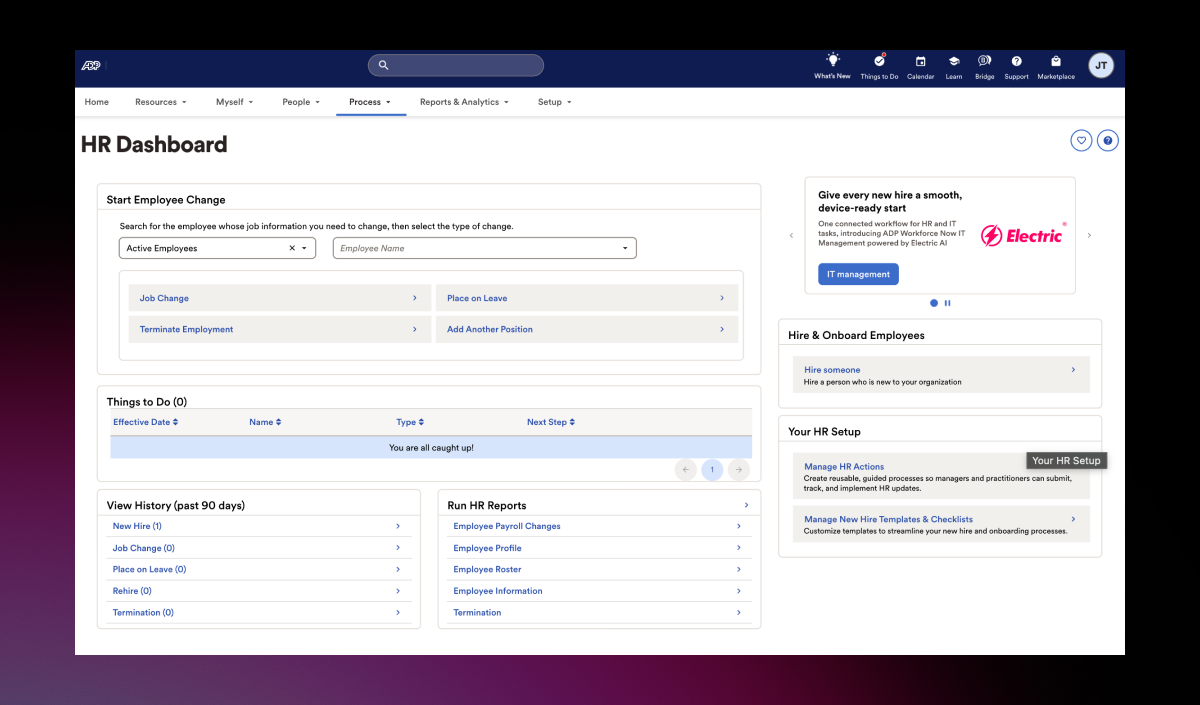
Electric’s second act changes how customers encounter the product. The company’s relaunched partner network includes ADP, Paychex, Paycor, UKG, Justworks, isolved, and TriNet. The logic is more specific than attaching a fashionable AI label to a familiar dashboard. Payroll and HR systems already hold the employee information that can trigger IT work. Selling there puts the product near the moment someone needs it.
ADP IT Management connects HR and IT workflows; Electric says existing Workforce Now, RUN, and TotalSource clients can activate a free offering. TriNet IT embeds purchasing, provisioning, and offboarding actions into its platform. Justworks synchronizes employee information into Electric. These arrangements differ, but each reduces the distance between the personnel record and the task it creates.
Against a traditional managed service provider, Electric emphasizes software-driven coordination and repeatable workflows. Against a collection of separate administration tools, its pitch is fewer handoffs. An established local provider may still be the sensible choice for a business needing substantial on-site assistance or specialized infrastructure expertise. The comparison should start with the work required, rather than an abstract contest between humans and automation.
What a 50-person company would pay
The published pricing makes an initial comparison possible. Free covers hardware visibility and asset tracking. Essentials, at $10 per user per month, adds SaaS application management, provisioning, license reporting, and spend visibility. Pro, at $25, adds mobile device management, Gigawatt automation, patch management, device health monitoring, and compliance policy enforcement. Volume pricing is available.
The calculation is simple; the buying decision is less so. A subscription price is a starting point for a budget. A laptop remains a purchase, and the scope of security and support needs checking. Ask which existing tasks disappear, which still require a person, and which integrations support the exact workflow your business uses. That produces a more honest estimate than multiplying a marketing claim by everybody’s salary.
Copy the handoff, question the promise
The part worth borrowing is the sequence. Begin with the employee event. List every device, account, and permission affected. Assign responsibility for exceptions, then test the whole journey with a real joiner and a real departure. This is an editorial recommendation drawn from Electric’s workflow approach. It is useful even if you ultimately select another vendor.
The conditions matter. Accurate employee data, enrolled devices, supported applications, and sensible access rules give automation something reliable to act on. Missing records and unusual systems leave gaps. Businesses with bespoke infrastructure or extensive physical support requirements should test those needs separately. The elegance of one trigger depends on the less elegant work of making its consequences correct.
Electric’s first business made IT help easier to request. Its rebuilt business tries to make routine requests less necessary. Whether that produces the durable software economics Denehy wants remains a question for the new company to answer. For a customer, the test is satisfyingly ordinary: on Monday morning, can the new colleague open the laptop and get to work?