A software update ought to be a small event. At Demandbase, it could become a queue of employees unable to reach the systems they needed. The company’s old routine relied on manual update packaging and, eventually, restricting access for Macs that had fallen behind. Security enforcement arrived at the help desk wearing a complaint.
- Iru combines device management, workforce identity and compliance in a subscription platform.
- Its distinguishing idea is shared context: the same users, devices and policies inform several jobs.
- The practical test is how many recurring tasks you can retire, and which integrations you still need.
Demandbase’s published Iru case study reports 75% fewer Mac support tickets and 40-50 hours saved each month after switching from Jamf. In its proof of concept, the team completed 90% of its required configuration in three hours. Those are one customer’s results. Still, they point to a revealing question: how much of an IT team’s work is caused by the machinery intended to help it?
The ticket queue tells the story
A company buys software to manage laptops. It buys another product to decide who may enter applications. A third keeps the evidence an auditor wants. Each purchase has a defensible purpose. Then someone has to reconcile the three accounts of reality. Is this laptop patched? Does its owner still work here? Does the evidence describe what is happening now?
That reconciliation is the territory Iru wants. Its premise is that IT and security teams lose time at the handoffs between systems. You can hear the appeal without accepting every claim about AI. A sensible control should help the employee complete the update before the employee discovers that access has vanished.
Demandbase’s reported reduction after migration. A customer outcome, not a platform-wide average.
An Apple specialist changes the brief
The company began in 2018 as Kandji, founded by Adam Pettit, Wesley Pettit and Mark Daughters. Its original specialty was Apple device management. That is an unusually good place to learn the value of repetitive work done correctly: provisioning computers, keeping applications current, applying settings and preventing a fleet from slowly becoming hundreds of exceptions.
On October 22, 2025, Kandji became Iru. The announcement widened its brief to workforce identity, cross-platform endpoint management and security, and compliance automation. Windows and Android joined the management proposition. The change of name announced a change of ambition: a company known for taking care of Apple devices wanted to take care of the relationships around devices, too.
Iru says more than 6,000 organizations use its products. Its customer material spans fintech, software, media and larger enterprises. A startup trying to prepare for an audit and a distributed company maintaining thousands of computers have different purchasing problems. Both may have people spending too much time keeping separate systems aligned.
One map, several decisions
Iru calls its shared foundation the Context Model: a living map of devices, applications, users, policies, posture, events and evidence. The important word is “shared.” An access decision can use knowledge of a device; compliance work can use knowledge of the controls applied to it. Iru AI sits across that model to offer guidance, propose actions and help maintain evidence.
A conceptual view of the platform’s shared context.
The products make the idea concrete. Endpoint Management provisions devices and enforces settings. Assignment Maps let administrators see why an application or policy reaches a particular machine, and stage changes for test groups. Auto Apps maintains a catalog of applications with managed updates. Configuration as code brings version history, review and rollback into device configuration.
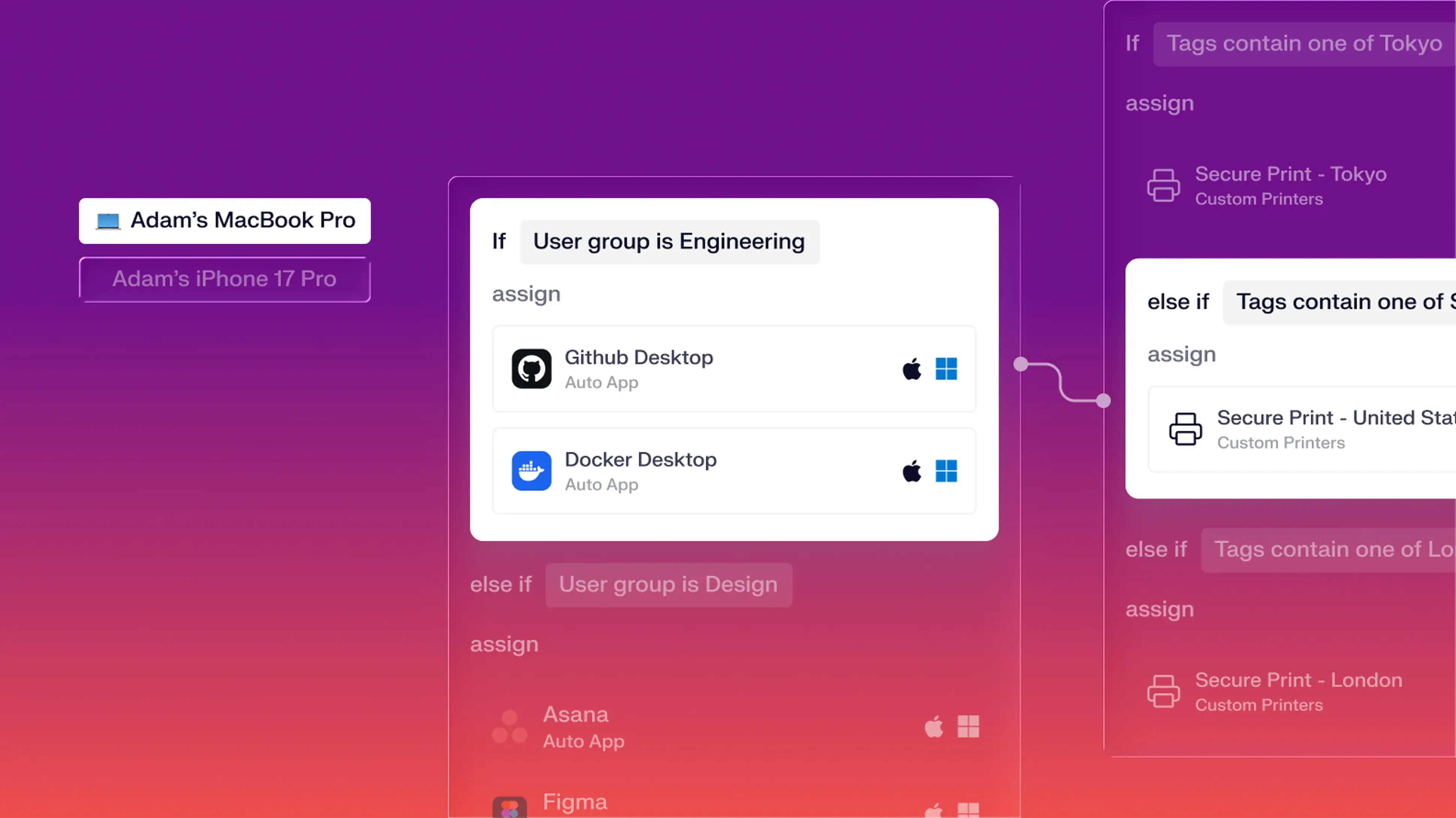
Workforce Identity supplies passwordless single sign-on using device-bound passkeys and posture checks. Endpoint Detection & Response investigates threats and can quarantine files or isolate devices. Vulnerability Management identifies risky software and can patch supported applications. Management covers Apple, Windows and Android; security capabilities need checking by operating system rather than assuming every feature follows every device.
Compliance Automation turns frameworks into tailored controls and assigned work, then collects and maps evidence. Its Adaptive Evidence Map flags stale or irrelevant material. Trust Center makes selected security information available to buyers, gates sensitive documents and drafts questionnaire answers. The auditor still has a job. A tidier evidence trail does not confer a certificate by itself.
Make the migration a booking, not a summons
GoCardless’s previous device management arrangement consumed nearly a full-time engineer’s effort, according to its Iru customer story. Enrollment could take more than an hour. IT partner Remitech helped the payments company evaluate a replacement. Automated updates and a clearer operating experience helped persuade the team.
Then IT engineer Laura Lorca did something readers can copy. Employees booked migration slots through Google Forms. Live Zoom support accompanied the sessions. The team moved 900 devices over three weeks, using nine time slots rather than an indiscriminate company-wide interruption. GoCardless reported enrollment falling to ten minutes.
The lesson survives a change of vendor: give people a choice of timing, provide a person when something goes wrong, and preserve the ordinary working day. Migration is a technical operation performed in a social setting. Forget the second half and the first half acquires a queue.
The archaeology of an old policy
At VICE, years of accumulated device rules made it difficult to explain why a machine received a configuration. Some policies belonged to offices that had closed. Its Iru story describes a small team replacing that tangle with visual assignments and a declared end state that the platform keeps checking and restoring.

VICE consolidated Mac and Windows management, yet retained Okta and migrated endpoint protection from Carbon Black to SentinelOne. That detail keeps the story honest. An integrated platform can reduce duplication while still operating with specialists. Consolidation need not become a solemn vow to buy every product from one company.

The bill, and the work it must retire
Iru sells annual subscriptions, billed annually, with general quotes based on products, users and devices. Its startup bundle begins at $9,000 a year for up to 25 endpoints, 25 mobile devices and 25 identity users. Onboarding and migration support are included. Several operational products offer a 14-day trial; compliance products are available through a personalized demonstration.
The sensible comparison includes licenses, existing commitments, migration labor and recurring administration. Alternatives include Jamf or Microsoft Intune for devices, Okta for identity, specialist endpoint protection and providers such as Vanta or Drata for compliance. Iru’s advantage must show up in a working process: fewer duplicated checks, clearer assignments, useful evidence. A shorter vendor list alone proves little.
Startup bundle: up to 25 endpoints, 25 mobile devices and 25 identity users. General deployments require a quote.
There is capital behind the expansion. In July 2024, General Catalyst supplied a $100 million package: $50 million of Series D equity and $50 million for go-to-market investment, at an announced $850 million valuation. Half for equity, half for distribution is a distinction worth keeping when the headline number is so temptingly round.
The company’s careers page describes a demanding workplace, emphasizing ownership, speed and customer outcomes. “We value impact over effort” is one of its stated values. That philosophy has an obvious product analogue: hours spent tending a console are a poor measure of whether the computers are properly tended.
“We value impact over effort.”
Iru’s stated workplace values
The next operator has a prompt
In May 2026, Iru introduced MCP connectivity for endpoint workflows in compatible AI tools. Administrators can build processes that cross device management, ticketing and communication. Iru describes scoped permissions, logged actions and human approval before irreversible operations. Those boundaries matter when a conversational instruction might end in a wiped computer.
The less theatrical release notes matter too. September brought Windows vulnerability remediation for supported Auto Apps and daily billing visibility for U.S. managed service providers. On October 1, Iru added a more detailed identity activity log. A wider platform earns its place through these small, inspectable improvements.
The purchase makes most sense when a team has repeated handoffs it can remove and supported workflows it can test. Bespoke applications, deeply embedded specialist controls or long existing contracts can shrink the benefit. Start with a representative pilot. Measure tickets, maintenance time and evidence quality. Ask which work has actually disappeared. A quiet help desk is a rather convincing demonstration.
Take a closer look
Explore the product, the customer accounts and the people building it.