The trouble began with a date. Thumbtack’s IT team was updating a macOS profile meant to give employees two weeks to install a new operating system. The version number was right; the date field pointed backward. Every Mac was told to update immediately. This is the sort of mistake that looks trivial in a form and enormous once it reaches a company. Thumbtack later described the episode in a customer account for Fleet, the device management company it chose to make the next change easier to review.
The short version
- Fleet manages and secures computers and mobile devices across macOS, Windows, Linux, ChromeOS, iOS, and Android.
- Its unusual move is to put device settings in Git, where teams can review and reverse a change.
- Its free tier is open source; the listed Premium price is $7 per host per month, with custom enterprise plans.
- Customer figures are reported by Fleet and its customers, not independent benchmarks.
A laptop management console sounds like an unlikely place for a philosophy of work. Yet the console has enormous power. It can install software, enforce encryption, change a login setting, or lock a machine. In many companies, those choices still arrive through a series of clicks made by one administrator. Software engineers would find this odd. They have spent years building tools so a consequential change can be proposed, checked by another person, recorded, and undone.
First, ask the computers
Fleet’s roots lie in osquery, an open source project created at Facebook in 2014 by a team that included Fleet co-founder Zach Wasserman. The trick was to make a computer answer questions as if it were a database. An administrator could ask which machines had a vulnerable application, an encryption setting, or an unexpected process. A query against one laptop was useful. A query against thousands required a server to gather the answers. Wasserman, Mike Arpaia, and Jason Meller built the first Fleet project at Kolide in 2016 to do that job.
Kolide changed direction. The Fleet project continued with its community, and Wasserman kept maintaining it. In 2020 he and Mike McNeil formed Fleet Device Management as an independent company. That sequence matters. Fleet did not begin with a glossy panel of buttons and hunt for a technical reason to exist. Its first job was visibility: helping an IT or security team learn what was actually running on machines it was responsible for. Management, software delivery, patching, and vulnerability work followed.
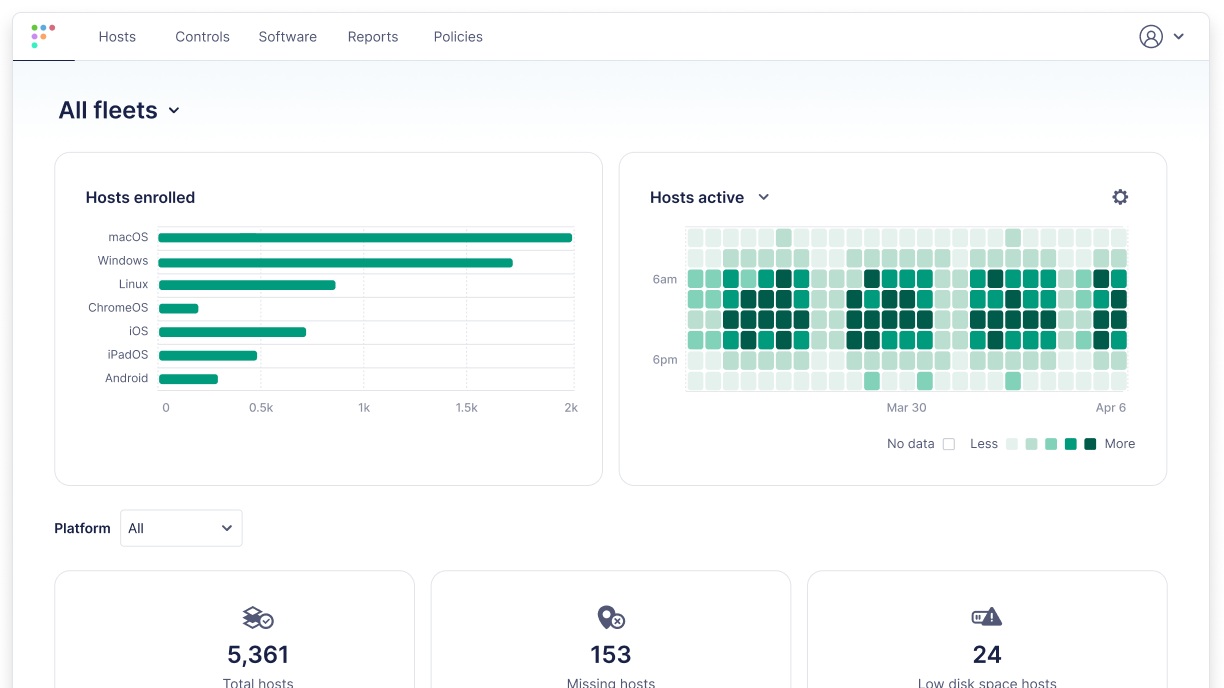
Today Fleet offers an agent and a shared view of devices across desktop and mobile operating systems. A team can enroll a computer, see its hardware and installed software, check a security policy, deploy an app, run a script, or examine a vulnerability. On supported platforms it can manage configurations and updates over the air. Some controls still depend on the operating system: a Linux workstation, a Mac, and a personal Android phone do not obey identical commands. Fleet’s promise is a common inventory, policy approach, and API around that uneven reality.
The click that reached every Mac
Thumbtack had a practical reason to care about Git. The team described a previous workflow in which configuration changes went straight from a dashboard to devices. The update date error made the risk visible. With Fleet, Thumbtack says it moved device configurations into code review, where another person can see a proposed change before it ships. The resulting history shows who changed what and why; a bad setting can be reverted in minutes. It reports migrating more than 90% of its Macs without manual IT enrollment work.
“With Fleet, every change gets a second set of eyes on it before it’s deployed.”
The mechanics are ordinary in engineering and still unusual in device management. Put a configuration file in a repository. Propose a change. Have a colleague review the diff. Merge it. Let Fleet apply the setting, then check the result. The same route creates an audit trail without asking someone to reconstruct a Tuesday afternoon from memory. It is a method a reader can copy even without buying Fleet: start with one risky policy, write down its desired state, require a second reviewer, test on a small device group, and keep a rollback plan.
A configuration becomes a decision
- 01 / PROPOSEChange the file and show the diff.
- 02 / REVIEWA second person checks the target and timing.
- 03 / APPLYFleet sends it to devices and records the result.
A market full of operating systems
Fleet sits among familiar names: Jamf Pro for Apple estates, Microsoft Intune for Microsoft centered ones, and Workspace ONE for broad enterprise management. The company argues for a different combination: inspectable source code, Linux as a serious platform, one API, and the choice to run the server yourself or use Fleet Cloud. That last choice mattered to Stripe. Its team already used Fleet for osquery visibility and wanted its MDM under its own control because the system could command thousands of Macs.
At renewal time, Stripe compared alternatives and chose Fleet for its Macs. It says it moved 10,000 of them in 10 days and saved hundreds of thousands of dollars a year in licensing. Those are Stripe’s reported results, shaped by its existing Fleet experience, engineering staff, and automated enrollment setup. A company without those conditions should treat the figure as a case study, not a migration timetable.
Foursquare tells a smaller, equally revealing story. It had one MDM for roughly 200 Macs and another for around 15 Windows machines. Maintaining both consumed a small IT team’s time. After moving to Fleet, Foursquare reported a 24% fall in licensing costs, 50% less endpoint maintenance effort, and a 114% return on investment. The headline is not that one product is cheaper in every setting. It is that duplicate tools carry a hidden wage bill: someone must keep both configured, integrated, and understood.
Free code, paid responsibility
Fleet’s business model is open core. Its free tier is MIT licensed, and Fleet publishes its code, issue discussions, and company handbook. The public pricing page lists Free at $0 per host and Premium at $7 per host per month, with custom plans for larger deployments. Premium sells deeper management and support. Customers can use Fleet Cloud or host the software themselves. The arrangement invites scrutiny from security teams and gives buyers more control over where device data lives.
Public list price · September 2026
$7 / host / monthFleet Premium. Free is $0 per host; large deployments can seek custom pricing. Price is a list figure, not a quoted contract.

Openness also defines how the company behaves. The handbook describes an all-remote team spread across four continents and nine time zones; it even publishes McNeil’s own list of working flaws. In 2025, the company says it raised its $27 million Series B using a written memo rather than a pitch deck, with employees invited to comment. The round brought its announced funding to $52.3 million. The memo is a neat miniature of the product’s argument: important changes improve when the reasoning is visible.
Fleet now says its software reaches more than 2 million computing devices at more than 1,300 organizations in over 90 countries. A 2025 partnership made its agent the default for Secureframe’s compliance platform, putting the open source code on devices at many more customer organizations. Its September 2026 release added Android commands and Windows Autopilot host support. The company keeps widening the list of devices it can reach, even as each platform brings its own rules.
There is a sensible limit to the lesson. Git review works best when a team can maintain configuration files, test changes, and decide who approves them. An organization needing only basic controls on a single operating system may find a simpler console sufficient. And a live query answers only what the agent and operating system can observe; it cannot turn every device into the same device. Fleet’s more durable idea is narrower and better: when a setting can affect every employee, treat changing it with the care of changing software.
Go see for yourself
Fleet and the accounts behind this story
- Fleet website · pricing · source code · public handbook
- Thumbtack · Stripe · Foursquare customer accounts
- Fleet articles · LinkedIn · X · YouTube videos