The checkout freezes. A customer waits. An employee tries again, then calls someone who may know what went wrong. This is the unglamorous territory where 1E built its business: the expensive distance between a computer developing a problem and somebody fixing it.
TeamViewer put a large price on shortening that distance. Its acquisition of 1E, completed on January 31, 2025, carried a $720 million enterprise value. The logic was straightforward. TeamViewer could connect a technician to a device. 1E could help discover what needed attention across a fleet, then automate the response.
Today, that technology is sold as TeamViewer DEX, short for digital employee experience. The phrase sounds like something devised for a conference lanyard. Its practical subject is much more familiar: slow applications, unhealthy laptops, troublesome updates and the working hours consumed by all three.
The checkout is the argument
A customer account published by TeamViewer describes an unnamed British retailer with more than 1,000 UK stores. Since 2020, the software has helped its engineers investigate point-of-sale problems. The account reports device uptime increasing from 92% to 98%, across an operation managing more than 26,000 devices.
Those figures are the vendor’s published customer results, rather than a forecast for every deployment. Still, the mechanism matters. Engineers gained a view of where the checkout process was going wrong. They could investigate recurring trouble with evidence gathered from the devices themselves.
“Within a day of initial deployment, 1E could tell us exactly what was happening with that long-standing POS issue.”
Unnamed retailer · TeamViewer customer account
Six percentage points.
Fewer chances to lose the sale.
A checkout is a useful corrective to the idea that employee experience belongs exclusively to office workers. The customer sees a queue. The assistant sees a malfunction. IT sees an endpoint. All three are looking at the same lost minute.
An error code becomes a business
Founded in 1997 by Sumir Karayi, Phil Wilcock and Mark Blackburn, 1E emerged from the Microsoft world. Even its name carried a technical joke: a reference to a Windows blue-screen error code. Building a company around the thing customers hoped never to see was a fairly direct statement of intent.
Its earlier products attacked waste in concrete forms. NightWatchman addressed computer energy consumption. Nomad handled software distribution. Shopping let employees request applications through an enterprise store. AppClarity addressed software assets and licensing. The common subject was unnecessary expense: electricity, infrastructure, unused software and people doing repetitive work.
One historical pharmaceutical case study puts that last category into focus. Using Shopping alongside other 1E tools, the organization reported fulfilling more than 116,000 software requests and saving over $5 million in twelve months. About 10,000 users a month downloaded software in under five minutes. Automating request and delivery removed waiting from an ordinary task.
The company’s language eventually shifted toward experience, but the underlying obsession remained recognizable. Karayi’s public writing argued for identifying and eliminating IT waste. By 2021, Carlyle’s majority investment was backing international expansion and further product development as hybrid work increased the need to support people away from the office.
That announcement also described a business retaining an employee-owned portion, with staff sharing in future growth. It is a useful detail in a company history otherwise dominated by product acronyms: the ownership arrangement included people doing the building.
A dashboard with permission to act
The product lineage runs through Tachyon, then the 1E Platform, to today’s TeamViewer DEX. At its center is a combination of observation and action. IT teams can examine device and application experience, investigate faults, gather employee sentiment and apply automated fixes. The expertise lies in making those actions usable across a large, varied computer estate.
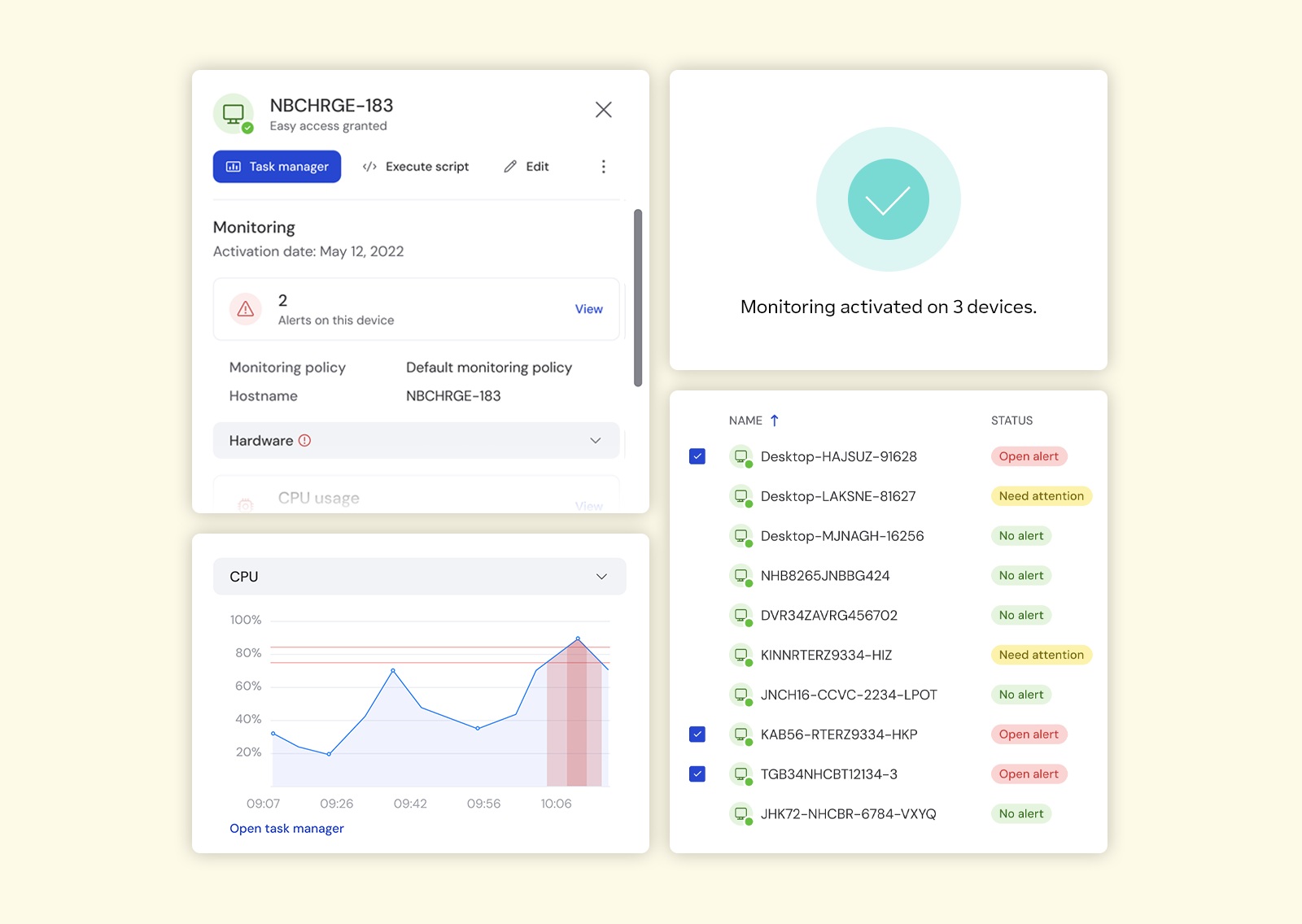
The current product range includes endpoint troubleshooting, automation, experience analytics, inventory and patch insights. Separate offerings address hardware refresh decisions and software reclamation. Integrations with Microsoft tools and ServiceNow let administrators bring this work into systems they already use. A service desk can therefore become an entry point for diagnosis and repair.
Consider a recurring configuration problem. An administrator needs to identify affected devices, establish the intended setting, authorize a correction and confirm the result. DEX provides machinery for that sequence. The business value comes when the sequence prevents the same problem from becoming tomorrow’s collection of tickets.
- 01ObserveRead device health
- 02InvestigateFind the cause
- 03ActApply an approved fix
- 04VerifyCheck the outcome
The surrounding market is busy. Nexthink, Lakeside SysTrack, ControlUp, Riverbed Aternity, Tanium and Ivanti all offer competing approaches to digital experience. 1E’s case rests on its remediation heritage, enterprise integrations and, now, TeamViewer’s remote-support connection. A shortlist should test those capabilities against actual faults in the buyer’s environment. A category label cannot settle that comparison.
The laptop that earns another year
At environmental engineering firm Carollo Engineers, the platform supports a dispersed workforce and combines current endpoint information with other business data. Its IT team uses integrations including Configuration Manager and Power BI to support reporting and decisions.
The revealing use case is hardware replacement. Systems administrator Erik Dixon describes using experience data to justify keeping machines that still work well. A laptop’s age is easy to count. Whether it is getting in somebody’s way takes more investigation.

The account also describes the difference between a previous inventory scan and information available when a remote machine comes online. Off-VPN employees make that distinction particularly useful. If the question is what a computer needs now, a report describing its condition several days ago can send an investigation in the wrong direction.
The lesson readers can copy is a purchasing discipline: examine performance and user experience before applying a replacement calendar. Keep security support and the employee’s workload in the decision. Extending a useful machine’s life has value; extending somebody’s daily frustration has a cost.
Even 1E had a Mac problem
There is an agreeable wrinkle in 1E’s own IT story. A customer account from Apple-management supplier Iru describes 1E struggling with legacy tools for its Mac fleet. Onboarding was awkward, packaging applications required manual intervention, and updates could take eight hours or more.
The team moved to a specialist Apple-management product, now branded Iru. The account credits easier automation, clearer update visibility and a shorter learning curve. Administrators could support the Mac population without adding IT headcount, while retaining other management tooling for other devices.
This supplies a concrete answer to what changed the team’s mind: the existing approach was demanding too much specialist effort for routine work. It also puts a sensible boundary around 1E’s proposition. Experience management can sit alongside device-management tools. A company can sell endpoint expertise and still buy another vendor’s software for a particular job.
What the $720 million bought
Before becoming an acquisition target itself, 1E bought Exoprise in October 2024. That added expertise in monitoring networks, cloud applications and communications services. A laptop can appear healthy while its user struggles with a SaaS application or a video call. Real-user monitoring and synthetic tests widen the investigation beyond the machine.
TeamViewer’s December 2024 deal presentation showed how enterprise-focused the business had become: 99% of September annual recurring revenue came from enterprise customers. The purchase paired that installed base and remediation technology with TeamViewer’s connectivity business. In practical terms, the combined pitch covers finding trouble, automating routine fixes and bringing in a person when needed.
Enterprise value, cash-free and debt-free.
Announced December 2024 · Closed January 2025
For customers, the commercial model is recurring enterprise software. Current packages run from Standard through Enterprise to Enterprise Plus, with targeted solutions alongside them. Buyers obtain a sales quote. The useful cost comparison includes the required capabilities, rollout work and ongoing administration against measurable reductions in support effort, downtime or avoidable purchases.
The acquisition did not produce an uninterrupted growth story. TeamViewer’s 2025 results show 1E pro forma revenue of €65.6 million, down from €68.5 million in 2024 and flat at constant currency. Those comparative figures are unaudited and should not be confused with recurring-revenue run rates.
By July 2026, TeamViewer was reporting a DEX commercial recovery, including larger customer agreements and increased adoption of its combined platform. That is management’s account of progress. It makes customer retention and expansion part of the story, alongside the engineering.
The next repair still needs a human decision
The August 2026 DEX 26.8 release notes show where development is going: updated conversational reporting through Tia, a Freshservice integration and Exoprise components delivered through the existing client installer. There are also finer controls over permissions. The product is making information easier to ask for while continuing to define who may see and change what.
Deployment conditions still matter. The on-premises setup guide specifies clients, server infrastructure, networking and certificates; custom instructions require code signing. An organization needs supported devices, connectivity and authority to make the intended changes. Monitoring alone cannot repair a service outside its control.
A practical starting point is one recurring fault with a measurable baseline. Establish how often it happens, what the approved fix does and how the team will verify success. Expand after the evidence holds. This is an inference from the customer examples, rather than a promised deployment recipe.
For the employee at the till or behind the laptop, the test remains wonderfully plain. Does the thing work? Can they get on with their day? After decades of changing product names and a $720 million transaction, those are still the questions 1E has to answer.
Open another tab
Explore the product, follow the company, or watch the machinery explained.