The interesting thing about a computer file is how quietly it can change. A permission expands. A setting drifts. A file acquires a new line. Nothing obliges the machine to announce that yesterday’s sensible arrangement has become today’s security problem. Someone has to remember the old arrangement, inspect the new one, and ask an awkward question.
Fortra’s Tripwire has spent its commercial life making that question systematic. What changed? It is an admirably small question for an industry fond of large promises. Its answer can help a security analyst investigate tampering, an operations team untangle a mistake, or a compliance officer explain what happened between two audits.
- The job: detect suspect changes, assess configurations, and prioritize vulnerabilities.
- The buyer: enterprise and industrial teams with important systems and recurring evidence requirements.
- The twist: Tripwire also sells the expertise to operate those controls.
- The lesson: an alert needs a trustworthy baseline and a person responsible for the next step.
The alarm before the alarm
Before Tripwire was a company, it was software developed at Purdue. Gene Kim worked on integrity checking with professor Eugene Spafford. The academic release appeared in 1992; Kim and Wyatt Starnes formed the commercial company in 1997. The research’s appeal was straightforward: record the condition of important files, then detect differences.
That approach gives security a memory. A file need not look obviously villainous to deserve attention. It may simply differ from the version that was accepted as good. The distinction matters: detecting change supplies evidence for an investigation, while deciding whether that change is legitimate requires context.
The idea also escaped the usual fate of old software. Tripwire contributed an open-source version in 2000, and that project remains on GitHub. Its documentation still describes policies that specify files, directories, and attributes to monitor. A scheduled check compares the present filesystem with a baseline. The administrator decides which expected changes should become the new normal.
A cupboard full of evidence
The commercial portfolio surrounds that original idea with adjacent jobs. Tripwire Enterprise combines file integrity monitoring with security configuration management. The former notices changes; the latter evaluates settings against an accepted configuration. A machine can have an intact file and an unsafe setting. Keeping both questions in view is useful.
IP360 addresses another problem: finding assets and their vulnerabilities, then sorting the findings into a practical queue. Its scoring considers a vulnerability’s age, ease of exploitation, and consequences. LogCenter collects and retains logs, with event correlation and reporting. The products answer related questions about state, exposure, and activity.
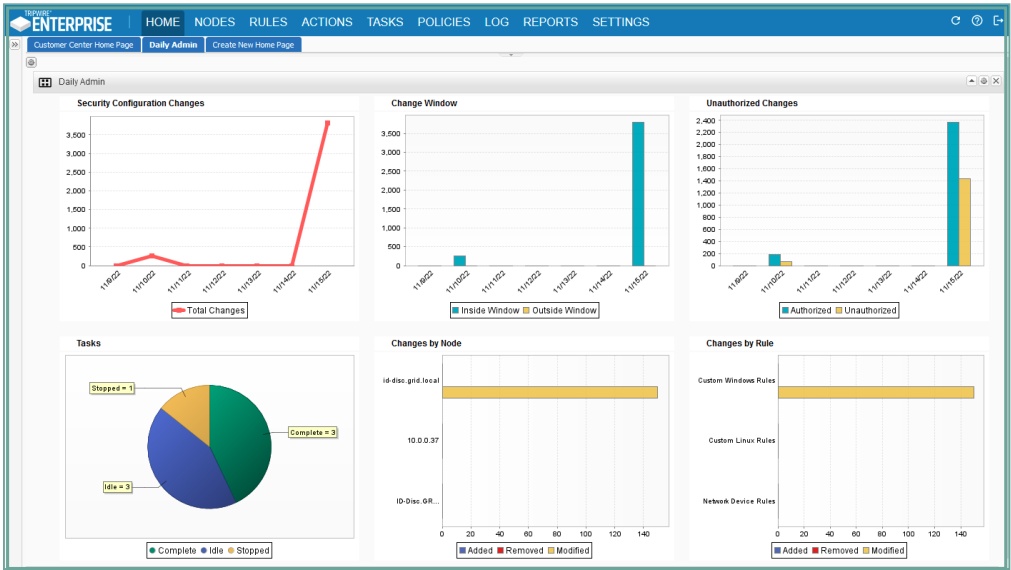
The company’s expertise sits in the connective tissue. Its Vulnerability and Exposure Research Team, VERT, researches weaknesses and supplies detection content. Product integrations carry findings into tools such as Splunk and ServiceNow. Enterprise can reconcile detected changes with change-management requests, helping teams distinguish approved work from something that needs attention.
That matters because “a change occurred” is not a verdict. Administrators patch systems. Applications update. Approved work leaves traces, too. A control that cannot distinguish ordinary maintenance from suspicious activity risks becoming another inbox that nobody opens.
The operator is part of the product
Software assumes an operator. Enterprise buyers do not always have one to spare. ExpertOps makes the staffing problem part of the offering: a subscription combines software, a hosted environment, and designated expertise. The service can cover integrity monitoring, configuration management, or vulnerability management, with reporting and audit assistance.
One anonymous software company in Tripwire’s published customer accounts had 400 employees and an operations team struggling to keep up with vulnerabilities. After a leadership change, it adopted ExpertOps across more than 600 servers and 400 desktops. Tripwire helped prioritize remediation and provided regular analysis. Over nine months, the customer reported a 42% reduction in vulnerabilities and a 77% reduction in average host score.
fewer vulnerabilities
Indexed counts, not raw totals. Anonymous software customer; vendor-reported outcome, not a controlled comparison.The useful detail is the routine behind the percentage. Scan results became a repair agenda. Experts helped the team decide what deserved attention first. The result does not promise that another customer will achieve the same reduction; it shows what a managed service is intended to change in the working day.
“The VERT team and the Technical Account Managers (TAM) always have our backs.”
Anonymous federal-government IT specialist, quoted on Tripwire’s IP360 page
The power grid has a different clock
Industrial buyers bring an additional complication. A vulnerable office system and a vulnerable control system may require very different repair schedules. Tripwire’s industrial guidance discusses the constraints around patching operational technology, where availability and safe operation shape the decision. A fix must fit the machinery’s life, not merely the scanner’s timetable.
Consider a Fortune 250 energy company described in a Tripwire case study. Its previous configuration tool was cumbersome and manual. Vulnerability scanning had caused problems for sensitive control systems. A difficult NERC CIP audit helped prompt a switch to Enterprise and IP360, covering more than 1,000 NERC CIP assets and 2,000 IP addresses.
A separate energy customer outsourcing its corporate IT wanted visibility into unauthorized changes. That engagement covered more than 5,000 assets, involved a multimillion-dollar deal, and included two resident engineers on renewable one-year contracts. This is what security implementation can cost: software plus the human work of making it operational. The account is one deployment, not a price list.
The two accounts reveal different reasons to buy. One organization needed relief from an awkward tool and a painful audit. The other needed oversight while handing operations to someone else. In both, the product’s value depended on how it fitted a specific operating problem.
Two deals, one persistent question
Tripwire’s ownership history is less quiet than its founding idea. Thoma Bravo acquired it in 2011. Belden announced a $710 million cash acquisition in December 2014 and completed the purchase in January 2015. In February 2022, Belden sold Tripwire to HelpSystems for $350 million in gross cash consideration. HelpSystems became Fortra that November.
Those sums describe transfers of ownership. They are neither venture rounds nor the cost of a customer deployment. They also cannot, by themselves, settle an argument about the software. Belden’s original rationale emphasized putting cybersecurity beside mission-critical networking; Fortra placed Tripwire in a broader security portfolio.
In today’s market, the company occupies the intersection of integrity, configuration, vulnerability management, and compliance operations. Alternatives overlap rather than line up neatly. Qualys offers cloud-based file integrity monitoring. Tenable’s Nessus and vulnerability-management products assess weaknesses and prioritize findings. Tripwire’s case rests on its combination of controls, operational integrations, industrial experience, and managed expertise. A buyer still has to test the fit.
Keep the baseline honest
The practical lesson is available without signing a contract. Identify the systems that matter. Establish an accepted state. Decide which changes require investigation and who owns the response. Connect approvals with monitoring, then preserve the evidence. Tripwire’s own open-source documentation makes the underlying discipline unusually visible.
There are conditions to respect. A compromised starting state makes a poor baseline. Unreviewed baseline updates can teach the tool to accept a mistake. A finding without a repair owner can sit indefinitely. For industrial assets, testing the collection and scanning approach against operational constraints belongs near the beginning of a deployment.
Even the engineering culture described in Tripwire’s public appliance documentation returns to these habits: peer review, signed software updates, penetration testing, and use of its own security tools. The proposition has a pleasing lack of glamour. Remember what should be there. Notice what moved. Make the next action somebody’s job.
Go closer
Explore Tripwire, the Enterprise product tour, and the eight-minute IP360 demo. Read The State of Security or inspect Open Source Tripwire.
LinkedIn ↗X ↗Facebook ↗YouTube ↗Zoë Rose interview ↗Acquisition news ↗