David D’Andrea’s explanation for opening a production facility in Las Vegas contained a curious admission. He was taking a risk because he was afraid of standing still. For a printer, whose business depends on getting ink, materials and machinery to behave predictably, that is an interesting kind of fear. It sends you looking for another building.
His customers had provided a reason to look. Exhibit clients wanted to know whether a Las Vegas presence would let them give D’Andrea Visual Communications more work. The city offered proximity to the convention halls where their graphics would eventually have to perform. In 2019, DVC opened a second production facility, with 50,000 square feet for printing and custom fabrication.
There is an appealing lack of mystery in the proposition. Put the people who make the display closer to the people who need the display. When something changes near opening time, geography becomes part of customer service. A beautiful graphic several hours away has an unfortunate limitation: it is several hours away.
“What prompted me to ultimately take the risk of opening a second location was the fear of standing still.”
David D’Andrea · on the Las Vegas expansion
The move gives us a way into D’Andrea’s working life. He is the founder and CEO of a company that began with lithographic printing and accumulated a wider set of skills: grand-format graphics, fabrication, packaging and installation. His career can be followed through the practical decisions that changed what a customer could ask his company to make.
The sheet gets bigger
The business began in Los Angeles in 2005 as D’Andrea Graphic Communications. Lithography supplied the starting point. The work involved the printed sheet, and the company’s subsequent history would keep returning to it even as other kinds of production took up more room.
A separate milestone arrived in April 2013, when D’Andrea Visual Communications launched. By September, a Cypress business outreach delegation was touring its new facility on Gateway Drive. The equipment included six VUTEk printers, a ten-foot cutting table and metal fabrication facilities. Those details describe a substantial change in the questions the business could answer.
Metal fabrication is a particularly useful detail. A printer can produce an image for a structure. A business with fabrication equipment can also work on the structure itself. That changes the conversation from the appearance of a surface to the making of an object. It brings engineering and assembly closer to the printing decision.
The company now describes a team spanning sales, project management, design, engineering, craft and installation. For D’Andrea, expansion meant bringing several kinds of work into the same business. The variety matters because a finished display has to reconcile them. A designer’s intention must survive the decisions about materials, dimensions, finishing and transport.
Lithographic roots
Grand-format launch
Second production shop
Keep the pressroom in the picture
Adding digital printing and fabrication did not end D’Andrea’s investment in offset printing. In 2017, DVC announced a new eight-color KBA Rapida 106. A subsequent interview described how the 40-inch UV offset press supported an eight-color Komori press with inline cold foil capability.
The machines help explain the breadth of the business. Different assignments make different demands. A large fabric graphic belongs to one production conversation; an elaborately finished printed package belongs to another. D’Andrea’s expansion left space for both. The older craft acquired company rather than being shown the door.
Cold foil offers a small lesson in why the details count. DVC applies adhesive to a sheet, transfers metallic foil onto it and prints over the foil in later units. The result can combine metallic color with ordinary printed areas. The placement is selective, allowing a designer to decide where the shine should appear.
That sequence also connects appearance with scheduling. Applying foil inline keeps the effect within the press workflow. What the recipient sees as a gleam on a package begins as decisions about the order in which materials meet. Glamour, it turns out, has a production schedule.
In his Printerverse interview at SGIAexpo, D’Andrea discussed packaging, wide-format equipment and his experience as a Hispanic business owner. The subjects sit comfortably together in this career: the tools, the work those tools permit, and the person making the decisions to buy them.
A package with a belt
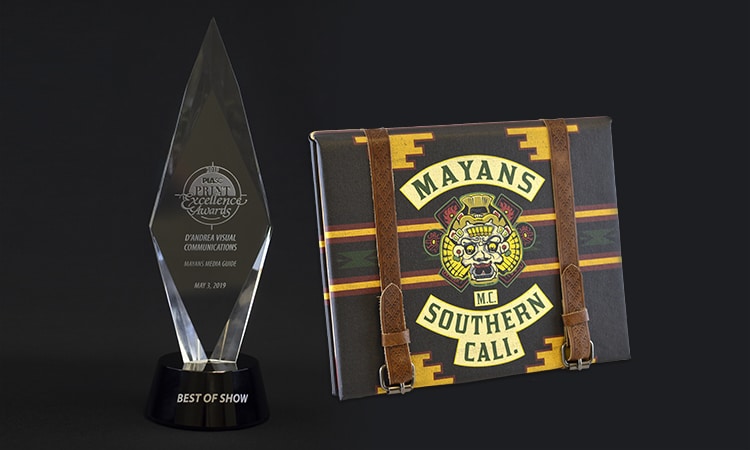
One of DVC’s more revealing objects looks as though it might ask to borrow a motorcycle. Its media kit for Mayans used leather belts to close the package. A padded, printed canvas cover echoed the blanket rolls carried on motorcycle handlebars. Both grand-format and lithographic presses contributed to the finished piece.
In 2019, the kit won Best of Show at the PIASC Print Excellence Awards. It also received recognition for binding, finishing and other categories. A photograph from that year shows D’Andrea with senior account executive Denise Okata and an arrangement of awards on the table in front of them. There is very little spare table.
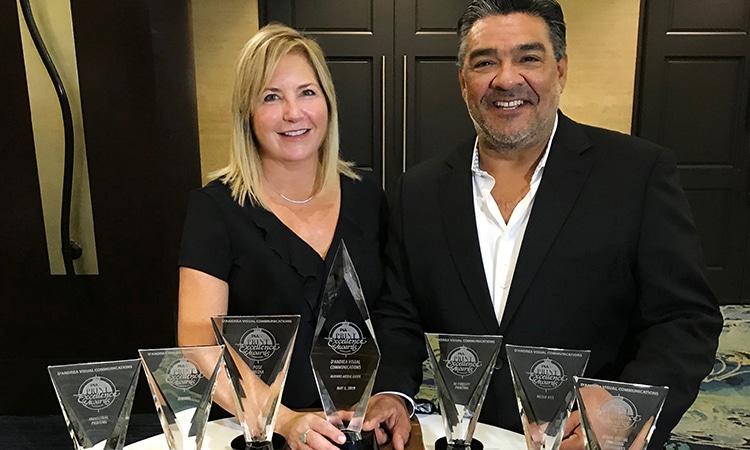
The packaging makes the company’s expansion legible. A canvas cover and a printed interior require different processes to cooperate. Belts add another material and another assembly decision. The prize belongs to a finished object whose character depends on the relationships among those parts.
The same awards account describes a Pose kit incorporating glitter foil, coatings, feathers and specialty inks. These are company projects, made by teams for clients. They give D’Andrea’s leadership story its physical evidence: investment in a broader shop can make a more complicated brief possible.
Five and a half feet of album packaging
Consider another assignment: the limited-edition box set for Roger Waters’ concert film and soundtrack, The Wall. DVC’s work covered engineering, pre-media, print and bindery. Fully opened, the triple-gatefold box measured five and a half feet. This is the point where an album package begins negotiating with the furniture.
Before the boxes went to collectors, they were arranged as tiles in a wall in a Los Angeles warehouse. The Brazilian artist duo Osgemeos painted a mural across them. Each of the 3,000 sets would therefore carry a section of a larger artwork, alongside its contents and Waters’ signature.
The package included a 170-page hardcover book and four art prints, as well as the recordings. Its appeal depended partly on the experience of opening and handling it. Fold, surface and scale all had work to do. Those are production questions with a visible place in the collector’s experience.
For an executive profile, such an object is useful because it makes the enterprise tangible. D’Andrea’s company could participate in turning an ambitious design into a manufactured edition. The outcome rests on a succession of small agreements between an idea and the materials available to realize it.
Who gets a say
D’Andrea’s stated approach to people follows another practical connection. In his message about diversity, he argues that a workforce should reflect the varied backgrounds of customers. Different views should have a place in decisions about ideas and solutions. He ends with a short declaration: “Empowering others strengthens us all.”
That statement matters in a business where several trades contribute to the result. A project manager, a designer and a fabricator encounter different parts of the same problem. Giving those perspectives room is a recognizable operating concern. D’Andrea places inclusion inside the work of deciding what to do for customers.
His company identifies itself as minority-owned and maintains a supplier diversity presence. On his public LinkedIn activity, colleague Alex Navarro thanked D’Andrea and then-president Mark Marth for the opportunity to establish and lead DVC’s supplier diversity program. The account connected that support with the team’s attendance at the 2024 NMSDC conference in Atlanta.
These details give the broader principle a setting. There are people to appoint, events to attend and relationships to build. D’Andrea’s role appears in the opportunity he helped provide, while Navarro’s account puts the work of developing the program with the person leading it.
A foothold becomes a fixture
The Las Vegas decision also involved collaborators. David Schiller described a second production facility there as a goal dating back to DVC’s beginnings. Partner Scott Powers connected the move to clients’ requests for support in that market. D’Andrea’s risk had a shared commercial purpose behind it.
By 2026, the company’s regional work had reached another kind of public venue. Las Vegas Lights FC announced DVC as its print and installation partner for the season at Cashman Field. The announcement identified Schiller as president. The company’s current Las Vegas-area contact address is in Henderson.
A football ground is another place where graphics have to fit into a working environment. DVC’s assignments have moved among packages, exhibition spaces, retail settings and event venues. Across those settings, the work keeps returning to the relationship between a printed image and the place or object that carries it.
D’Andrea’s story is most interesting at that junction. The business he started with lithography has expanded its range while retaining a pressroom’s attention to the making. His Las Vegas explanation remains a useful closing thought because it names the discomfort behind a concrete decision. Standing still worried him. His answer was to give the company more places, and more ways, to work.
Follow the work
Explore D’Andrea’s interviews, the company’s projects and its public channels.