David Chandler Thomas brought two large plates of homemade cookies to a final exam. An environmental economics student saw an opportunity to test the syllabus. Were the cookies a common pool resource? Thomas conceded the point. The student announced an approaching tragedy of the commons: with the course ending, there would be little reason to observe the class’s social rules. Thomas reminded him that the exams still needed grading. There was, he suggested, another round to this game.
The exchange took place while Thomas was a doctoral student at George Mason University. He had already spent years running software companies and representing the technology industry. Now he was making cookies, teaching economics and accepting the peculiar status of being an experienced executive who still had homework. “This class has certain social norms,” he told his opportunistic student. The cookies had become a teaching aid with a rather short useful life.
Thomas’s name belongs to the early history of Intacct, the accounting software company he co-founded with Odysseas Tsatalos in 1999. Sage acquired it for $850 million in 2017. That transaction supplies a convenient ending to a business biography. Thomas had already started a different one: finishing an undergraduate degree, earning a master’s, completing a doctorate and beginning a university teaching career. Following him requires keeping two calendars open.
The degree that waited
Born in Phoenix on July 27, 1954, Thomas graduated from Arcadia High School in 1972. He served a church mission in Brisbane between 1973 and 1975, and married Gayle Bradshaw in Mesa in May 1976. Their family eventually included five children. In the late 1970s, while studying at Arizona State University, he faced a choice that would leave a long gap in his educational record.
His accounting software business was taking off. Completing his business degree would have to wait. Thomas chose the company; McGraw-Hill later bought it and put him in charge of its Financial Software Division. The business was CYMA, an early participant in personal computer accounting. He had entered the software industry through the wonderfully practical problem of helping people keep their books.
The unfinished degree stayed with him. Working alongside executives with advanced qualifications increased his interest in returning to school. He also acquired a less formal education in expansion, financing and recessions. He wanted to understand the economic cycles that had shaped those experiences. Years later, he described himself as “an unusually seasoned graduate.” It was a tidy phrase for a student whose previous assignments had included running companies.
- 1999Co-founds Intacct
- 2010Completes economics BA
- 2015Earns PhD; joins Ball State
- 2017Sage acquires Intacct
The company’s later sale and its founder’s academic career overlap.
A ledger with an internet address
Intacct offered a new route through a familiar problem. Growing businesses needed accounting tools beyond an entry-level package, but buying and operating a more elaborate system involved money, maintenance and technical work. Thomas and Tsatalos built around delivering accounting through the web. The books would remain central to the business; the machinery for running the application could sit elsewhere.
In March 2000, Intacct announced a $10 million funding commitment from Hummer Winblad Venture Partners. Ann Winblad joined its board. More than 120 companies were already trying the system. Thomas discussed a basic monthly charge of about $50, with additional services contributing to revenue. This was a proposed price at the beginning of the company’s life, when making the first purchasing decision easier was part of the pitch.
By June, Intacct was launching its accounting services and announcing a collaboration with Deloitte & Touche on an online auditing tool. The division of work was revealing: Deloitte would supply the auditing content; Intacct would supply the engineering and host the service. Other partnerships were intended to bring more business functions into the same environment. An accounting application could become a meeting place for services.
The architecture included an XML interface for connecting partner applications. That detail matters because Thomas’s plan depended on other businesses being able to contribute. Building every service internally would have been a different undertaking. Intacct’s core accounting functions would anchor a wider offering, including services such as payroll and bill payment. The ambition was substantial, though its everyday vocabulary remained accounts payable, budgets and closing the books.
The first team, and the years after it
Aaron Harris entered the story through a colleague at Arthur Andersen, Glenn Thomas, whose uncle was David. Harris flew to California late in 1999 to see what David was building. The proposed web accounting system caught his interest, and he joined as its first full-time developer. A family connection had made the introduction; a software idea made the job worth taking.
In February 2001, Intacct announced another $21 million in financing, led by JK&B Capital, with Goldman Sachs and existing investors participating. Its E-Practice Alliance already included more than 100 accounting firms. The subscription service put maintenance and upgrades on Intacct’s side of the arrangement. Accountants were also a distribution channel, helping bring the service to businesses that trusted them with financial work.
Thomas’s period as founding chief executive ended in 2004. Intacct’s subsequent history involved other leaders, additional investment and difficult decisions. In December 2006, the company ran short of money and two potential corporate buyers withdrew. Emergence Capital supplied funding when a shutdown was a possibility. Those events came after Thomas’s leadership, and they belong in the story because the eventual acquisition was the result of work across several administrations.
Rob Reid became chief executive in 2009. Sage’s $850 million agreement arrived in 2017, eighteen years after Intacct’s founding. Thomas was by then teaching at Ball State. The distance between those dates is useful: a founder can help establish a company whose eventual outcome takes years of further work by colleagues and successors. A sale price compresses that history into a number. The history deserves its space.
Sage’s agreed consideration for Intacct, years after Thomas’s tenure as founding CEO.
From K Street to the classroom
Thomas also worked in the machinery of industry representation. He chaired the software board of the Software and Information Industry Association and later became its executive director. He subsequently served as an executive vice president at TechAmerica. The work brought him into discussions among companies and government officials, where agreement had to be assembled from competing interests.
He connected those experiences to his growing interest in economics and institutions. His academic ambitions included teaching and research, with human decision-making among the subjects he wanted to understand. Returning to education gave that interest a formal sequence: a BA in economics from San Jose State in 2010, an MA there in 2012, and a PhD from George Mason in 2015.
He joined Ball State that year. His teaching included macroeconomics, game theory, environmental economics and entrepreneurial economics. The cookie exchange fits this career unusually well. It turns an ordinary classroom moment into a discussion about incentives, future encounters and the rules people follow when they expect to meet again. A plate of biscuits offered rather better audience participation than another slide.
“I love teaching almost as much as research.”
David Chandler Thomas · objective statement
What a market cannot see
With fellow economist James E. McClure, Thomas examined a problem familiar to people developing new products: rivals cannot always see what one another are building. Their 2018 research distinguished the search for a working prototype, the work of turning it into a commercially viable product, and preparation of inventory before launch. Much investment occurs before an open market can reveal how the finished product will fare.
They explored related questions in financial history. Their 2017 study of Dutch tulipmania proposed that bulbs concealed underground helped obscure investment and future supply. The timing of planting and sprouting mattered to their explanation of the boom and collapse. A software entrepreneur studying buried flower bulbs may appear to have wandered some distance from his original business. Both subjects involve decisions made while valuable information remains hidden.
Find a working prototype.
Make a product commercially viable.
Build inventory ahead of launch.
A simplified reading of McClure and Thomas’s three stages of new-product R&D.
In 2025, a paper bearing Thomas’s name appeared with McClure and Steven G. Horwitz: The Great Correction of 1929: New Evidence on Investment-Trust Pricing. It compared trusts that published their portfolios with those whose holdings remained undisclosed until a reporting deadline. The authors argued that newly available information helped explain price corrections. They explicitly credited Thomas’s entrepreneurial experience as useful to the investigation. His earlier career had supplied research tools as well as research questions.
A little room for the guitar
There was plenty beyond work. Thomas created computer games, wrote music and devised recipes. He painted, worked with wood, played basketball, and sang and played guitar with his children and grandchildren. He traced his family’s journey from Wales through Alberta to Arizona and gained British citizenship. These interests make the career changes easier to understand: he repeatedly found something else he wanted to learn how to do.
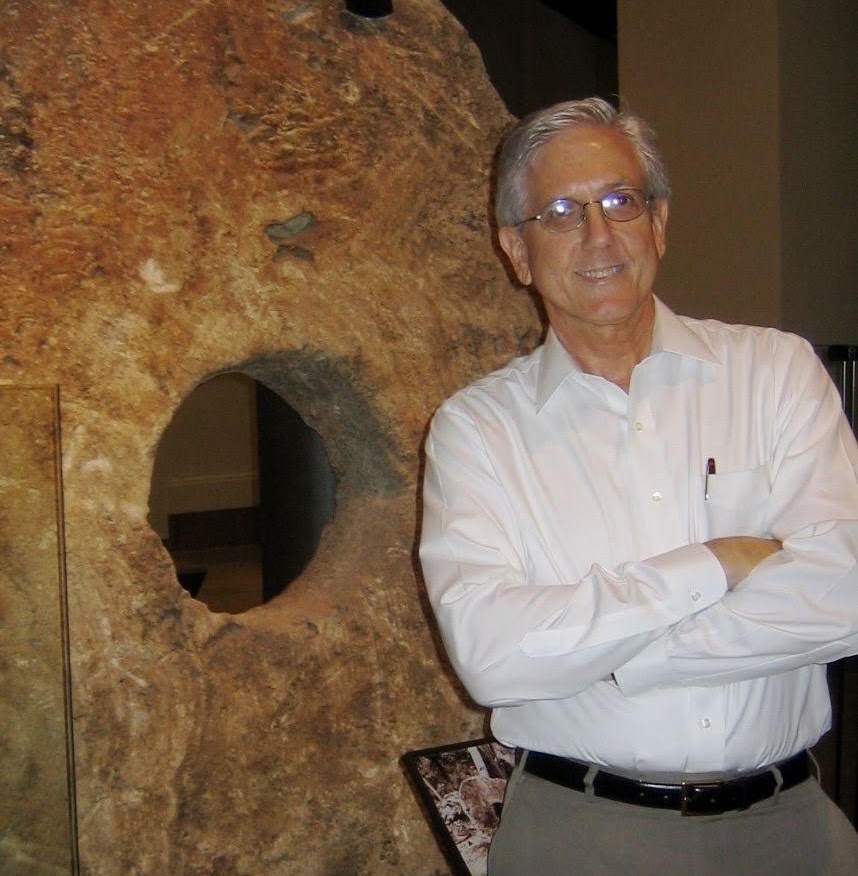
One photograph shows him at the Smithsonian beside the stone currency of Yap. He stands with his arms folded, smiling next to a piece of money considerably less portable than a subscription payment. It is an apt picture for someone whose work ranged from accounting software to the workings of markets. Thomas died on December 28, 2021, aged 67. His research continued to reach print afterward. For a founder who returned to being a student, there was still work left to hand in.
Follow the questions
- Personal websiteThomas’s biography, CV and academic work
- LinkedInHis professional profile
- Watch · InterviewFrom Silicon Valley to Economics Academia
- YouTube · Course materialDC Thomas, Ph.D. - economics teaching videos
- The classroom exchange · 2013The cookies, the commons and the final exam
- Intacct’s launch · 2000The early web accounting pitch
- Research · 2025 · PDFThe Great Correction of 1929
- Podcast · October 2026Aaron Harris remembers the early Intacct team