Dave Morrow had a problem that would not survive a business-school presentation. His lacrosse sticks kept bending. He played defense, which meant his equipment was regularly introduced to people who had other plans for the afternoon. Aluminum was proving an expensive accomplice. A stick that looked perfectly respectable at the beginning of a game could finish it with a different opinion about geometry.
His father, Kevin, ran a tubing shop outside Detroit. A customer had been exploring titanium for a modern snowshoe. Father and son saw another use for the material. The question was wonderfully specific: could something intended to make a better snowshoe also make a lacrosse shaft that stayed straight? You could test the answer by handing it to Dave.
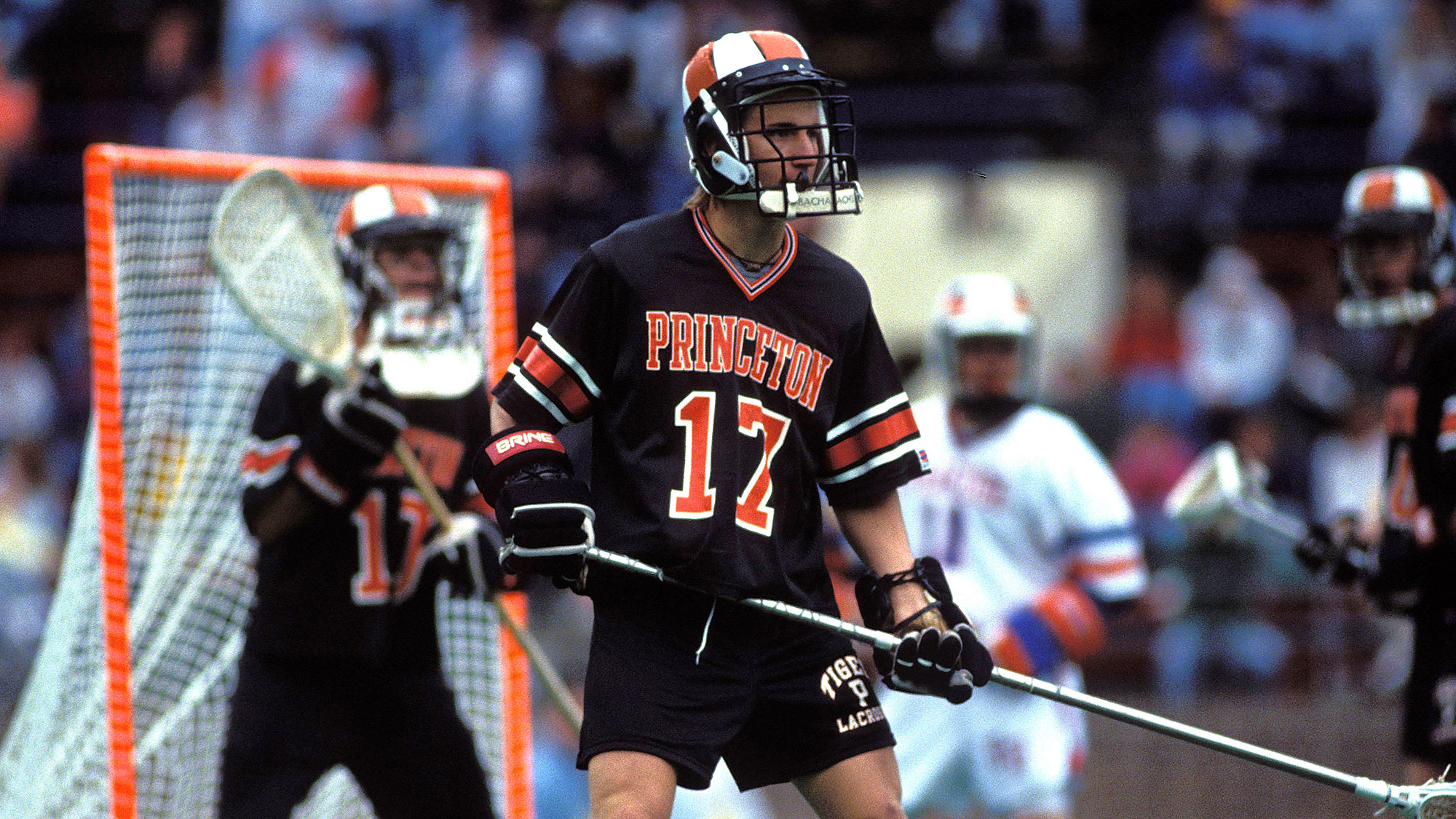
In the 1992 NCAA semifinals, Morrow and his Princeton teammates used the titanium sticks against North Carolina. Princeton won 16-14, with two goals from Morrow, a defenseman. The Tigers then beat Syracuse in double overtime for their first national championship. The product had received a rather public demonstration. A college tournament had also become an unusually demanding showroom.
Warrior would take its name from the Warriors of Brother Rice, his Michigan high school. Before there was a global sports business, there was a familiar manufacturing exercise: find the part that fails, change the material, and see whether it holds. Morrow would spend much of his working life enlarging that exercise.
The Michigan kid nearly went back to hockey
Princeton had not initially felt like a natural home for him. Morrow arrived in 1989 from a state outside lacrosse’s traditional centers, with a hockey background and plenty to learn. He played little as a freshman and considered returning to hockey. Coach Bill Tierney persuaded him to stay. The future equipment founder first needed someone to insist that he remain on the field.
For his first college start, against Johns Hopkins on March 2, 1991, Morrow was assigned to cover Matt Panetta. He kept a photograph of the opponent beside his bed. Preparation had acquired the atmosphere of a very small detective agency. The assignment went well enough to change his sense of what was possible. An unfamiliar game began to feel like a place where he belonged.
His later description was plain: lacrosse had given him self-confidence. That is a useful detail in a career often told backward, beginning with trophies and companies. Before those came a young player who had nearly walked away, then discovered that an intimidating opponent could be contained. Confidence arrived through a particular job, done successfully, and then repeated.
“I just wanted a stick that wouldn’t bend.”Dave Morrow, recalling the titanium shaft
Defense has its own arithmetic
The honors accumulated quickly. Morrow was an All-American in 1991, 1992 and 1993, earning first-team recognition in the latter two years. He won the national defenseman award twice and the national player award in 1993. His position matters to the story. A defenseman’s work often becomes visible in the opportunities an opponent fails to have.
He also made the All-Ivy team three times. Those individual distinctions sat alongside Princeton’s first NCAA title, a team achievement that gave the titanium experiment its stage. A new material had entered the game in the hands of players who had to trust it when there was little room for a technical disappointment.
International lacrosse extended both the competition and the connections. Morrow won world championship gold with the United States in 1994 and 1998, and earned All-World recognition in 1998. In 2018 he entered the National Lacrosse Hall of Fame. By then his connection to the game included playing it, supplying its equipment and helping create a professional league.
A dorm room grows a factory floor
Warrior began while Morrow was still a Princeton student in the early 1990s. Its starting advantage was intimate knowledge of a customer complaint, because the customer had been him. That makes the origin less mysterious than the usual invention story. He knew how the old shaft failed, knew people who could work metal, and had teammates prepared to try the replacement.
By 2004, New Balance had acquired a controlling interest in Warrior. Morrow stayed. Selling the company did not end his education in making things; it expanded it. Warrior moved beyond its original lacrosse business into other sports, including hockey. The small company’s manufacturing problem became a much larger question about products, facilities and customers in different markets.
He also co-founded Major League Lacrosse with Jake Steinfeld and Tim Robertson. For an equipment entrepreneur, helping establish a league placed him close to another question: where would the sport’s players go next? The relationship between a game and the businesses around it became a recurring feature of his career.
In 2018, the NCAA gave him its Silver Anniversary Award, recognizing the years after college as well as the years in uniform. He was Princeton’s first recipient. The award offered a wider view of the résumé: athletic accomplishment, professional work and service. Morrow and Warrior had supported more than 70 charitable and service organizations. Equipment could help someone enter a sport as well as help an established player compete.
- 1992Titanium shafts on the championship field
- 2004New Balance acquires control of Warrior
- 2019Morrow begins Lume
- 2026A Michigan operation, a national ambition
The old team tries a new field
Morrow remained Warrior’s CEO until January 2019. His next undertaking was Lume Cannabis Co., where he became founder and CEO. The move brought him into a different product category, but some of the people were familiar. Doug Hellyar, a Warrior colleague, joined as president and chief operating officer. Their working relationship preceded the new business by years.
Lume’s first 50,000-square-foot cultivation facility in Evart came online in April 2019. By March 2021 the company had 15 stores. These early dates give the expansion a useful scale: a facility had to work, products had to reach shops, and another shop then had to open. The tidy line of a growth story conceals a great many individual opening days.
The company described its leadership as a mix of Warrior veterans, consumer-products experience and design training. Convenience and the shopping experience were part of the plan from the beginning. Morrow was bringing a brand-building background into a business where a customer would encounter the product on a shelf, in packaging and across a counter.
He was also willing to distinguish what he knew from what he needed to learn. Product development and manufacturing were familiar territory. Cultivation was a new specialty. Lume needed people who understood the plant as well as people who understood the factory. A founder’s experience could supply a direction; the team had to supply the rest.
Count the products, then count the customers
By early 2024, Lume was describing growth from $2 million in revenue in 2019 to nearly $200 million in 2023. Morrow’s explanation centered on making products at scale and offering value to customers. He pushed back against treating the number of states a company operated in as a sufficient measure of its business.
That position has the fingerprints of an equipment manufacturer. A map can tell you where a company has arrived. It takes a different set of questions to understand what happens after arrival: how much it sells, what customers pay, and whether the operation can keep producing something they want. Morrow wanted the conversation to include units sold and average selling price.
His comparisons ranged across ordinary consumer brands, including Starbucks, Lululemon and LaCroix. Cannabis was the category in front of him, but repeat purchases were the commercial problem he recognized. The discipline of a factory becomes useful only when someone wants what comes out of it. A warehouse full of unwanted products is merely an expensive collection.
In late 2024, he spoke about serving both occasional customers and connoisseurs, with different products and price points. He also described a future that included more formats beyond flower. The aspiration connected product design to a broader audience. Lume’s offer would have to make sense to people who did not all shop for the same thing.
The factory, and the people inside it
In July 2026, Morrow was still speaking about Lume with the surprise of someone who remembered the smaller version. The company had 40 Michigan stores and 1,400 employees in that account, with $190 million in 2025 revenue. At its Evart facility, he said, “I can’t believe we have a weed factory.” The remark contains both the old manufacturing vocabulary and some undiminished amusement at the product.
His longer ambition was national distribution if interstate sales became permitted. That remained an ambition. The business he was describing had concentrated on Michigan, developing an operation he believed could be repeated elsewhere. The distance between those two propositions matters: one concerns what a company has already built; the other concerns the market its founder hopes eventually to serve.
On his public LinkedIn profile, Morrow subsequently put the emphasis on the people around him. Responding to the attention from a major profile, he credited team members, partners, retailers, athletes and customers across both businesses. He described his continuing job as recruiting, keeping and developing people who could make products customers enjoyed.
That account brings the career back to a more human size. His father supplied manufacturing knowledge. Tierney persuaded him to keep playing. Teammates tried the new shafts. Hellyar joined him in a new industry. A founder occupies the headline, but these relationships keep turning up in the machinery underneath it.
Morrow’s original complaint was simple enough to hold in one hand. The shaft bent. The replacement needed to hold. Decades later, the questions around his work are bigger, involving teams, factories, shops and the possibility of new markets. There is still something appealingly practical about the beginning. Before asking how large a company could become, he had asked whether someone could make him a better stick.
Follow the thread
Continue with the people, the business and the games.
- Dave Morrow on LinkedIn
- National Lacrosse Hall of Fame profile
- Watch: NCAA Silver Anniversary tribute
- The Michigan kid’s lacrosse beginnings ↗
- The early Warrior story ↗
- The 2024 conversation about Lume ↗
- Princeton: The Athlete and Inventor
- The conversation about scale and consumer products
- The 2026 Lume profile
- Explore Lume Cannabis Co.
- Lume’s website ↗