Somewhere inside FMG, there was a shelf full of impossible things. They were not physically gathering dust, perhaps, but Dave Christensen talks about them as though they were: product problems his team understood, wanted to solve, and could not. One concerned the awkward little box that asks a financial advisor to write a social-media caption. FMG could supply the article and the distribution machinery. It could not supply the confidence. Advisors would type, reconsider, delete, and sometimes post a naked link that few people opened.
Then generative AI made the blank box less blank. FMG encoded the marketing practices it had learned, generated a first draft in real time, and left the advisor to edit it. Christensen says usage rose 1,000 percent overnight. The number matters, but his reaction is more revealing. He did not treat the result as permission to bolt one fashionable feature onto an established product. He treated it as permission to walk back to the shelf.
The impossible list was suddenly a roadmap. Features that had failed the technology test might now pass it. Christensen, appointed FMG's CEO in January 2026 after years leading product and strategy, describes his next several years in that language: retrieve the problems, reconsider the assumptions, and rebuild the advisor's marketing experience around what has become possible.
The first useful website
His career has been a long study in tools catching up with needs. Around 2001 and 2002, Christensen joined Duluth-based 50 Below, where he led product and engineering work. Financial firms were beginning to treat the web as operating infrastructure rather than a digital brochure rack. His teams built early large-scale website programs for names including Smith Barney, Ameriprise Financial, U.S. Bancorp Piper Jaffray, R.W. Baird, Janney Montgomery Scott, Hilliard Lyons, and RBC Wealth Management.
The recurring difficulty was not making a website. It was making thousands of them useful, consistent, and manageable for professionals working inside a regulated industry. That distinction would follow him. A product could be technically available and practically unusable at the same time. The interesting work lived in the gap.
In 2006, life rearranged the problem. Christensen moved his young family to Sierra Leone to complete an adoption. The journey between Africa and the United States could take 36 hours, and the schedule demanded flexibility. He left 50 Below and co-founded Versimark, a software business serving large property and casualty insurance organizations.
Versimark grew into a multi-tenant marketing platform that powered more than 20,000 websites for organizations such as Farmers Insurance, American Family Insurance, and Farm Bureau Financial Services. In 2011, it was acquired and became the foundation for FMG. The family constraint, the startup, and the platform form a sequence too untidy for a business-school diagram and too logical to be accidental. Christensen needed a different way to work, so he built one. The thing he built happened to solve a large commercial problem.
A platform for the whole untidy job
FMG's founding thesis was almost domestic: put the scattered things in one place. An advisor who managed a website in one tool, email in another, and social posts somewhere else was unlikely to become a better marketer merely by receiving another password. FMG joined those channels in an all-in-one system and layered in content, automation, mobile tools, events, and print.
Christensen has repeatedly returned to the customer's actual job rather than the software category. Advisors do not wake up longing to administer a marketing stack. They want to remain present in clients' lives, explain difficult subjects clearly, recognize milestones, and find the next client without turning every evening into a second shift. A platform earns its keep when it gives time back.
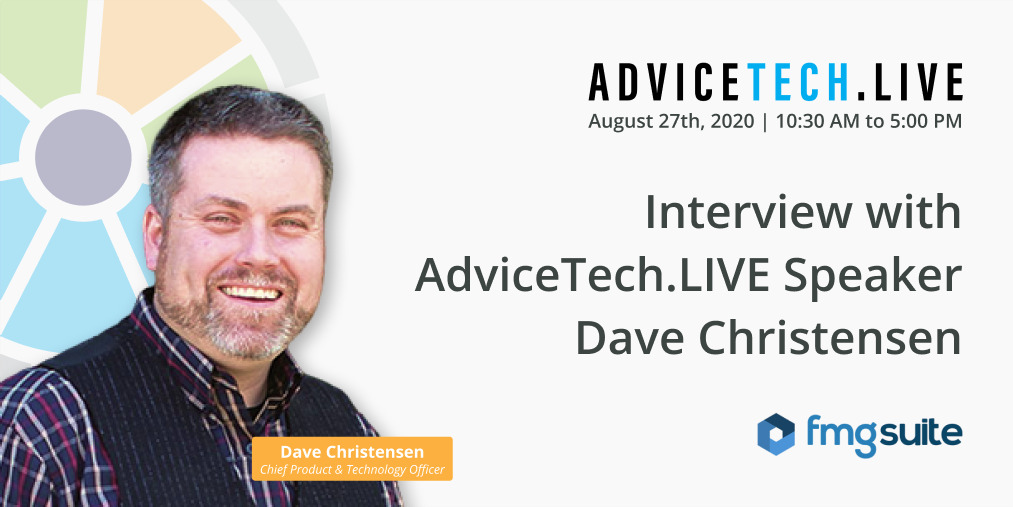
In a 2020 conversation before AdviceTech.LIVE, he offered a line that has aged nicely: “It's rarely a crisis.” Early startup life had made every problem feel terminal. With distance, most crises looked like another workday wearing a siren. The point was not to become casual. It was to keep enough perspective for creativity. Panic has a way of shrinking a roadmap to the size of the next notification.
That calm sits alongside a conspicuously busy life. FMG's biography says Christensen and his wife are raising twelve children, seven through adoption. It also records a continuing relationship with Sierra Leone: a direct micro-loan program launched in 2007, the social-business nonprofit The Founded Group, a housing initiative called Neba established in 2013, and support for a care center opened for children orphaned by the Ebola crisis in 2015.
His LinkedIn account fills in small, telling details. A loan helped launch a family-owned poda, or taxi, business. A Christmas store was designed so working parents could choose presents for their own children. The distinction is characteristic of his product thinking. Help is not only about delivery. It is also about dignity, agency, and who gets to press the button.
Scale without the robotic aftertaste
FMG now occupies a larger stage. The company reported in 2026 that its platform was used by more than 80,000 advisors reaching over 45 million investors. GTCR acquired FMG in 2025 and installed former LPL Financial CEO Mark Casady as executive chairman. Christensen moved into the CEO role, Scott White moved to the board, and FMG added senior product, data, and technology leadership.
The new agenda extends beyond polishing captions. Christensen wants FMG to move farther up the funnel, helping advisors find prospects before the nurturing begins, and then connect the full journey through to assets under management. He has spoken about an open ecosystem, additional product categories, acquisitions, and AI woven through the workflow. FMG's purchase of Testimonial iQ added compliant testimonials, reviews, referrals, and client-feedback tools, all aimed at turning credibility into discoverability and then growth.
There is a comic irony in using artificial intelligence to make marketing feel less artificial, and Christensen knows it. At an FMG event, he argued that AI could let the industry become more human. The claim becomes sensible when reduced to the level of a Tuesday afternoon. A machine supplies the first caption. An advisor adds judgment. A system remembers a client milestone. A person makes the call. The automation is not the relationship. It clears a path toward one.
The English major in the product room
Christensen's reported education is gloriously ill-behaved for a software executive: English with pre-medical studies and a theater minor at the College of St. Scholastica. It is tempting to make the curriculum carry too much symbolic weight, but it does explain a certain comfort with competing systems. Language, science, performance. Story, evidence, audience. A product leader uses all three before lunch.
His public persona is equally resistant to the polished executive template. The hobbies in his company biography include hiking, attending the theater, jeeping in the desert, and “eating good food slowly.” On LinkedIn, he has joked about being a novice coach for his daughter's lacrosse team, which won only a few games. His stated mission is to inspire potential in ideas, teams, leaders, and businesses. The verb is revealing. Potential is not a thing one installs. It needs conditions.
That may be the most useful way to read FMG's AI turn. Christensen is not describing a machine that replaces the advisor's voice. He is describing conditions in which the advisor can use it more often. The old bottleneck was technical. The newer one is confidence, time, and coordination. If AI can absorb the mechanical hesitation without stealing the human judgment, an awkward little caption box can become a meaningful product.
The impossible list is a fine object for a new CEO to inherit from himself. It keeps ambition tethered to memory. It prevents novelty from becoming the strategy. And it asks a wonderfully practical question: what did customers need before the technology was ready to help them?
Christensen has spent more than two decades circling the same answer. Financial professionals need to communicate clearly, consistently, and personally, even as their businesses grow. Websites solved part of it. A platform solved more. AI may solve some of what remains. The tools change. The stubborn question stays on the desk.