A vial of blood enters a modern clinical laboratory with a barcode and a job to do. The analyzer may belong to one manufacturer. The laboratory information system may come from another. The electronic health record may be Epic. Somebody has to move the order, result, quality checks and exceptions among them without confusing the patient, stalling the bench or asking a technologist to type the same thing twice.
That somebody is often Data Innovations. The Colchester, Vermont company makes middleware: software that sits between laboratory instruments and the systems that store and deliver their data. It is an unshowy corner of healthcare technology where reliability beats novelty and a large library of drivers - the translators that let different systems communicate - can matter more than a splashy interface.
Data Innovations says its software runs in more than 6,000 hospitals and laboratories across over 80 countries. Its library holds more than 1,200 drivers. Those figures explain the business better than a grand mission statement. The company sells compatibility in a place where ripping out every old machine at once is neither sensible nor possible.
Its customer list spans very different laboratories: academic centers such as the University of Iowa, large nonprofit systems such as Sanford Health, public hospitals including Santa Clara Valley Medical Center, children's hospitals, federal facilities and regional networks. The buyers are typically laboratory and IT leaders; the daily users are medical technologists, quality managers and LIS administrators. Their shared problem is not a shortage of data. It is too many sources of data, each with its own vocabulary and failure modes.
That makes Data Innovations different from an LIS, which is the laboratory's primary system of record, and from an analyzer vendor, which sells the machine that performs a particular test. Middleware occupies the middle on purpose. It lets the laboratory preserve a common rules and connectivity layer even as an instrument is replaced, a hospital is acquired or an EHR changes. The less uniform the estate, the more valuable that separation becomes.
The product is the intersection
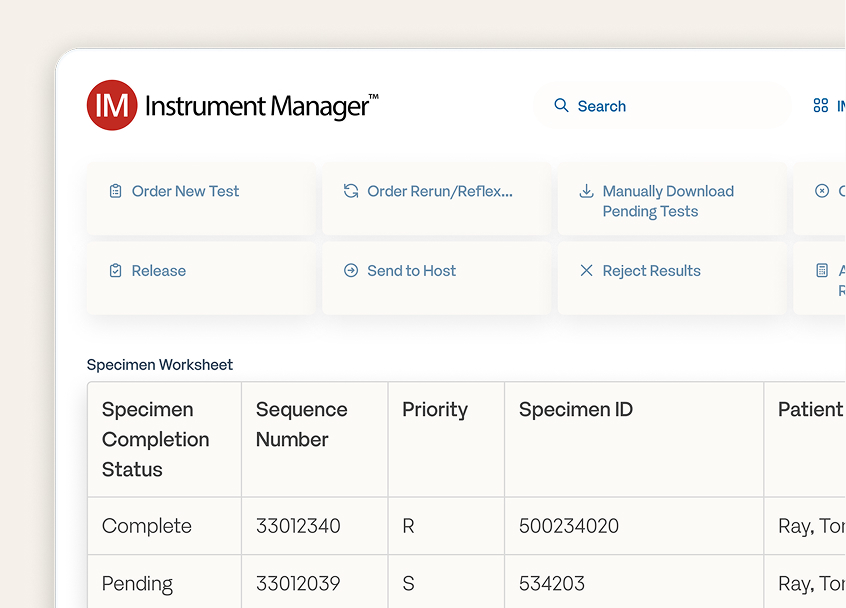
Instrument Manager is the flagship. It connects analyzers, laboratory information systems and electronic health records, then provides a place to manage workflows across them. A laboratory can write rules that automatically release routine results while diverting suspect ones for human review. It can watch specimens, centralize connections across sites, track performance indicators and keep configurations independent of a single instrument vendor.
One result, three systems
Two companion products cover different kinds of laboratory anxiety. EP Evaluator handles instrument validation and quality assurance, importing results into statistical studies and generating reports for inspectors. Lab GPS watches connectivity. Its 2.4 release, announced in February 2026, lets teams define four alert windows over a day, tightening thresholds during busy hours and relaxing them when traffic naturally falls. The mobile app can monitor and restart inactive connections remotely.
What failed first was the handoff
The clearest way to understand the product is to look at the work that breaks without it. In an older case study, Mid America Clinical Laboratories was operating two information systems side by side. Outreach samples had to be manually relabeled before instruments could process them. Labor rose, turnaround slowed and customer satisfaction slipped. The machines could perform the tests. The handoff was failing.
After evaluating middleware vendors, the lab chose Instrument Manager because its rules could recognize different sample identifiers and return results to the proper system. The implementation converted 15 analyzers from several manufacturers in four months. The case study reported seven specimen-processing positions removed from that step, turnaround time cut by almost five hours and more than $200,000 avoided in instrument licensing fees over five years.
Other customers tell the same story with different bottlenecks. Santa Clara Valley Medical Center reported that hematology turnaround fell from 52 minutes to 28 after adding autoverification, with an initial autoverification rate of 83 percent. The University of Iowa has reported 99.5 percent. Sanford Health, integrating Instrument Manager with EP Evaluator, turned a roughly 10-hour instrument-comparison data-entry job into a three-second import.
These are customer case-study results, not guaranteed outcomes. Each reflects its own instruments, rules, staffing and implementation.
The rare public receipt
Data Innovations does not publish a simple price list, because this is not a $29-a-month app. A deployment is assembled from software, interfaces, high-availability options, implementation, training, maintenance and support. A 2023 San Francisco public-health contract gives a useful, unusually transparent example.
Five-year ceiling
The agreement covered on-premise middleware connecting instruments at Zuckerberg San Francisco General Hospital's clinical and public-health labs to Epic Beaker. Its total included optional items and a 12 percent contingency, so it should not be mistaken for a universal quote. It does reveal the business model: enterprise software licenses, paid implementation and training, recurring maintenance, optional modules and, in Lab GPS, subscription services.
The economic argument is not merely “buy software.” It is “compare software with relabeling, repeat entry, slower results, interface fees and downtime.” That case is strongest in complex, high-volume networks. A tiny lab with a stable, single-vendor setup may find a narrower interface cheaper and easier.
Neutrality is useful - and expensive to maintain
Data Innovations competes with point-of-care middleware such as TELCOR QML, broad laboratory products such as Siemens Atellica Data Manager, and vendor ecosystems including Roche cobas infinity and Sysmex WAM. Laboratories can also stitch together direct interfaces or lean on their LIS. The distinction Data Innovations sells is breadth: one vendor-neutral foundation across disciplines, manufacturers and sites.
That position creates its own burden. Every operating-system change, security requirement, analyzer revision and hospital merger can disturb the chain. Instrument Manager 9.01, released in January 2026, upgraded its database, added multiple-domain LDAP authentication, improved startup and failover, refreshed moving-average tools and corrected several software issues. Older versions are moving toward end of maintenance or end of life. In clinical infrastructure, “works forever” usually means “must be upgraded carefully forever.”
The company itself has changed hands without abandoning its niche. Gregory R. Vail and David G. Potter incorporated Data Innovations in 1989. It bought David G. Rhoads Associates, creator of EP Evaluator, in 2009 and acquired assets from connectivity supplier Dawning Technologies in 2013. Roper Industries, now Roper Technologies, acquired Data Innovations in March 2015. Roper disclosed $450 million as the combined price for Data Innovations and pharmacy-software company SoftWriters, but not an individual price for Data Innovations.
A new operator inherits an old moat
Eric Dingfelder became president and chief executive in January 2025, replacing Premila Peters. He arrived with almost two decades in laboratory information systems and experience launching a SaaS laboratory platform at Clinisys. His appointment suggests the next chapter is less about proving that middleware matters and more about modernizing how a deeply installed product is delivered, secured and supported.
The recent releases fit that brief. My DI Community expanded worldwide in December 2025, putting support tickets, drivers, documentation and software downloads in one portal. Instrument Manager 9.01 concentrated on resilience and security. Lab GPS 2.4 made alarms more sensitive to the actual rhythm of the day. None is a moonshot. All reduce friction in a system customers expect to be boring.

What another software company can copy
- Own the translation problem. A reusable integration library can become a moat when every customer has a different collection of old and new systems.
- Sell the exception, not just the automation. Autoverification is valuable because routine results move quickly while experts keep control of the strange ones.
- Measure the removed work. Seconds, hours, relabels, interface fees and turnaround time make infrastructure legible to a buyer.
- Expand along the workflow. Data Innovations moved from connectivity into validation, compliance, analytics, support and uptime - adjacent pains for the same user.
The playbook depends on conditions. Integration must be painful enough that customers will pay to abstract it, but standardized enough that connectors can be reused. Errors must carry a real cost. Customers must value choice among upstream vendors. And the software company must be willing to support old infrastructure while improving the new.
Data Innovations occupies the narrow strip between “the instrument produced a number” and “the clinician can act on it.” Its achievement is not making that strip exciting. It is turning thousands of one-off connections and rules into infrastructure that lets the excitement happen somewhere else - preferably in the form of a faster, correct result.