Darpan Seth has a travel tip for entrepreneurs: find the smallest rental car. In a video about watching expenses, the Nextuple co-founder describes choosing a pink Chevy Spark, the sort of vehicle whose appeal becomes particularly clear when the bill arrives. His hotel requirements are similarly concise: functional, clean, free breakfast. A second client visit on the same trip improves the arithmetic. Glamour will have to make its own arrangements.
The anecdote is funny because Seth has already built and sold a business. Publicis Groupe acquired Expicient, the order management specialist he founded, in 2015. Yet here he is, still explaining the merits of a modest travel budget. He connects those habits to a larger obligation: respecting customers’ budgets, treating colleagues fairly, and looking after investors’ money. The rental counter becomes a small test of whether a founder practices the discipline he recommends.
That attention to ordinary decisions provides a useful introduction to his career. Based in Andover, Massachusetts, Seth works in the machinery of commerce: inventory, orders, fulfillment, and the awkward business of making several systems agree. His subject often looks unremarkable from the outside. A parcel arrives when expected. A store has the item it said it had. Getting there has occupied much of his working life.
A sale, then another beginning
Expicient was founded in 2008. By March 2015, its expertise in inventory and order management had drawn Publicis Groupe into a deal that placed the company within Publicis.Sapient under the Rosetta brand. Expicient operated from Andover, with offices in Britain and India. Its clients included retailers such as Target, Staples, Tesco, and Williams Sonoma. The acquisition connected a specialist business to a much larger marketing and commerce organization.
Seth’s earlier professional experience included Sterling Commerce. His education combined computer science and mathematics at BITS Pilani with an MBA in strategy and marketing at the Indian Institute of Management Bangalore. The combination spans two questions his later work keeps bringing together: how a system functions, and why a business should spend money changing it.
A colleague’s account of Target.com’s 2009-2010 replatforming offers a closer view of Seth at work. Andy Cerio recalled a pragmatic approach, a willingness to identify the critical path, and a leader who could mentor a team while getting into implementation details. It is a useful counterweight to the clean lines of an acquisition announcement. Large programs depend on people who can turn a grand objective into the next decision.
- 2008Expicient begins
- 2015Publicis acquires Expicient
- 2017Seth leads Nextuple
- 2026KIBO evaluation partnership
The customer has already clicked
Seth led Nextuple’s vision and strategy from 2017. An October 2018 financing announcement named him alongside fellow founders Laxman Mandayam and Das Pattathil, and disclosed a $1.5 million seed round for machine learning products and expansion of the team. Mandayam had also built Expicient; Pattathil brought experience leading Walmart’s online grocery and supply chain technology teams.
The early proposition concentrated on the experience after purchase. Retailers had invested in the ability to sell through multiple channels, but orders could still go wrong after customers committed their money. Nextuple proposed using data to identify risks to those commitments and recommend action before the disappointment arrived. Seth’s line from that period remains a compact description of his territory: “What happens beyond the ‘Buy’ button is critical to delivering value and building brand retention.”
The emphasis helps explain why a founder might return to a field after selling a company in it. The sale had concluded one corporate chapter. Customers still needed orders fulfilled, retailers still had systems to connect, and the team saw room for another approach. Nextuple gave Seth and his colleagues another business through which to work on those problems.
“You watch the pennies and the dollars take care of themselves.”
Darpan Seth / On founder travel budgets
Leave room to change the machinery
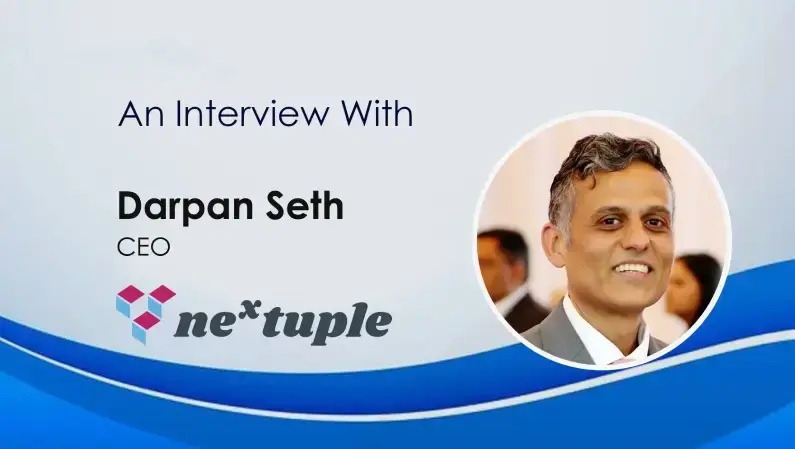
By his December 2022 interview, Seth was describing a studio of software building blocks. Retailers could use individual services or combine them, moving from the promise shown to a shopper through order coordination and fulfillment. His account also included strategy work before implementation and operational services afterward. Choosing software was one part of a longer commitment.
He was attentive to the predicament facing a retailer that wanted to build its own capabilities. Hiring specialists could be expensive and slow. Buying an existing service brought another complication: a supplier’s priorities might diverge from the retailer’s. Seth argued for deliberate choices about ownership, partnerships, and the capabilities that mattered to a particular business. He also emphasized the operational expertise required to keep those services running.
His advice favored an ongoing program with product teams and a habit of evaluating business value alongside technical change. That is a patient prescription from someone selling modernization. The attractive new feature has to survive daily operations, future requirements, and the next round of customer expectations. A technology decision made once can create work for years.
A date is a surprisingly complicated promise
In 2024, Seth was discussing an especially familiar retail irritation: the delivery estimate. A shopper sees a date. Behind that date sit relationships among the item, its location, the destination, the carrier, and the time an order is placed. Past performance matters too. A warehouse’s nominal capability and what it actually achieves need not be identical.
His argument for predictive promising was that machine learning could examine those relationships in more detail and help retailers make more accurate commitments. Nextuple’s March 2024 product announcement described models for processing and carrier transit times, with simulations against historical orders before deployment. This is an application of AI with a conveniently plain question attached: will the customer receive the order when the retailer says?
The distinction matters to the portrait of Seth. Much of his public discussion returns technical possibilities to a specific operational decision. Which location should fulfill an order? How much stock should a store hold back? Which carrier’s record supports the proposed date? Even the fashionable technology has a shift to work and a promise to keep.
Four systems, several versions of reality
His more recent writing makes the problem tangible through a European retailer whose inventory lived across four systems: order management, warehouse management, store point of sale, and enterprise resource planning. Each had a different account of availability. Before a company can decide where an order should go, it needs a dependable answer about what can actually be sold.
Seth’s explanation includes an easily overlooked complication. A perfect count of items on shelves can still mislead if it ignores demand already committed against them. Supply and demand must meet in the same calculation. The remedy he describes includes timely events, rules for resolving disagreements, awareness of store capacity, and fast access for the systems that make customer promises.
Another article addresses the less photogenic reasons implementations go off track: incomplete requirements, realistic testing postponed too long, and confusion between configuration choices and platform limitations. A request to offer store pickup raises questions about participating locations, picking deadlines, missing items, and refunds. Seth’s examples give the apparently simple request its operational weight. Someone must settle those details before the software can behave sensibly.
The adviser has something to sell, too
Running a company with its own technology creates a delicate question for a consultant: how does a customer know the advice serves the customer? Seth has addressed that tension directly in public. He says Nextuple avoids pitching its intellectual property against a partner already working in an account, and describes the creation of separate company OnePint.ai as part of protecting neutrality.
That is his stated approach, and it places trust at the center of the relationship. The issue becomes more interesting as partnerships deepen. In March 2026, Nextuple and KIBO announced an expanded relationship that made Nextuple an authorized reseller of KIBO order management and commerce solutions. They also introduced KIBO Kickstart, a structured evaluation using a configured sandbox.
Seth’s explanation stressed giving clients an independent assessment with practical deliverables. The program offers a concrete expression of that ambition: prospective customers can explore a platform before committing to it. His role therefore involves both recommending tools and helping buyers examine them closely. The quality of the advice has to remain visible as the commercial relationships become more involved.
A little foolishness, carefully budgeted
There is a lighter register alongside the system diagrams. On April Fool’s Day in 2024, Seth turned the joke on himself, calling entrepreneurship a fool’s errand and celebrating founders willing to attempt something new. He spoke about putting fun into enterprise order and inventory management, a field whose reputation for merriment has room to grow.
His public activity also includes the Order Management Gurus community and conversations beyond his own company. A 2022 ShopTok episode focused on what he learned from selling his first business. A 2024 Retail Corner appearance explored fulfillment. More recently, he joined AWS’s Wilson Thankachan to discuss inventory and order management modernization. The subjects circle the same working territory from different angles: building a business, making choices, and getting orders through.
In March 2026, he also published a LinkedIn article about AI transformation inside Nextuple itself. The emphasis turned inward, toward the company doing the advising. It fits the question raised by his travel video: what does the person making the recommendation do when the decision is his own?
Seth’s career offers several answers, from founding Expicient to returning with Nextuple, from supporting modular software to explaining why customers need usable evaluations. The pink rental car supplies the smallest one, and perhaps the easiest to remember. There are expenses worth making and promises worth keeping. A founder’s work includes knowing which details deserve his attention.
Continue the conversation
Explore Seth’s writing, interviews, and professional community.
- Darpan Seth on LinkedIn
- Nextuple: company website
- Seth’s essays on inventory and commerce
- ShopTok: How to Exit from Your Startup
- Retail Corner: fulfillment conversation
- AWS conversation with Wilson Thankachan
- SalesTechStar: the 2022 interview
- Watch: the rental car and travel budget
- Nextuple on YouTube ↗
- Order Management Gurus community ↗