Daria Leshchenko was having coffee in the office when a colleague asked which project she worked on. It was a reasonable question. It was also a question for the chief executive. The company had grown large enough for somebody to share its café without knowing who ran it. Leshchenko enjoyed the evidence of growth, then went away and changed the onboarding process.
The episode makes a useful introduction to her. She could have treated it as a dent in her importance. Instead, she wondered what else a newcomer might have missed about the business. The conversation became a small piece of operational evidence. Somewhere between the coffee and the next induction, an awkward encounter acquired a job.
Today she is co-founder, CEO and managing partner of SupportYourApp, the customer and technical support business that began in Kyiv in 2010. Her career has involved learning how much attention a person can give, and how much responsibility she can hand to somebody else. Both lessons took practice.
A business on the other side of the wall
She grew up in Zvenyhorodka, in Ukraine’s Cherkasy region, and moved to Kyiv in 2006. Foreign languages and conversation interested her. Customer support offered a way to turn those interests into paid work while she studied. There was no childhood business plan waiting to be unveiled. She has repeatedly described wanting to do her work well before she wanted to own a company.
The opportunity arrived with the unglamorous practicality of a shared office building. A neighboring startup needed help answering customers. Its business was expanding; the people building its product could use somebody else to handle the growing correspondence. Leshchenko’s department agreed to help. A support team that had been serving its own employer now had an outside customer.
She saw a market in the request. Young technology businesses needed people who understood their products, could communicate across languages and could keep answering after the founders went home. She proposed a separate business to senior management. A manager named Peter backed the idea and became her co-founder.
There is something pleasingly literal about this origin. The next business was next door. Before there was a proposition to polish, there was somebody asking for help. SupportYourApp’s early customer MacPaw remained a client fifteen years later, according to Leshchenko’s account of the relationship.
MacPaw’s support request helped turn an internal department into an independent business.
Learning to be the boss, rather expensively
Her early management education was less tidy. She wanted to be friends with the team. When she became its manager, that familiarity did not automatically turn into authority. In her telling, colleagues failed to take her directions seriously, the department missed its goals, and she eventually dismissed the team.
The immediate reward for this decisive act was answering the customers herself. She has recalled eating at the office, sleeping on its floor and studying on the subway while she rebuilt the operation. The story has an uncomfortable edge that a neat founder biography might sand away. A title had arrived before the ability to manage the relationships around it.
She tells it as a mistake she had to learn from. The subsequent business required recruitment, training, quality assurance and sales, and she worked across those jobs. For nine years she handled business development. That meant learning the customer’s side of the bargain as well as the employee’s: what could be promised, what had to be delivered, and what happened when the two drifted apart.
Formal study supplied language and methods for problems she was already living. At MIM business school in Kyiv, she took a six-month management course and immediately applied what she learned. The school identifies her as a 2013 Program for Management Development graduate. In 2021 she also completed study at the Ukrainian Corporate Governance Academy. Experience gave her questions; education gave her more ways to answer them.
“It takes time to evolve from a manager to a true leader.”
Daria Leshchenko
The year the numbers finally answered back
For all the apparent inevitability of a company viewed after its expansion, Leshchenko remembers periods when clients and profitability were difficult. She considered removing herself from the role. The turning point she singles out is 2016, when the team grew from 50 to 300 people. Demand, a capable team and her own place in the business began to feel less provisional.
A growing service business creates a peculiar problem for its leader. Every additional person increases the company’s capacity to help customers. That person also needs context, training and somebody who can make decisions. Being useful at every desk eventually becomes impossible. The café encounter was a comic version of the same arithmetic.
Team members during the year Leshchenko identifies as the turning point.
The recognition followed over several years. Kyiv Post included her in its 2017 Top 30 Under 30. In 2021 she received a Stevie award in the Woman of the Year in Customer Service category. Inc. included her among its 200 Female Founders in 2023. These are dated milestones in a working career, rather than a substitute for understanding how she works.
Please leave the walls to the artists
The offices offer another clue. Art entered through her business partner’s interest, with colorful abstractions by Anton Poperniak enlivening a gray workplace. Leshchenko began visiting artists herself. At Petro Bevza’s studio she chose work for her collection, including a painting called Turtle. Her business was moving quickly; her walls could accommodate a slower creature.
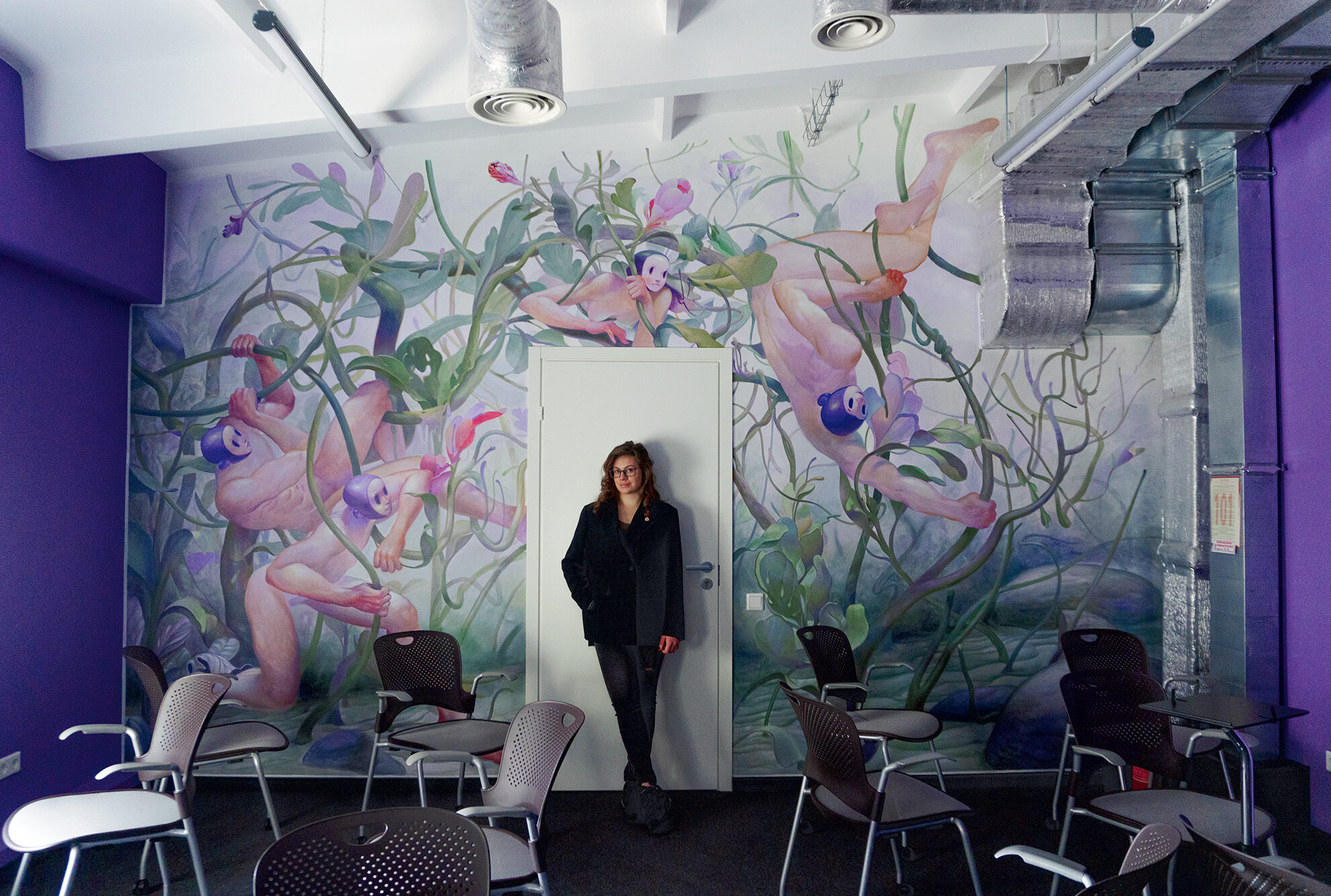
A mural commission grew into a wider project. Artist Volodymyr Manzhos suggested involving other artists and curator Oleg Sosnov. The company let them make their own choices, sometimes without reviewing sketches. The resulting spaces brought together murals, calligraphy, prints and installations. By her 2021 account, more than 25 artists had been involved.
The freedom mattered to her. Restricting the walls to her own taste, she thought, would make the result boring. It is a revealing position for somebody whose job involves maintaining standards: there are situations in which the person paying benefits from surrendering the last word. A workplace full of other people’s visual decisions makes that argument rather visibly.
What distance made possible
During Russia’s full-scale invasion of Ukraine, distributing responsibility acquired an immediate practical purpose. Colleagues abroad could take on work while Ukrainian teammates moved to safer places. The company had prepared its Kyiv office’s shelter and arranged backup power and internet. Leshchenko later said the preparation helped when the first shock arrived.
She reported that the business did not miss a day of work. Maintaining service involved people in different countries, generators and Starlink connections, as well as conversations with worried clients. International expansion had produced a network that could cover for parts of itself. An organizational chart was suddenly a very practical document.
Her writing about the period emphasizes diversifying both clients and teams. Geographic spread meant more than access to another market. It gave colleagues somewhere to pass a task. Her later arguments for delegation carry the weight of that experience: trust has consequences that reach well beyond whether a manager has a free afternoon.
Teaching the machine, keeping the judgment
The next pressure comes from technology aimed directly at the work her company sells. Leshchenko has helped establish businesses beyond SupportYourApp, including data annotation company Label Your Data, staffing business Outstaff Your Team and CoSupport AI. She is participating in the automation of customer support while continuing to run a company built around its people.
CoSupport AI announced a US patent for its multi-model message generation architecture in January 2024. Its approach separates different kinds of requests and uses company-specific information to help generate responses. For Leshchenko, the connection between these ventures is practical: support produces conversations, and useful AI depends on understanding the information inside them.
“I don’t think it will replace accountability, ownership, or judgment.”
Daria Leshchenko
In May 2026, she described that distinction in terms of responsibility. Machines could take repetitive questions; complicated interactions still called for people. She also wanted the measurements to change. Reply speed alone would tell an incomplete story when software handled more routine conversations. Retention and the quality of the interaction deserved attention too.
The work behind a helpful automated answer can be stubbornly manual. Customer conversations have to be organized, knowledge bases cleaned up, and the handoff to a person designed. Leshchenko spends time testing tools herself, then discussing them with her teams. Curiosity remains part of the job, even as more of her calendar goes to strategy and mentoring other leaders.
A smaller counter, someday
Her public philosophy has become more explicit about the individual behind the company. A contact can change jobs; a relationship can travel with them. She speaks and writes about failed projects as well as successful ones, and participates in mentoring initiatives for women and students. Sharing a lesson requires admitting there was once something to learn.
There is still a meticulous streak. Teammates remember her corrections when they used a hyphen where she wanted a dash. Some Windows users kept a text file containing the correct punctuation for copying. Among the many possible monuments to a chief executive, a saved dash has the advantage of occupying very little disk space.
Asked about an alternative career, she imagines a coffee shop: making drinks, selling cookies and talking to customers. It is a modestly sized ambition for somebody who built an international support business, and an entirely recognizable one. The setting changes. There is still a person across the counter, and something they would like her to understand.