The Company That Rents You the Internet's Best Behavior
ModSquad started as an avatar hangout in Second Life. Fifteen years later it is a 10,000-Mod global network moderating communities and answering support tickets for the NFL, EA, and Spotify - without ever having raised a dollar.
In the mid-2000s, an attorney named Amy Pritchard had a side gig she could not shake: moderating online message boards. She introduced a handful of her fellow moderators to the virtual world Second Life, convinced them to build avatars, and started meeting them at an in-world sports bar called the Thirsty Tiger. The hangout turned into a plan. The plan turned into a payroll. Today that avatar clubhouse is ModSquad - a digital engagement company that supplies more than 10,000 vetted remote workers to some of the biggest brands online.
The pitch is deceptively simple. Brands have communities, comment sections, support queues, and social feeds that never sleep. Most companies are terrible at staffing that work, and traditional call centers are built for cost-per-ticket, not for the person on the other end. ModSquad rents brands teams of specialists - internally called Mods - who moderate content, manage communities, run social channels, and answer support tickets. You do not hire them. You do not build the center. You turn the team up or down as you need it.
The origin still shapes the company. Pritchard was a Silicon Valley litigator moderating message boards on the side - work she found oddly compelling. When she pulled her fellow moderators into Second Life around 2007, the group needed somewhere to meet, so they claimed the Thirsty Tiger. Brands were pouring money into virtual worlds at the time and had no idea how to staff them. ModSquad launched publicly at the 2008 Virtual Worlds Conference in New York under a slogan that now sounds like a period piece: "Avatar Staffing for Virtual Worlds." The virtual-world gold rush cooled, but the underlying insight - that online spaces need trained humans to run them - only got bigger. By 2015 the work had spread so far past Second Life that the company dropped "Metaverse" from its name and became simply ModSquad.
01 / What it doesA products-and-services company, not a staffing desk
What began as an on-demand moderation workforce is now a products-and-services company organized around four core solutions. Customer support handles chat, email, and tickets - with a deep bench of Zendesk expertise - while community management and social media management grow brand channels and step in when a post goes sideways. Trust & safety keeps user-generated content within the rules and protects communities from the ugly stuff. Security is its own practice now, not a feature bolted onto the rest. And enterprise technology - the most overlooked part of the business - plans, builds, runs, and sources the software its clients depend on.
The connective idea is composability: modular people, technology, and operations that clients can swap and scale independently, rather than buying a fixed package. Need more moderators and a new support workflow but not the software layer? Take only the pieces you need.
The security practice runs deep because a distributed workforce handling sensitive client data demands it. Cubeless, the company's patent-pending secure workspace, gives Mods an isolated environment with data-loss prevention, multi-factor authentication, and full audit logging; Passless SSO is separate identity infrastructure built on passkey authentication. The compliance list runs to SOC 2 Type II, GDPR, HIPAA, and PCI-DSS. Newer initiatives sit alongside these too - in 2023 the company launched Department X, a customer-experience innovation division, and promoted Rich Weil to Chief Experience Officer to run it.
02 / Who buys itThe NFL, EA, Spotify, and a surprising cast
ModSquad's client list reads like a scan across the internet's busiest properties: the NFL, Electronic Arts, Spotify, Warner Bros (including the Harry Potter franchise), NBC, A&E, PBS Kids, National Geographic, Vimeo, Funko, Topps, Penguin Random House, and HarperCollins. More recent engagements span Geneverse, Tourism Ireland, the Wounded Warrior Project, and DFW Airport, alongside government and nonprofit work from the U.S. Department of State and the U.S. Army to Children's Miracle Network Hospitals.
The common thread is scale and sensitivity. These are organizations with large audiences, real reputational exposure, and content that must be handled by people who understand the brand. That is the wedge against generic outsourcing: a Mod assigned to a gaming publisher is not the same interchangeable seat you would get answering utility-bill questions.
It also explains why ModSquad clusters in a few verticals. Gaming and media companies live and die by their communities - a mishandled forum thread or a tone-deaf reply can spill into headlines within hours. A children's network like PBS Kids needs moderators who understand child-safety rules cold. A publisher rolling out a new title needs people who can talk about it credibly. Generic seat-filling does not clear that bar, and ModSquad's argument is that curation and brand fluency do.
03 / The proofA support queue, rebuilt
The clearest example of the model working is Vimeo. Before ModSquad restructured its Zendesk setup and routing, Mods handled roughly 40% of the platform's incoming support. After the rebuild - better administration, smarter routing, product-fluent agents - that coverage climbed to nearly 90% of about 30,000 average monthly requests. The lesson is unglamorous and repeatable: most support problems are staffing and workflow problems wearing a technology costume.
Vimeo support coverage before and after ModSquad's Zendesk rebuild, of ~30,000 monthly requests.
Spotify tells a similar story. On the support engagement ModSquad runs for the streaming service, the team has posted a 92% customer-satisfaction score and ramped new agents twice as fast as the prior setup - the kind of numbers that come from productive time, not idle seats.
04 / The modelBootstrapped, remote, and stubbornly independent
Here is the detail that makes founders sit up: ModSquad has never raised venture capital. There are no rounds on record. It grew to 10,000-plus Mods and a 250-person corporate team on client revenue alone, reinvesting as it signed brands. In an industry where competitors are private-equity roll-ups and publicly traded giants, that independence is its own strategy - the company answers to clients, not a cap table.
The commercial model is unusual too. ModSquad bills by the hour at 100% utilization - clients pay only for productive time, not for FTE seats sitting idle between tickets. Paired with teams and technology that scale up or down on demand, it is the company's clearest pitch against both in-house hiring and the per-seat mega-BPOs.
It has also been fully remote since 2007, more than a decade before the pandemic made distributed work ordinary. That was not a reaction to a trend; it was the entire premise. A worldwide talent pool is the supply chain, and ModSquad treats sourcing and curation - it talks about hiring the "top 1%" - as the real product development. When your inventory is people, recruiting is R&D.
The company is deliberate about what it calls these specialists: Mods - vetted, brand-fluent members of a managed team, not interchangeable seats.
Being distributed is also a coverage advantage. Communities do not go quiet at 6 p.m., and a support crisis rarely respects business hours. A network spread across 90-plus countries means someone is always awake and on shift, and someone almost always speaks the customer's language. The company runs 24/7 operations centers in Sacramento, Austin, and Derry in Northern Ireland to anchor that around-the-clock coverage. The trade-off is trust: handing sensitive client data to thousands of Mods demands serious security, which is exactly why Cubeless and Passless SSO exist.
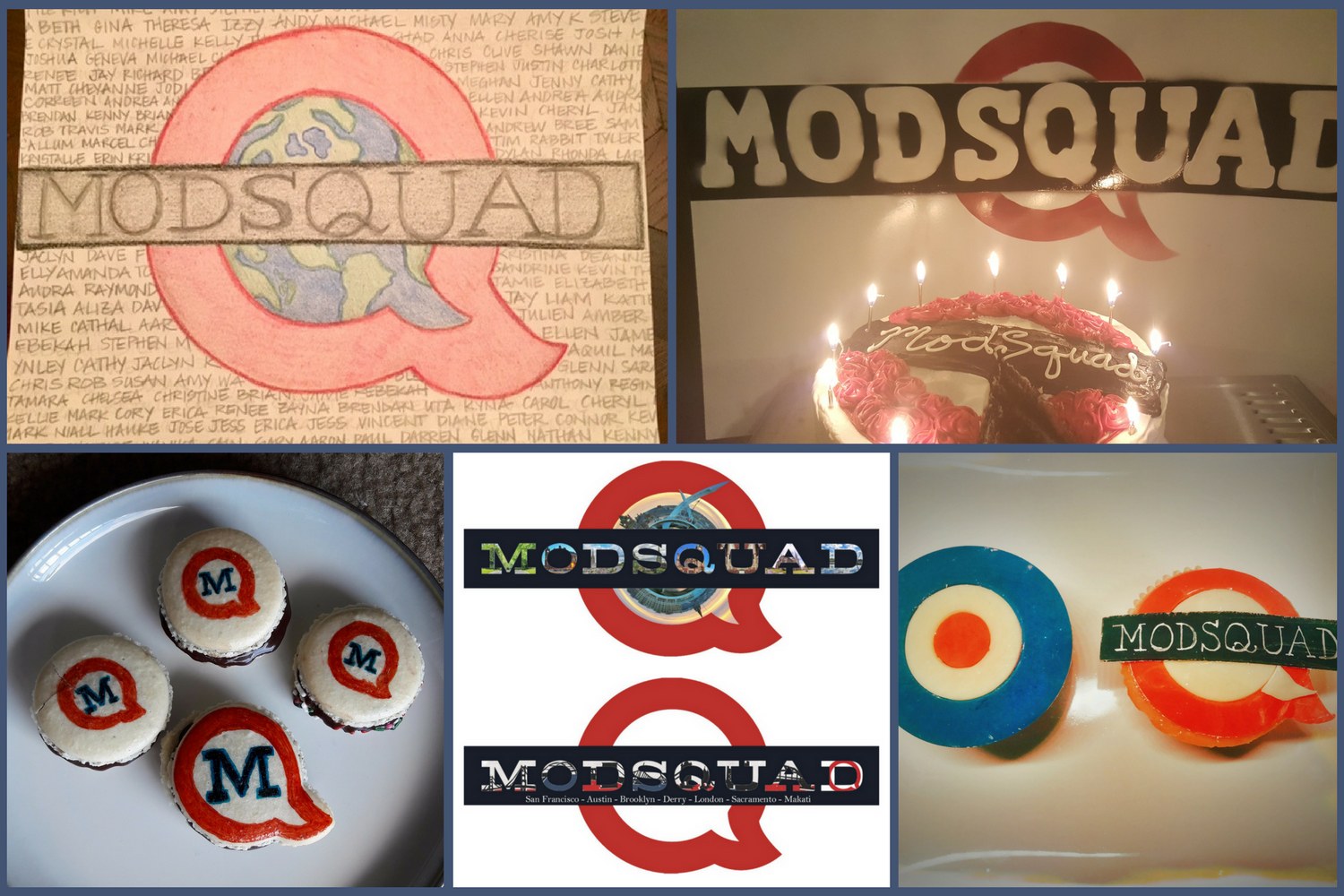
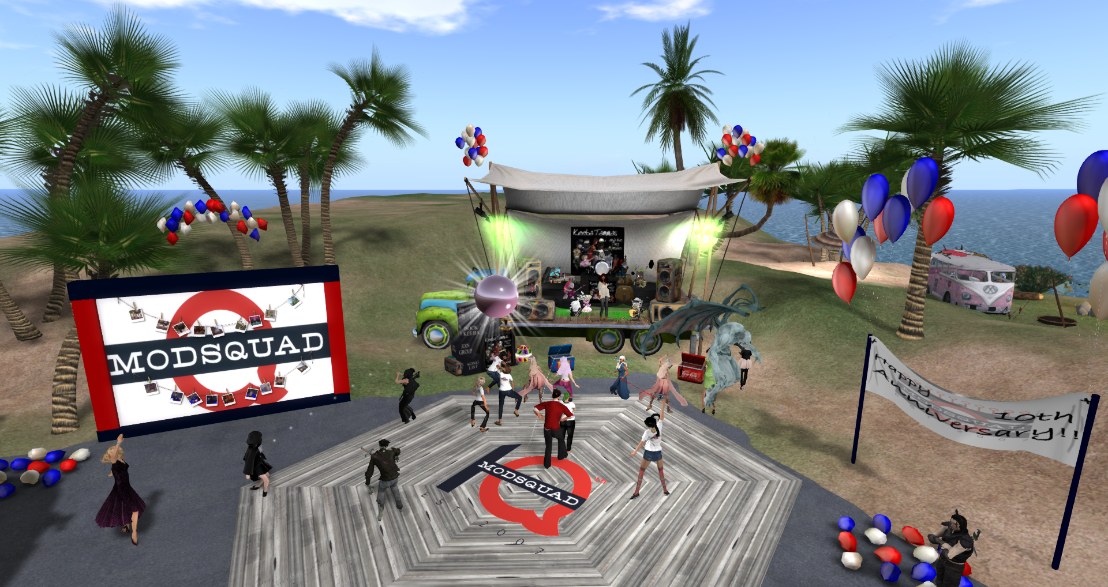
The workforce has a culture of its own. Mods are a genuine community, not just a labor pool - the company's 10th anniversary in 2017 spanned six cities and a Second Life reunion, complete with the craft contest whose entries appear above. That esprit de corps is not decoration; in a business where your product walks out the door every night, retention and morale are operating metrics.
The Quick Facts
- Founded: 2007, as Metaverse Mod Squad
- Renamed: ModSquad, in 2015
- HQ: Sacramento, California, with centers in Austin and Derry, Northern Ireland
- Founder: Amy Pritchard (CEO)
- Funding: Bootstrapped - no outside capital
- Awards: Five-time Stevie Award winner
05 / The fieldA boutique among giants
The outsourcing and trust & safety market is crowded with heavyweights - TaskUs, Teleperformance, Concentrix, Alorica, Foundever - alongside moderation specialists like Sutherland, WebPurify, and AI-first entrants such as Modulate. Most are enormous. ModSquad's counter-position is flexibility and depth in specific verticals: gaming, media, and community platforms, where brand fluency and cultural fit matter as much as headcount.
Relative scale, illustrative. ModSquad competes on specialization and flexibility, not raw seat count.
06 / What's nextComposable AI, human core
The obvious threat to a company built on human labor is automation. ModSquad's framing is "composable AI paired with human expertise" - automate the repetitive tier, and keep a trained person for the moment that actually matters, whether that is a distressed customer or a moderation call with real stakes. It is a measured position in a market prone to promising that software will replace everyone. For the brands on ModSquad's roster, the human in the loop is not a cost to eliminate; it is the reason they signed.
Eighteen years in, ModSquad has outlasted two full metaverse hype cycles - it was named after the first one, then dropped the name when the work outgrew the world. What remains is a quiet, durable business doing something the internet cannot function without: keeping communities civil and customers answered, one Mod at a time.