Daniela Sichel’s founder story begins with a bureaucratic sentence delivered to somebody who had already done the work: your credentials do not travel. When she moved from Venezuela to Miami in 2008 with her husband and three children, the psychology degree and practice she had built in Caracas did not automatically qualify her to work in the United States. Expertise, it turned out, had encountered customs.
She could have treated the reset as an insult. Instead, she treated it as an itinerary. In 2010, Sichel enrolled at Nova Southeastern University, completed the training required to become licensed in marriage and family therapy, and rebuilt her practice in Florida. The detour also produced a consequential introduction: in the program, she met Mariana Morales, the psychologist who would later become her co-founder.
There is a tidy version of entrepreneurship in which a founder spots a market on a chart and confidently draws an arrow toward it. Sichel’s version is messier and more useful. The evidence arrived through immigration rules, family moves, client requests, and the curious way a profession changes when it crosses a border. Her company would eventually grow from those inconveniences. First, though, there was another relocation.
The Skype experiment nobody called an experiment
In 2016, Sichel and her family moved from Miami to Lima. Her existing clients proposed something that now sounds banal: keep the appointments, open Skype. Before video calls became the wallpaper of working life, they were choosing continuity over proximity. Sichel began working online and added clients from other countries. Geography had stopped being the hard boundary it once was.
Founders often spend handsomely on customer research. Sichel’s customers had quietly conducted it for her. They were willing to change the medium to preserve the relationship. The screen was not the attraction. It simply removed the commute, the waiting room, and the local limits on whom a person could meet.
“It has been a great challenge, but it’s amazing how much you can learn when you know your mission and you want to achieve something.”Daniela Sichel on moving from psychologist to technology founder
By 2019, Sichel and Morales were ready to make the experiment into a company. They launched Opción YO as a fully virtual platform. The name translates roughly as “I choose myself,” a small declaration disguised as a brand. Its initial thesis was direct: Spanish speakers were underserved by the large digital platforms already in the market, so build a marketplace of Spanish-speaking specialists.
Then the customers refined the thesis.
Language opens the door. Culture furnishes the room.
The founders discovered that Spanish was necessary but insufficient. A service could translate every button and still miss what people meant. Family, migration, identity, expectations, and idiom all travel inside a conversation. Two people may use the same dictionary and inhabit different worlds.
“It makes a big difference as a patient when you have a therapist that speaks your language and understands your culture,” Sichel said in 2024. That sentence contains the company’s sharper product idea. Cultural understanding was not decorative copy for a landing page. It shaped matching, hiring, training, and the kind of context a specialist brought into the room.
The pandemic arrived only months after launch and made video calls ordinary with astonishing speed. Timing helped demand, but timing did not decide how the company would operate. Sichel and Morales still had to turn access into a coherent experience. A marketplace can provide a list. A durable service has to provide a path.
Opción YO eventually shifted toward a subscription and a five-stage program designed to make the journey more legible before, during, and after each live session. By 2024, Sichel said the company had moved specialists into full-time roles, allowing closer supervision and professional development. She also described a company culture built around respect, vulnerability, openness, and honesty, with team sessions beginning with meditation and personal check-ins.
The progression matters because it reveals Sichel the operator, not only Sichel the practitioner. She and Morales changed the business when the original model no longer expressed the promise clearly enough. The mission remained recognizable. The machinery did not.
A sale that widened the table
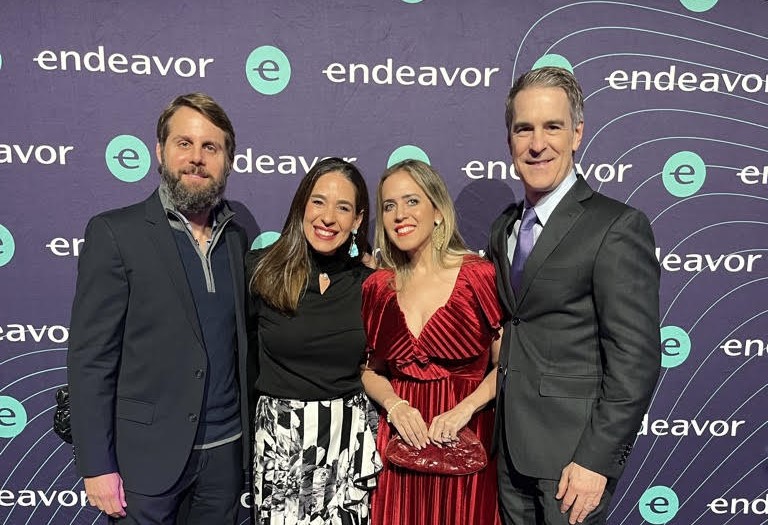
Opción YO joined EndeavorLAB’s third Miami cohort in 2021. Sichel called the program “the best experience at the best time for our company,” while the network introduced the founders to advisers who could see the business at a different altitude. One was Abi Mandelbaum, the entrepreneur who had previously built and sold the virtual-tour company YouVisit.
The relationship outgrew advice. In December 2022, Opción YO announced an acquisition involving Mandelbaum, who became president and chairman. Sichel remained CEO; Morales remained COO. The arrangement avoided the familiar exit picture of founders disappearing through one door while the new owner enters through another. Here, the table simply gained another chair, plus a partner experienced in scaling a technology company.
The company kept changing after the deal. In 2024, Sichel spoke about the subscription model, the structured program, and a reported Net Promoter Score of 95. In 2026, Opción YO reached No. 141 on the Inc. 5000, with reported three-year growth of 2,227 percent. It reported more than 100 employees, more than 40,000 clients served, and $4.5 million in 2025 revenue.
The line she will not automate
For a digital founder, Sichel is strikingly plain about what technology should not do. In 2024, as nearly every company raced to append “AI” to its vocabulary, she said Opción YO was steering clear of putting artificial intelligence into its core live service, at least for the moment. “We believe in the human connection,” she explained. “If you’re looking for AI, there are other platforms.”
The stance is less anti-technology than pro-boundary. Software is excellent at reach, matching, scheduling, reminders, content, and measurement. Sichel’s company depends on it. But the central encounter remains between people. Knowing where automation ends is a product decision as consequential as knowing where it begins.
It also makes sense of the three-city journey. Caracas supplied a profession. Miami forced Sichel to learn how institutions encode trust. Lima proved a relationship could survive a screen. Opción YO combined all three lessons: credentials matter, access matters, and context matters. Remove any one and the experience becomes thinner.
Sichel has spoken candidly about another boundary: the unequal reception faced by women and Latin American founders in venture capital. Early in the company’s life, she said she had expected minority status to make fundraising easier and found the opposite. Her response was neither coy nor resigned. She wanted to help change the disparity while continuing to build.
“We believe in the human connection.”A product principle in five words
What the detour was teaching
By conventional accounting, Sichel lost time when she returned to school. She lost continuity when she moved countries. She complicated a stable practice when her family relocated again. Yet each disruption produced knowledge that later became unusually practical: how trust is certified, why clients protect a useful relationship, and how much culture hides beneath language.
This is the part worth stealing. A career detour can be customer discovery if you stay observant enough to notice what people keep asking for. A forced restart can expose the invisible infrastructure of a profession. A workaround can become a distribution model. None of this requires pretending the inconvenience was charming. It requires refusing to waste it.
Sichel’s long-term ambition for Opción YO is broad but concrete: make emotional wellness feel ordinary and accessible for Hispanic communities, supported before a moment becomes urgent. The company’s evolving form suggests she is willing to revise the route without abandoning the destination.
There is a pleasing circularity here. The woman whose credentials once stopped at a border built a platform designed to cross them. The woman whose clients carried a practice onto Skype built a company that made geography less decisive. And the founder who entered the market speaking about language ended up building around something translation alone cannot deliver.