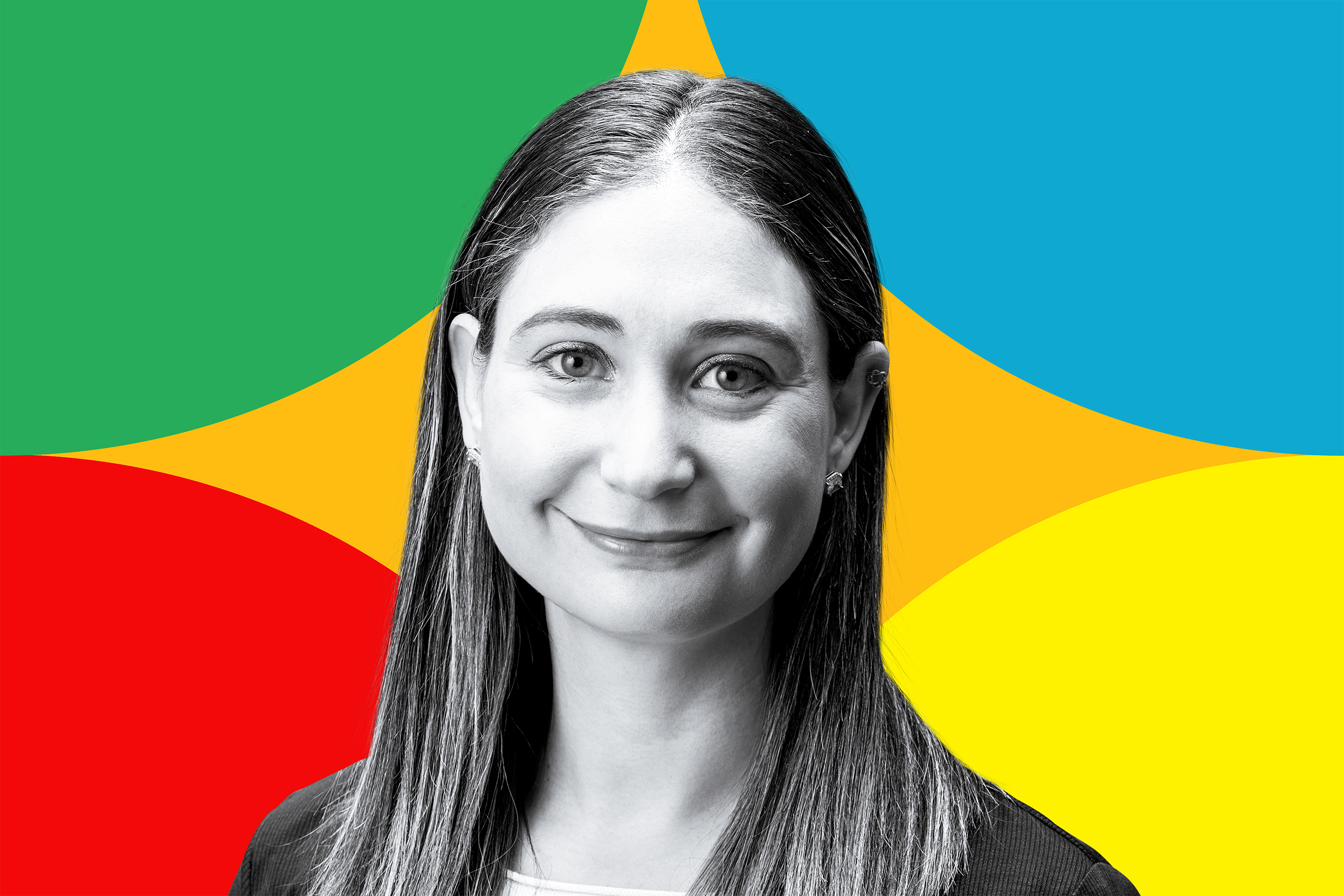
She is mid-sentence when you find her. Always mid-sentence. The company she co-founded is projecting $10 billion in revenue for 2025 - its third consecutive year of 10x growth. There are 300,000 enterprise customers now, up from fewer than 1,000 two years ago. Amazon put in $8 billion. Google followed. The valuation hit $380 billion in February 2026. Daniela Amodei is running Anthropic, and Anthropic is running fast, and she once described it as "running down stairs really quickly. You can't think too hard about it or you're gonna fall." That is not a figure of speech. That is her operating manual.
What she actually does at Anthropic is harder to explain than CEO. Dario Amodei has that job. Daniela is President - which at a company this size, this fast, means she is the one who makes the machine work. She owns operations, enterprise sales, go-to-market, culture, and hiring. She is the reason the company did not break under pressure. She is the reason it scaled. The research team produces Claude. Daniela decides who sells it, how it gets to customers, and what kind of people get to be part of the thing at all.
There is a version of this story where her background is a footnote - the English Literature degree, the flute scholarship, the brief stint on Capitol Hill before finding Stripe and then OpenAI and then building her own company. That version is wrong. Her background is the thesis. She is making the explicit argument, loudly and publicly, that the humanities are going to matter more in the AI era, not less. That empathy and communication and historical understanding are not soft skills but core ones. She made that argument by hiring for it at scale.
Before the Company
Daniela Amodei grew up in San Francisco - her father an Italian leather craftsman from Tuscany, her mother a Jewish American from Chicago who managed library projects. She attended Lowell High School, San Francisco's prestigious public magnet school, before heading to UC Santa Cruz. She did not study computer science. She studied English Literature, with a side of politics and music theory. She graduated summa cum laude with university honors, college honors, and department honors. She won the 2008 UCSC Concerto Competition on classical flute, having arrived on a partial-tuition scholarship. Then she graduated and looked around for what to do next.
What she did next was work on a congressional campaign in Pennsylvania. Then she managed communications for Congressman Matt Cartwright on Capitol Hill. She was good at it. She found it slow, bureaucratic, and energy-draining. She left. This pattern - find the environment, give it a genuine shot, recognize when the pace is wrong, move on - repeats itself across her career like a theme. She does not drift. She calibrates.
"Sometimes it feels a little bit like when you're running down stairs really quickly. You can't think too hard about it or you're gonna fall."- Daniela Amodei on scaling Anthropic
She joined Stripe in 2013 as one of its early employees. Stripe was a different kind of institution - fast, smart, relentlessly focused on the quality of the product. She progressed from early roles to Risk Program Manager to Risk Manager, building underwriting infrastructure and user policy as Stripe scaled its payments business internationally. The operational instincts she developed there - how to build systems that hold under pressure, how to hire people who can grow with a company - became the foundation for what she would eventually build at Anthropic.
The OpenAI Years
She joined OpenAI in 2018, during the GPT-2 period, before the technology had become a household name. She managed teams during GPT-2's development and eventually became VP of Safety and Policy. This was not a symbolic title. At OpenAI in 2018 and 2019, the safety conversation was live and contested - how much to publish, how fast to deploy, what the actual risks of increasingly powerful models were. Daniela was inside that conversation.
She left OpenAI in late 2020, along with her brother Dario and six other colleagues. The reason, stated plainly in subsequent interviews, was a belief that OpenAI's commercial pressures were beginning to outweigh its safety commitments. They were not making a small bet. They were betting that there was a different way to build this technology - safer, and ultimately more successful because of it. Anthropic was founded in 2021 on that premise.
Building Anthropic
The division of labor between Daniela and Dario is one of the more interesting organizational experiments in modern tech. Dario is CEO: technical vision, research direction, long-term strategy, external policy. Daniela is President: operations, commercial scale, culture, the daily mechanics of keeping 2,500-plus people pointed in the right direction. She has been explicit about her own limitations - she is not deeply technical, she does not do the research herself - and built a role that is designed around what she actually is: an operator and a people-person of unusual caliber.
"We look for people who are great communicators," she has said, "who have excellent EQ and people skills, who are kind and compassionate and curious and want to help other people." That description is a self-portrait. It is also Anthropic's hiring brief. The culture she has built is described internally as "low politics, high integrity, mission alignment" - shorthand for an organization where difficult conversations happen directly rather than around corners, and where people are expected to care about the mission rather than the hierarchy.
"No one says, 'We want a less safe product.' We're setting what you can almost think of as minimum safety standards just by what we're putting into the economy."- Daniela Amodei on AI safety as competitive advantage
Safety as Strategy
The central argument Daniela Amodei makes - and she makes it in public, often, with precision - is that safety and commercial success are not in tension. That Claude's reputation for being harder to manipulate into harmful outputs than competing models is not a concession to ethics but a competitive moat. That enterprise customers, the 85% of Anthropic's revenue base, are not asking for a less safe product. They are asking for a product they can trust in front of their own customers.
This argument has been tested. Anthropic has grown from zero to $380 billion in valuation in four years. Claude is deployed in enterprise environments across healthcare, finance, law, and software development. Amazon integrated Claude into Alexa at scale. The list of enterprise partnerships - Snowflake, Stripe, Accenture, Novo Nordisk, Bridgewater, Slack - is a roster of institutions that do not make vendor decisions carelessly. The safety argument, it turns out, is also a business argument. Daniela bet on that before it was obvious, and the bet is paying off.
The Humanities Case
She makes the humanities argument with the energy of someone who has thought about it carefully and suspects she is right. "A lot of these models are actually very good at STEM," she has said. "But I think this idea that there are things that make us uniquely human - understanding ourselves, understanding history, understanding what makes us tick - I think that will always be really, really important." She says this as the president of a company that builds the most capable general-purpose AI models in the world. The irony is deliberate.
Her prediction - that the things AI cannot easily replicate are the things that will matter most - shapes how Anthropic hires. It shapes how she thinks about her own role. And it carries a subtext: the people who studied the humanities, who were told their degrees were impractical, may find that the AI era vindicates them. She is in a position to make that happen, and she appears to intend to.
The Family Business
The sibling dynamic at the top of Anthropic is unusual. Daniela and Dario Amodei have known each other for Daniela's entire life - he had four years without her, as she notes with dry humor, "poor guy." Their professional relationship is an extension of a personal alignment that goes back to childhood. He pushes her to think bigger. She pushes back on cultural drift and organizational sustainability. The company is, in a specific and literal sense, a family project.
It becomes stranger when you add Holden Karnofsky - Daniela's husband, co-founder of GiveWell and Open Philanthropy, and as of January 2025, a member of Anthropic's technical staff focused on responsible scaling policy. Karnofsky was, before all of this, Dario's roommate. The three of them are now building the same company together. This has drawn some governance scrutiny. Daniela is aware of it. She does not appear to find it particularly troubling.
She is, ultimately, the kind of leader who does not perform humility and does not perform confidence. She knows what she is good at. She knows what she is not good at. She built a company around that knowledge, and then she scaled it to a size that is genuinely hard to comprehend. The flute competition was 2008. The $380 billion valuation was 2026. The distance between those two facts is not a paradox. It is the argument she has been making all along.